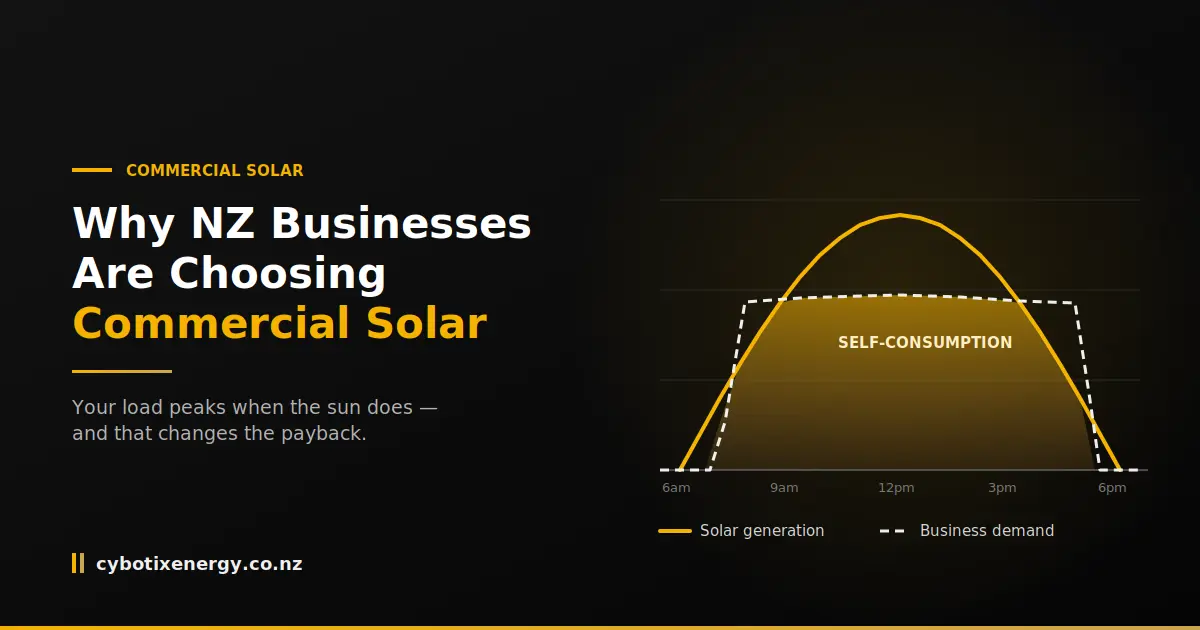
Look at your last power bill, then look at when your business actually uses power. Chances are the answer is “between about 7am and 6pm, Monday to Friday” which happens to be precisely when a rooftop array is generating.
Commercial Solar Installation
That overlap is the whole reason commercial solar installation in NZ has moved from a sustainability line item to a straightforward finance decision. Households struggle with solar economics because they use most of their power after dark. Businesses don’t have that problem. Same panels, same sunshine, materially better numbers.
Here’s what’s driving the shift, what it costs, and the parts of the process that quotes tend to gloss over.
The short answer: business load profiles suit solar better than homes do
A home’s demand peaks in the evening, hours after generation has stopped. A business’s demand usually peaks around the middle of the day, when an array is at maximum output. That single alignment is why commercial payback periods in New Zealand typically beat residential ones you consume what you generate instead of exporting it cheaply.
Everything else in the business case follows from that. It’s not that commercial hardware is better or that businesses get a special rate. It’s that the shape of your consumption matches the shape of your generation.
Why self-consumption matters more than export in New Zealand
Retailers pay a buyback rate for power you export, and that rate sits well below what you pay per unit to buy power back. So a unit of solar you use on site is worth considerably more than a unit you sell.
The practical consequence: the correct system size is the one that matches your daytime load, not the one that fills your roof. An oversized array that exports heavily on quiet days is money spent to earn the low rate rather than avoid the high one. If an installer sizes your system from roof area rather than from your consumption data, they’ve skipped the step that determines your return.
The businesses where the fit is strongest
Some load profiles are near-perfect matches. Others need more thought, and it’s worth being honest about which is which.
Strong fit:
- Cool stores and refrigerated facilities — compressors run through the day, and the hottest hours are both peak load and peak generation
- Packhouses and processing sites — daytime operation, often heaviest through the sunniest months
- Offices and retail with significant HVAC — summer cooling demand tracks solar output closely
- Workshops and light manufacturing on a single day shift
- Motels and accommodation — laundry, pool pumps and daytime servicing
- Irrigation — summer daytime pumping is about as well aligned as it gets
Worth a closer look:
- Dairy sheds: the milking peaks sit at the edges of the solar day, early morning and late afternoon. Water heating and refrigeration can be shifted into the middle of the day, which is where the value is, but the raw milking load isn’t the win it first appears
- Schools: strong weekday daytime demand, then closed for weeks over the sunniest part of summer
- Businesses with weekend-heavy trade: generation still happens, but the alignment weakens
What’s driving the shift right now
Five things have converged: commercial electricity costs, tax treatment that favours business buyers, customers asking for emissions data, a run of storm-driven outages, and panels that produce meaningfully more from the same roof than they did a few years ago.
Commercial electricity costs and how business tariffs are structured
Your bill isn’t one number. Commercial connections typically carry an energy charge per kWh, a fixed daily charge, and above a certain size a demand or capacity charge based on your peak draw.
That structure matters because solar attacks one component hard and the others barely at all. Knowing which part of your bill is which is the difference between a forecast that holds and one that disappoints.
The tax treatment nobody mentions to homeowners
This is the genuine commercial advantage, and it’s underexplained almost everywhere. A business buying a solar system is buying a depreciable asset, and a GST-registered business can recover the GST on the purchase. Households can do neither.
Both effects shorten your real payback compared with the headline figure often significantly. The specifics depend on how the asset is classified and on your own tax position, so this is a conversation with your accountant rather than your installer.
Customers and procurement teams asking for emissions data
Increasingly, the pressure isn’t internal. Large customers, government tenders and export buyers ask suppliers for emissions information, and on-site generation is one of the few levers that produces a clean, defensible reduction in purchased-electricity emissions.
For some businesses this is now the deciding factor rather than the payback period a contract requirement with a number attached.
Outage resilience after recent storm seasons
Work out what a day of lost production costs you. For a cool store it might be spoiled stock. For a workshop it’s idle staff and a slipped delivery date. For a motel it’s refunds and reviews.
Solar alone doesn’t solve this a standard grid-tied array shuts down in an outage but it changes the conversation about whether storage is worth adding.
Panel efficiency has moved
The modules available now produce more from the same roof than the ones your last quote assumed. Higher-efficiency monocrystalline panels the LONGi Hi-MO range is a current example mean a constrained roof can carry a system size that wasn’t achievable a few years ago.
If you priced solar three or four years back and the roof area killed it, the answer may have changed.
What commercial solar costs and returns in New Zealand
Commercial systems are quoted per kilowatt installed, and cost per kW generally falls as system size rises a 100kW array costs less per kW than a 10kW one. But price isn’t what decides your return. Your daytime consumption share is.
The number that decides your payback
Ask any installer this: what percentage of generation will we consume on site? That single figure moves payback more than anything else in the proposal.
A cool store running compressors through the day might self-consume the great majority of its generation. A weekday office that shuts at 5pm and does nothing on weekends will export a meaningful share at the low buyback rate. Same system, same city, materially different returns.
The demand-charge trap most quotes ignore
Solar reduces the kilowatt-hours you buy. It does much less to your peak demand, which is what a capacity or demand charge is based on. If your peak happens on a dark winter morning or right at start-up, an array won’t touch it.
That’s not a reason to skip solar. It’s a reason to read your bill properly before believing a percentage-saving headline. If demand charges are a large share of your spend, ask specifically what the proposal does to them — and whether storage is the tool for that job or an expensive way to shave a small line item
How businesses pay for it: capex, finance, or PPA
Three routes exist, and they suit different balance sheets rather than different buildings. Buying outright gives the best lifetime return and the depreciation benefit. Finance spreads the cost while you keep ownership. A power purchase agreement means someone else owns the asset and you buy the output.
| Capex purchase | Finance or lease | Power purchase agreement | |
|---|---|---|---|
| Upfront cost | Full system cost | Low to none | None |
| Who owns the asset | You | You (usually, at term end) | The provider |
| Depreciation benefit | Yours | Generally yours | Not yours |
| Effect on cash flow | Large one-off outflow | Predictable monthly cost | Pay per unit generated |
| Lifetime return | Highest | Reduced by finance cost | Lowest, but no capital risk |
| Best fit | Cash-positive businesses with a long horizon at the site | Businesses wanting the asset without the capital hit | Sites where capital is unavailable or tenure is uncertain |
What a commercial install actually involves in NZ
Expect four gates: approval from your local lines company, a compliant inverter, work carried out by a registered electrical worker, and certification paperwork at the end. It’s a more involved process than a residential install, and the timeline reflects that rather than the installer being slow.
Lines company approval and inverter compliance
Grid-connected generation needs a distributed generation application to your local network Vector, Powerco, Orion, Wellington Electricity, Aurora and the rest each run their own process. Inverters must meet the grid-connection standard applicable in New Zealand, and larger commercial connections can attract additional network requirements.
Approval timelines vary by network and by system size, and this is commonly the longest single step in a project. Ask for it as a date range in writing, not a reassurance.
Certification and consent
The electrical work must be done by a registered electrical worker, and you should receive the statutory certification for the installation on completion. Keep it you’ll want it for insurance, for any future warranty claim, and if you ever sell the building.
Building consent depends on the structure and how the array is mounted. Some rooftop installations on existing buildings are exempt; some are not.
The roof questions that decide feasibility
Before anything else, four things about your roof determine whether the project is viable:
- Structural loading — can it carry the array plus wind uplift? A structural engineer’s sign-off is normal on commercial buildings.
- Remaining roof life — mounting a 25-year array on a roof with five years left is a false economy. Deal with the roof first.
- Roof type — trapezoidal steel, membrane and concrete each need different mounting, and penetrations versus ballasted systems is a real decision with real cost implications.
- Age and materials — older industrial roofs may contain asbestos, which changes the scope entirely and must be identified before anyone starts drilling.
Where batteries and portable power fit alongside a rooftop system
A rooftop array cuts your energy bill. Storage is what keeps you running through an outage and gives you a tool against peak demand. They solve different problems, and buying one expecting the other is the most common misunderstanding in commercial solar.
Be realistic about scale. Battery storage sized for whole-site backup is a substantial investment. Portable power stations are a different proposition they cover critical loads, servers, comms, refrigeration for a defined period, or site power where there’s no connection at all. Useful, and genuinely cost-effective for that job, but not a substitute for a plant-scale system.
You can see the panel, inverter and storage range stocked locally at Cybotix Energy, including hybrid inverters that support adding storage later rather than committing to it on day one.
Pros and cons for a New Zealand business
In favour:
- Load profile alignment gives better returns than residential solar
- Depreciation and GST recovery improve the real payback
- A hedge against future electricity price movements
- Defensible emissions reduction for tenders and reporting
- Hybrid inverters allow storage to be added later
- 25-year-class equipment on a building you plan to keep
Against:
- Significant capital, or a finance cost that eats into the return
- Roof condition and structure can block or delay the project
- Network approval timelines are outside your control
- Demand charges may survive the install largely intact
- If you lease the building, the benefit and the spend can sit with different parties
- Weekend-light or seasonally closed operations self-consume less
How to scope your project in five steps
- Get 12 months of interval data from your retailer not just bill totals. Half-hourly data shows your actual load shape.
- Establish your daytime consumption share. This is the number that drives everything else.
- Commission a roof condition and structural check before you invest time in quotes.
- Request quotes priced per kW with a written annual yield estimate and a stated self-consumption assumption.
- Compare finance routes against your tax position with your accountant, not just against each other.
FAQs
Can a business claim depreciation on a solar installation?
Solar generating equipment is generally treated as a depreciable business asset, and a GST-registered business can usually recover the GST on the purchase. The classification and rate depend on your circumstances, so confirm the specifics with your accountant.
How much roof area does a 100kW commercial system need?
As a rough planning figure, allow somewhere in the region of 500–600 m² of usable roof for a pitched installation, and more on a flat roof where tilt frames need spacing to avoid shading each other. A site assessment will give you the real number.
How long does a commercial solar installation take?
The physical installation is usually the shortest part. Network approval, structural checks and equipment lead times typically dominate the timeline, so plan in months rather than weeks from decision to switch-on.
What happens to the power my business exports?
It’s credited by your retailer at a buyback rate that’s lower than the rate you pay to import. That’s exactly why systems should be sized to your daytime load rather than to your available roof area.
Will solar reduce demand charges as well as energy charges?
Not reliably. Demand charges are based on your peak draw, which may occur outside generating hours. Reducing them usually requires storage or load shifting, so ask for that to be addressed separately in any proposal.
We lease our building is solar still worth it?
It can be, but the economics depend on lease length and on who pays for what. The tenant gets the bill savings while the landlord’s building gains the asset, so the arrangement needs to be agreed in writing before anyone commits capital.