Three quotes land in your inbox. One says 4kW, one says 6.6kW, one says 10kW. All three sound confident, all three cite your power bill, and none of them explain why the others are wrong.
Solar System for Your NZ Home
The difference usually isn’t your roof. It’s what each installer assumed about when you use electricity and that assumption is where most of the money is won or lost. Learning to size a solar system for your NZ home isn’t about becoming an engineer. It’s about knowing which four numbers actually decide the answer, so you can tell a good proposal from an optimistic one.
Start with your consumption, not your roof
Sizing begins with twelve months of your actual electricity use. Your roof sets a ceiling on what’s physically possible; your consumption decides the right answer underneath that ceiling. Any quote that leads with roof area has skipped the step that matters.
An installer who sizes from satellite imagery is selling you panels. One who asks for your bills is sizing a system.
Where to find your real numbers
Your bill shows monthly kilowatt-hours that’s the starting point. Twelve of them gives you an annual total and shows your seasonal swing.
Better still, ask your retailer for your interval data: half-hourly consumption, usually available free on request or through their app. That file shows the shape of your day, not just the total, and the shape is what determines how much of your generation you’ll actually use.
Why you need a full year
New Zealand households use noticeably more power in winter heating, hot water working harder, lights on by five o’clock. Size from a February bill and you’ll build a system that looks great in summer and disappoints in July.
Twelve months, no shortcuts. A summer-only sample is the most common reason a system underperforms against expectations.
The residential problem nobody mentions in a sales pitch
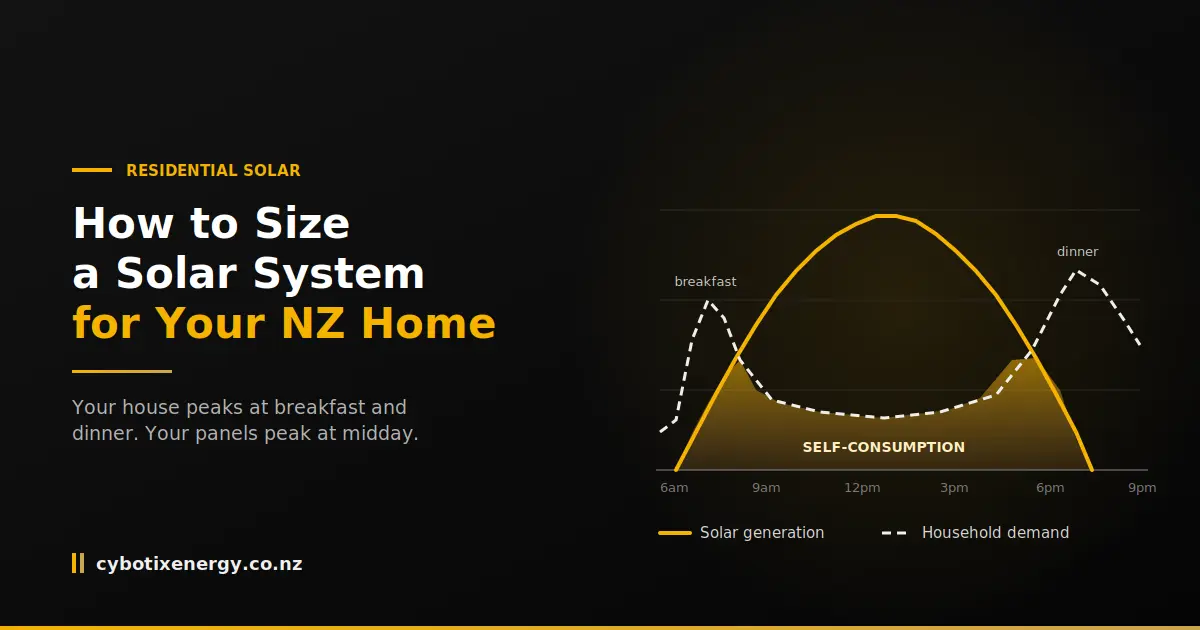
Your house peaks at breakfast and dinner. Your panels peak at midday. Unlike a business, a home’s demand curve actively fights its generation curve and that mismatch, not panel efficiency, is the biggest factor in getting your size right.
It’s the thing that makes residential solar harder than it looks, and the thing sales conversations skip.
Why exported power is worth less than power you use
New Zealand runs a net billing arrangement. You buy power at the retail rate and sell your surplus back at a buyback rate that’s substantially lower.
So a kilowatt-hour you consume as you generate it is worth considerably more than one you export. That single fact reshapes the sizing question: the goal isn’t maximum generation, it’s maximum self-consumption. A bigger array that exports most of its output is buying you the cheap rate, not the expensive one.
Shifting load into daylight
Before you buy more panels, move more of your usage into the middle of the day. It costs nothing and it raises the value of every panel you do install.
The big wins:
- Hot water cylinder. Usually the largest single load in a NZ home. A timer that heats at midday instead of overnight can transform your self-consumption on its own.
- Dishwasher and washing machine. Delay timers exist on almost every machine. Use them.
- EV charging. If you’re home during the day, or can charge at weekends, this is a large flexible load.
- Heat pumps. Pre-heat or pre-cool the house in the early afternoon and coast through the evening peak.
Do this well and a 5kW system can outperform a poorly-used 8kW one.
How much electricity a kilowatt of solar makes in New Zealand
Roughly 1,100 to 1,450 kilowatt-hours per installed kilowatt per year, depending where you are. Northland sits at the top of that range and Southland at the bottom a difference of around 30% between the ends of the country.
Within a region, orientation and shading move it further.
Location changes the maths
The same 5kW array will produce meaningfully more in Kerikeri than in Invercargill. That’s not a small adjustment it changes payback periods and can change the right system size.
The winter trap
Here’s where oversizing usually starts. Winter output is a fraction of summer output shorter days, lower sun angle, more cloud. So if you size the system to cover your winter consumption from solar alone, you’ll need a very large array.
That array then spends summer producing far more than you can use, exporting the surplus at the low buyback rate. You’ve paid for capacity that earns you the cheap rate for half the year.
Sizing to the shoulder seasons spring and autumn usually lands closer to the sweet spot: strong self-consumption most of the year, modest winter import, limited summer dumping.
What size system suits your household
Use the table as a starting point rather than a prescription. Two households with identical bills can need different systems depending on when they’re home, what they’re heating with, and what the roof allows.
| System size | Indicative annual generation | Panels (approx) | Roof area needed | Typically suits | Main caveat |
|---|---|---|---|---|---|
| 3kW | ~3,500–4,000 kWh | 7 | ~15 m² | Small households, low daytime use, apartments with roof rights | Limited winter contribution |
| 5kW | ~5,800–6,800 kWh | 12 | ~25 m² | Typical 3–4 bedroom family home | Needs load shifting to use it well |
| 8kW | ~9,500–11,000 kWh | 19 | ~40 m² | Larger homes, heat pump heating, one EV | Exports heavily without storage or daytime load |
| 10kW | ~11,500–13,500 kWh | 23 | ~48 m² | High consumption, EV plus electric hot water, home business | Check your export limit before committing |
Assumptions: roughly 440W panels at about 2.1 m² each, and a mid-range NZ yield. Your installer’s numbers will differ with panel model and location.
Reading the table honestly
Move up a size if you’re home during the day, charge an EV, heat with electricity, or plan to add storage.
Move down a size if the house is empty 8am–5pm, you’re on gas hot water and heating, your roof has any meaningful shading, or your export limit caps you.
Roof orientation, pitch and shading
North-facing panels generate the most electricity over a year. But an east–west split often suits a household better, because it spreads generation across morning and evening when you’re actually home. Shading is the one factor that can undo good sizing entirely.
The case for east–west
This is counterintuitive and rarely explained properly. An east–west array produces perhaps 10–15% less total energy than the same panels facing north. But it generates earlier and later in the day closer to when a family is making breakfast and cooking dinner.
Under net billing, where self-consumption is worth more than export, less total generation used at the right times can beat more generation dumped at midday. If your household is empty in the middle of the day, ask your installer to model both options rather than defaulting to north.
Shading and why one tree matters
Partial shade does more damage than people expect. Depending on how the system is wired, a single shaded panel can drag down others in its string which is why panel-level optimisation exists.
Satellite tools miss this. They don’t see the neighbour’s poplar in August, the chimney, or the way the roofline shades itself at 4pm in winter. Insist on a site assessment before signing anything.
Inverter sizing and export limits
Your inverter is usually smaller than your array, and that’s deliberate rather than a corner being cut. Separately, your local lines company may cap how much you’re allowed to export and that cap can decide your system size regardless of what your roof could carry.
Array-to-inverter ratio
A 6.6kW array paired with a 5kW inverter is standard practice. Panels rarely produce their rated output in real conditions, so a modestly oversized array keeps the inverter working closer to its efficient range for more of the day.
The trade-off is a small amount of clipping on the brightest days. The gain is better output across every other day of the year. If a quote pairs a large array with a matching inverter, ask why.
Export limits are a real constraint
Distributors set limits on how much generation a residential connection can export, and they differ by network and by whether you’re single or three-phase. Some households find the export limit, not the roof, decides their maximum practical system size.
Check this before you fall in love with a number.
Where batteries change the sizing answer
Storage lets you use midday generation in the evening, which lifts self-consumption sharply and can justify a larger array than would otherwise make sense. Without a battery, a big system on an empty daytime house mostly exports at the low rate.
That’s the honest summary. A battery isn’t a requirement, but it changes which system size is correct.
Hybrid inverters and buying in stages
If storage is a possibility later, choose a hybrid inverter now. It costs a little more upfront and saves replacing the inverter when you add a battery in three years.
This is the most common regret we see: a straight grid-tied inverter installed, a battery wanted eighteen months later, and the inverter has to be replaced to allow it. You can see hybrid inverter and panel options at Cybotix Energy.
Five sizing mistakes worth avoiding
- Sizing off one bill. Seasonal swing is large in NZ. Use twelve months.
- Sizing to fill the roof. Available area is a ceiling, not a target.
- Ignoring shading. One tree at the wrong angle can cost more output than a panel upgrade gains.
- Forgetting the export limit. Find out before you choose a size, not after.
- Sizing for today’s household. An EV, a new heat pump, a baby, or kids leaving home all change your consumption materially within the system’s 25-year life.
FAQs
What size solar system does a 3-bedroom NZ home need?
Commonly 5kW to 6.6kW, but the honest answer depends on whether anyone’s home during the day and how you heat your water. A household away 8am–5pm on gas hot water may do better with 3kW to 4kW.
How many panels is a 5kW system?
Around 12 panels with current 440W modules, occupying roughly 25 m² of roof. Higher-output panels reduce the count and the area required.
How much roof space do I need for solar?
Allow roughly 5 m² per installed kilowatt as a planning figure. A north-facing plane free of chimneys and vents is worth more than a larger area broken up by obstructions.
Is it better to oversize or undersize a solar system?
Slightly oversizing the array relative to the inverter is normal and sensible. Oversizing the whole system beyond your consumption is usually not, because the surplus earns the low buyback rate rather than offsetting the retail rate.
Does my roof have to face north?
No. North gives the highest annual total, but an east–west split generates more in the morning and evening, which can suit a household’s actual usage better. Ask your installer to model both.
What is an export limit and will it cap my system size?
It’s a limit your local lines company sets on how much power your connection can send back to the grid. Limits vary by network and connection type, and for some households they, rather than roof area, set the maximum practical system size.
Should I size for winter or summer?
Neither, usually. Sizing for winter demand produces an array that dumps surplus all summer; sizing for summer leaves you short in July. Sizing to the shoulder seasons tends to give the best year-round result.