You’ve found the BLUETTI you want, and an overseas listing has it a few hundred dollars cheaper than in New Zealand. It looks identical in the photos. So the obvious question comes next: do BLUETTI power stations work with New Zealand plugs and voltage?
The short version is that it depends entirely on which version you buy. BLUETTI makes different versions of its power stations for different countries, and they aren’t interchangeable. Get the right one and it simply works. Get the wrong one and a plug adapter won’t save you.
Do BLUETTI Power Stations Work in NZ
This guide explains what New Zealand uses, how regional versions differ, and how to check a unit before you spend a cent.
The short answer
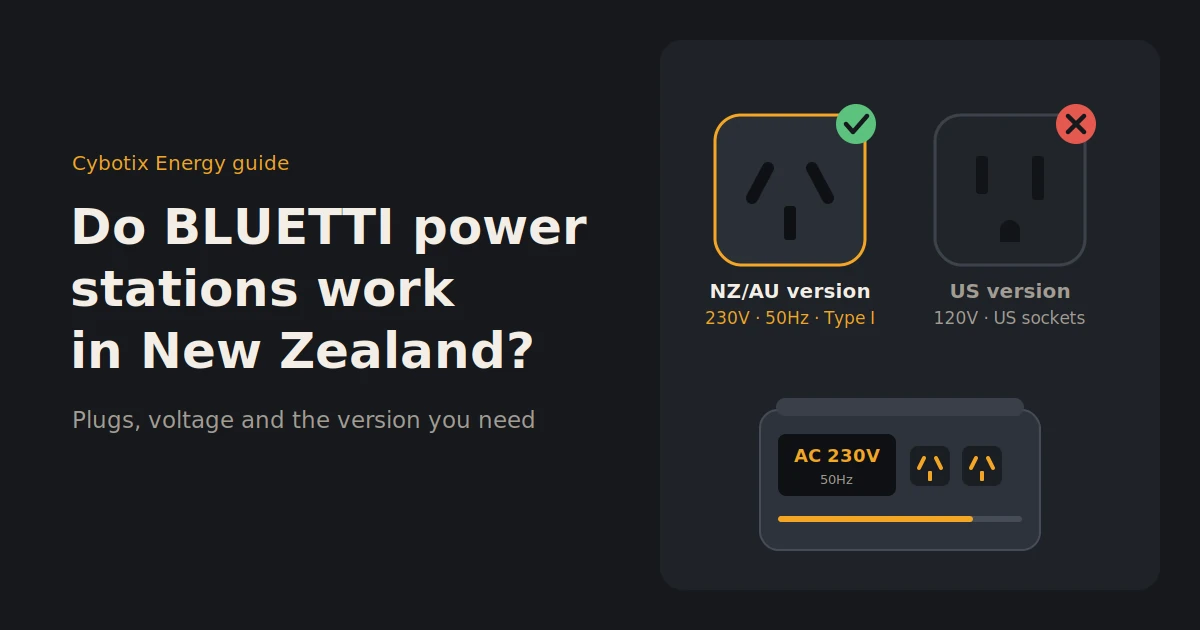
Yes, if you buy the version made for Australia and New Zealand. BLUETTI’s AU/NZ power stations have Type I sockets and 230V AC output, matching NZ appliances and wall sockets. Versions made for the US and other markets are built for different voltages and plugs, and a plug adapter won’t make them safe to use here.
BLUETTI’s own spec sheets show this clearly. The AC70P, for example, comes in regional versions rated at 100V for Japan, 120V for the US, 220V for China and 230V for the EU, UK and Australia, each with sockets to match. The model name is the same. The electrical design isn’t.
What New Zealand uses: 230V, 50Hz and Type I plugs
New Zealand’s mains power is 230 volts at 50 hertz, delivered through Type I sockets: the three flat, angled pins shared with Australia. Any power station you plug NZ appliances into, or charge from an NZ wall socket, needs to match all three.
- Voltage: 230V. Most NZ appliances are designed for around 230V. Feed them 120V and many won’t work properly; some won’t work at all.
- Frequency: 50Hz. The number of times the current alternates each second. Some appliances with motors or clocks care about this.
- Plug: Type I. Two angled flat pins and an earth pin. It’s the same shape used in Australia, so AU-version power stations fit NZ appliances directly.
- 10A and 15A plugs. Standard NZ plugs are 10A. Some heavy-duty appliances, caravan leads and equipment use 15A plugs with a wider earth pin, which don’t fit standard 10A sockets, including those on most power stations.
Because New Zealand and Australia share the same standards, BLUETTI power stations sold for the Australian market are the ones designed for New Zealand use too.
NZ/AU version vs overseas versions
The NZ/AU version is built for New Zealand’s power: 230V sockets that take NZ plugs, and an AC charger designed for NZ wall sockets. A US version uses 120V outlets and US-style sockets, and it’s designed to charge from 120V, not 230V. Even where the battery and features look identical, they’re different products.
| NZ/AU version | US version | |
|---|---|---|
| AC output voltage | 230V | 120V |
| AC sockets | Type I (NZ/AU) | Type A/B (US) |
| AC charging input | Designed for 230V wall power | Designed for 120V wall power |
| Plugs into NZ appliances directly | Yes | No |
| Charges safely from an NZ wall socket | Yes | No, not without the right equipment |
| USB, 12V car and solar ports | Work as normal | Generally work, but check specs |
| Local warranty and support | Through the NZ seller | Often difficult or unavailable |
| NZ consumer law protection | Yes, when bought from an NZ business | Harder to enforce with an overseas seller |
Versions for other regions, such as the UK, EU and Japan, differ again. The safest rule is simple: buy the AU/NZ version from a New Zealand seller.
Why a plug adapter won’t fix an overseas unit
A plug adapter only changes the shape of the plug. It doesn’t change the voltage or the electrical design behind it. A US power station with an adapter still outputs 120V to your appliances, and it still expects 120V when it charges, so plugging it into a 230V NZ socket can damage it or create a safety risk.
Here’s what goes wrong:
- Charging from an NZ wall socket. A charger designed for 120V can be damaged, or become a fire risk, when connected to 230V.
- Running NZ appliances. Many 230V appliances won’t run properly on 120V. Motors may labour, heaters run weakly, and some electronics may refuse to start.
- Mismatched safety design. Overseas products aren’t designed or certified for NZ’s electrical system, and an adapter can bypass safety features like earthing.
- Insurance and warranty. If something goes wrong with a non-compliant setup, you may struggle to claim on your warranty or insurance.
Step-up transformers and voltage converters are sometimes suggested as a fix. They add cost, bulk, energy losses and another point of failure, and they don’t solve the warranty or compliance issues. For a device you’ll rely on during power cuts, it isn’t worth it.
What works the same everywhere
Not everything on a power station is region-specific. USB ports, the 12V car-style output and the solar and car-charging inputs are low-voltage DC connections that work the same way worldwide. It’s only the 230V or 120V AC side, meaning the wall charging and AC sockets, that changes between versions.
- USB-A and USB-C. Phones, laptops, tablets and cameras charge the same way in any country.
- 12V car-style output. Runs 12V camping fridges, pumps and other 12V gear anywhere.
- Car charging. Charging from your vehicle’s 12V socket works the same in NZ as overseas.
- Solar input. Solar panels connect through DC inputs. The AC70P, for example, accepts 12–58V of solar input, regardless of region. Check the connector type, since some panels need an adapter cable.
So an overseas unit isn’t useless. But the AC side is usually why people buy a power station, to run a fridge, laptop charger or CPAP, and that’s exactly the part that won’t match New Zealand.
How to check a BLUETTI before you buy
Before you buy, especially online, check the AC output voltage and socket type, the region or model code, and where the seller is based. A few minutes of checking avoids an expensive mistake that’s hard to undo.
- Look at the AC sockets in the photos. They should be Type I, with three angled flat pins, the same as your wall sockets at home.
- Check the AC output rating. It should say 230V. If the listing says 110V, 120V or 100V, it’s not for New Zealand.
- Check the charging input. It should be rated for 230V or a range that includes 230V.
- Look for the region or version. Listings often mention “AU version”, “AU plug” or similar. Be wary if the region isn’t stated.
- Check for compliance markings. Look for the RCM mark on the product or its packaging.
- Check where it ships from and who supports it. An NZ seller with local warranty support is the simplest option.
- Ask if you’re unsure. A reputable seller will confirm the version, voltage and warranty before you buy.
Safety, compliance and warranty in New Zealand
Electrical products sold in New Zealand need to meet NZ safety requirements, and buying locally makes warranty claims and consumer rights far simpler. An overseas version may not carry NZ compliance markings, and getting it repaired here can be difficult or impossible.
Electrical safety compliance
Australia and New Zealand share an Electrical Equipment Safety System, which uses a single compliance mark: the RCM. WorkSafe New Zealand also requires equipment sold here to be marked with a voltage it operates on safely in New Zealand. A US-market power station marked for 120V doesn’t meet that.
When you buy from an NZ seller, the seller is responsible for supplying products that meet these requirements. When you import a unit yourself, that responsibility, and the risk, shifts to you.
Warranty and support
Warranty support is usually handled through the seller, or the region where the product was bought. A unit bought overseas may need to be returned overseas for repairs, at your cost, or may not be supported locally at all. With a battery product you’ll rely on for years, local support matters.
Consumer Guarantees Act
Buying from a New Zealand business gives you rights under the Consumer Guarantees Act: products must be of acceptable quality, fit for purpose and match their description. Those rights are much harder to enforce against an overseas seller.
NZ-specific situations
A few New Zealand situations come up often: 15A plugs that don’t fit a power station’s 10A sockets, connecting a power station to a campervan or caravan, and what to do if you already own an overseas unit. In each case, the safe answer involves the right equipment, not improvised adapters.
15A appliances and plugs
Some NZ equipment, such as larger heaters, welders and some caravan leads, uses 15A plugs with a wider earth pin. They won’t fit the 10A sockets on most portable power stations, and that’s by design. Don’t force them, and don’t use an adapter to get around it. Check whether the appliance’s power draw is even within the power station’s output rating.
Campervans and caravans
Many campervans and caravans have a 15A inlet for mains power. Running the vehicle’s wiring from a power station needs the right connection and should be done safely. Never use a lead with a plug on both ends, which can leave exposed pins live. Talk to an electrician about a safe setup, and keep your electrical warrant of fitness in mind.
If you already own an overseas unit
If you’ve moved to New Zealand with a US or other overseas BLUETTI:
- Don’t plug its AC charger into an NZ wall socket unless it’s clearly rated for 230V input.
- Use its DC side, including USB, 12V car output, car charging and solar input, which generally works the same here.
- Consider selling it in its home market and buying an NZ/AU version, especially if you need it for appliances or backup at home.
FAQs
Will a US BLUETTI work in New Zealand?
Not properly. A US version outputs 120V through US-style sockets and is designed to charge from 120V. NZ appliances need 230V and Type I sockets. Its USB, 12V and solar ports generally work, but the AC side doesn’t match New Zealand.
Can I use a plug adapter with a power station?
A plug adapter only changes the plug shape, not the voltage. With an NZ/AU version, you don’t need one. With an overseas version, an adapter won’t make it compatible, and plugging a 120V charger into a 230V socket can damage it or create a safety risk.
Does BLUETTI make a New Zealand version?
New Zealand uses the same plugs and voltage as Australia, so BLUETTI’s AU versions are the ones designed for NZ. They have Type I sockets and 230V output.
What voltage does a BLUETTI output in NZ?
An NZ/AU-version BLUETTI outputs 230V AC through Type I sockets, the same as your wall sockets. Check the rating label or spec sheet to confirm before you buy.
Can I charge an overseas power station in NZ?
Only if its AC charging input is clearly rated for 230V. Many US versions are designed for 120V input. You can usually still charge from solar panels or a car’s 12V socket, since those DC inputs aren’t region-specific.
Is it worth buying a BLUETTI from overseas to save money?
Usually not. You may save on the price, but you risk a unit that doesn’t match NZ voltage, can’t be charged safely from the wall, lacks NZ compliance markings and can’t be repaired locally.
Buy the version made for New Zealand
A BLUETTI power station works perfectly in New Zealand, as long as it’s the version built for it. Choose the AU/NZ version with Type I sockets and 230V output, buy from a seller who supports it locally, and it’ll plug straight into your appliances, your wall sockets and your life.
Shop NZ-version BLUETTI power stations at Cybotix Energy, with NZD pricing including GST and local support. Not sure which model suits you? Get in touch with our New Zealand team and we’ll help you choose.