It’s a winter night and the power cuts out. The fridge goes quiet, the modem lights go dark, and the house starts to cool. You’ve got a power station charged and ready, but which of those things can it actually keep going, and for how long?
If you’re asking what a 1000Wh power station can run, the answer is more than most people expect, and less than some hope. It can comfortably run a fridge, modem, lights and devices. It usually can’t run a kettle or heater at all, and the reason has nothing to do with the battery size.
Can a 1000Wh Power Station Run
This guide explains the two numbers that matter, gives realistic runtimes for everyday NZ appliances, and walks through real scenarios, from a storm outage to a weekend at the bach.
The short answer
A 1000Wh power station can run a household fridge for most of a day, a modem and router for a day and a half or more, a laptop for many hours and LED lights for well over a week. It usually can’t run a kettle, heater or heat pump, because those draw more watts than its output can supply.
Two numbers decide what works:
- Watt-hours (Wh) tell you how long it can run things.
- Watts (W) tell you whether it can run something at all.
Get both right and a 1000Wh unit covers the essentials during most outages.
Watt-hours vs watts: the two numbers that decide everything
Watt-hours measure how much energy the battery stores, which tells you how long it can run something. Watts measure how much power it can deliver at once, which decides whether it can run something at all. A “1000Wh” power station doesn’t automatically mean 1,000W of output.
Watt-hours (Wh): how long
Think of watt-hours as the size of the fuel tank. A 1000Wh battery could, in theory, supply 100W for 10 hours, or 50W for 20 hours. In practice you lose some energy converting it to 230V AC, so plan on roughly 85% of the rated capacity being usable.
Watts (W): what it can run at all
Think of watts as the size of the engine. If an appliance needs more watts than the power station’s rated output, it won’t run, however full the battery is.
This catches out many New Zealand buyers. Our kettles, heaters and hair dryers typically draw 2,000–2,400W. A power station with 1,000W of rated output can’t run them normally.
Surge and power-lifting modes
Two features change the picture slightly:
- Surge power. Fridges and other appliances with motors draw a short spike of power when they start. The BLUETTI AC70P, for example, is rated at 1,000W continuous with a 2,000W surge, enough for most household fridges to start.
- Power-lifting mode. Some BLUETTI units can run simple heating appliances above their rated output by delivering lower power, so the appliance runs more slowly. The AC70P’s Power Lifting mode supports resistive loads up to 2,000W, such as some kettles, hair dryers and electric grills. BLUETTI says not to use it for air conditioners, heat pumps or washing machines, as motors and compressors can surge well beyond the unit’s limit.
Check your appliance’s rating plate. Many NZ kettles are rated above 2,000W, which is over even the power-lifting limit.
Runtime table: common NZ appliances on a 1000Wh power station
Assume about 850Wh is usable from a 1000Wh power station, then divide by the appliance’s average power draw. Low-power essentials run for a day or more each. High-power heating appliances either can’t run or drain it within minutes.
Runtime (hours) ≈ 850 ÷ average watts
| Appliance | Typical average draw | Estimated runtime on 1000Wh |
|---|---|---|
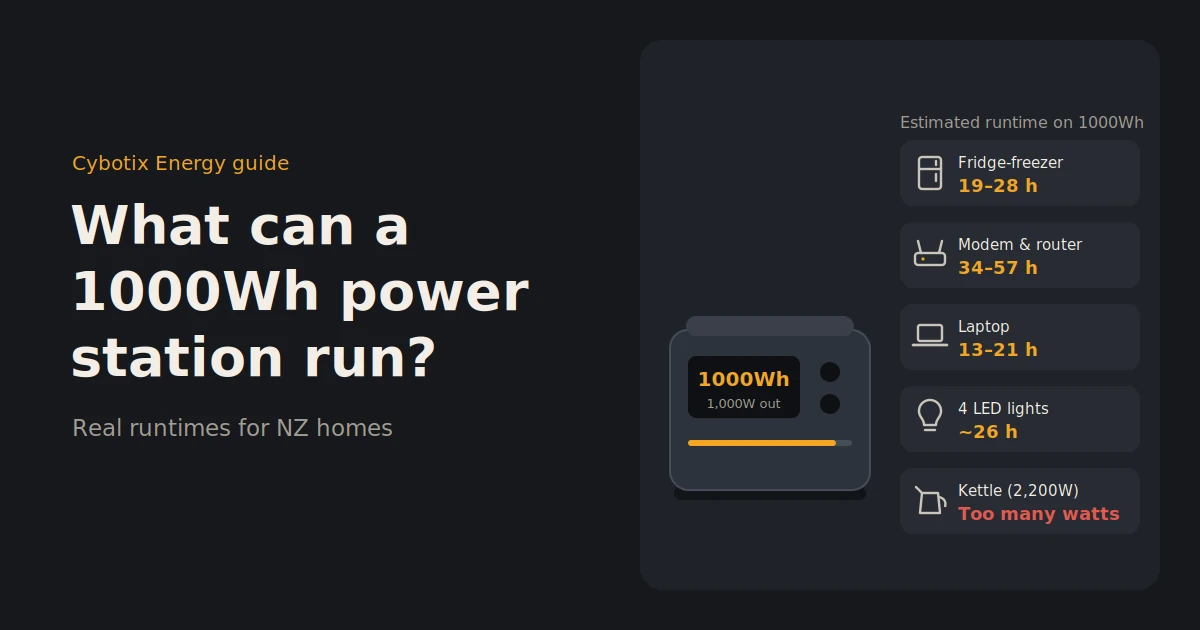
| Modern fridge-freezer | 30–45 W average (0.7–1.1 kWh a day) | About 19–28 hours |
| Older fridge-freezer | 50–70 W average (up to 1.6 kWh a day) | About 12–17 hours |
| Chest freezer | 25–35 W average | About 1–1.5 days |
| Modem and router | 15–25 W | About 34–57 hours |
| Laptop | 40–65 W | About 13–21 hours |
| TV (40–55″) | 60–120 W | About 7–14 hours |
| LED lights (4 × 8 W bulbs) | 32 W | About 26 hours |
| Phone charges | About 15 Wh each | Around 50 charges |
| CPAP, no humidifier | 30–60 W | About 14–28 hours |
| CPAP with heated humidifier | 70–100 W | About 8–12 hours |
| Electric blanket | 50–100 W | About 8–17 hours |
| Pedestal fan | 30–50 W | About 17–28 hours |
| Microwave (800–900 W cooking power) | 1,200–1,400 W input | Usually exceeds a 1,000W output |
| Electric kettle | 2,000–2,400 W | Can’t run on 1,000W output |
| Heater or heat pump | 1,000–2,400 W+ | Not practical |
Fridges and freezers don’t run constantly. The compressor cycles on and off, so their average draw is much lower than their running wattage. Your fridge’s Energy Rating Label shows its yearly energy use in kWh. Divide that by 365 for a daily figure.
These are estimates. Your appliances, the room temperature and how often you open the fridge all change real-world runtime.
What a 1000Wh power station can’t run (or only briefly)
Appliances that make heat are the problem. Kettles, heaters, heat pumps, ovens, hair dryers and washing machines on hot cycles draw more than 1,000W, so most 1000Wh units can’t run them normally. Some can run simple heating appliances in a reduced-power mode, but slowly and at a big cost to the battery.
- Electric kettle (2,000–2,400W). Above the rated output of most 1000Wh units. Power-lifting modes may run kettles rated up to 2,000W, but slowly. Boiling water on a gas burner is far more efficient.
- Heaters and heat pumps. A heater would empty the battery in well under an hour, and BLUETTI advises against running compressors like heat pumps on the AC70P. Use an electric blanket instead.
- Ovens and cooktops. Far beyond a 1,000W output. Cook on gas or a camp stove.
- Hair dryers and straighteners. Usually 1,500–2,400W. Some may run in power-lifting mode on a low setting.
- Washing machines and dryers. Heating cycles and motor surges are a poor match for a mid-size unit.
- Hot water cylinders. Not practical. Heating a full cylinder takes several times the battery’s capacity.
The rule of thumb: if its job is to heat a room, water or food, it probably uses too much power for a 1000Wh unit. If it lights, cools, charges or connects, it’s probably fine.
Real-world scenarios
In real use, a 1000Wh power station covers one night of essentials during an outage, one full workday at a home desk, or roughly a day and a half of camping with a 12V fridge. Adding solar or recharging between uses stretches each of these further.
An overnight winter storm outage
The power goes out at 6pm and comes back at 6am. Here’s a realistic plan:
- Fridge-freezer, 12 hours: about 480Wh
- Modem and router, 8 hours (off while you sleep): about 160Wh
- Two LED lights for the evening, 5 hours: about 80Wh
- Three phone charges: about 45Wh
- Electric blanket to warm the bed, 1 hour: about 60Wh
Total: about 825Wh. That just fits within a 1000Wh unit. Leave the modem on all night or run the blanket longer, and you’ll run short by morning. A small change, like switching the modem off overnight, makes the difference.
A home-office day
- Laptop, 8 hours: about 400Wh
- Monitor, 8 hours: about 200Wh
- Modem and router, 8 hours: about 160Wh
- Phone charge: about 15Wh
Total: about 775Wh, a full workday with a little to spare.
A weekend at the bach or campsite
A 12V camping fridge uses roughly 300–600Wh a day. Add lights and phones and you’re at around 500Wh a day, so a 1000Wh unit lasts about a day and a half on its own. A 200W solar panel can keep it going for the weekend in decent sun.
CPAP users
A CPAP without a heated humidifier often uses 30–60W, around 240–480Wh over eight hours. A 1000Wh unit can usually cover two nights, sometimes three. With a heated humidifier, expect about one night. Check your machine’s actual draw, and talk to your supplier or doctor before changing how you use it.
How to make 1000Wh last longer
The biggest gains come from small habits: use DC outputs where you can, switch off AC output when nothing needs it, keep the fridge door shut, and turn things off overnight. Recharging from solar, a car or a generator between uses stretches a 1000Wh unit through longer outages.
- Use DC and USB outputs. Phones, laptops and many routers can charge from USB-C or 12V outputs, which avoids the losses of converting to 230V AC.
- Switch off the AC inverter when idle. The inverter uses power just by being on, even if nothing is plugged in.
- Keep the fridge closed. A full, closed fridge stays cold for hours. Every opening makes the compressor work harder.
- Turn the modem off overnight. It’s an easy saving of 100–200Wh across a night.
- Use eco mode. Many power stations can switch off AC output automatically when the load is very low.
- Recharge whenever you can. Solar panels, a car’s 12V socket or a generator can top the battery up during a longer outage.
- Start full. Keep your power station charged ahead of storm warnings, and check it every few months if it’s in storage.
Is 1000Wh enough for you? 500Wh vs 1000Wh vs 2000Wh+
For most households, around 1000Wh covers the essentials for one night or one workday. Go smaller if you only need devices and a modem. Go to 2000Wh or more if you want to keep a fridge running through longer outages, run heavier appliances, or power a campervan.
| Around 500Wh | Around 1000Wh | 2000Wh and up | |
|---|---|---|---|
| Typical rated output | 500–800W | About 1,000W | 2,000–3,000W+ |
| Approx. weight | 5–7 kg | About 10 kg | 20–30 kg |
| Runs comfortably | Modem, phones, laptop, lights | A fridge overnight, plus essentials | A fridge for a day or more, plus a microwave or kettle |
| Best for | Short outages, home office backup | Overnight outages, weekends away | Longer outages, campervans, larger households |
| BLUETTI example | A compact unit | AC70P (864Wh, 1,000W) | Premium 200 V2 (2,073.6Wh, 2,700W) |
There’s also a middle path. The AC70P can be expanded with a BLUETTI expansion battery, such as the B80P (806Wh) or B230 (2,048Wh). That lets you start at around 1000Wh and add capacity later.
FAQs
How long will a 1000Wh power station run a fridge?
A modern fridge-freezer averages around 30–45W over a day, so a 1000Wh power station can run it for roughly 19–28 hours. An older, less efficient fridge may last 12–17 hours. Keeping the door closed helps it last longer.
Can a 1000Wh power station run a kettle?
Usually not normally. NZ kettles draw 2,000–2,400W, well above the 1,000W output of most 1000Wh units. Some, like the AC70P, have a power-lifting mode for resistive loads up to 2,000W, which can boil water slowly. A gas burner is usually more practical.
Can a 1000Wh power station run a heat pump?
No, it’s not practical. Heat pumps draw 1,000–2,400W or more, have compressor start-up surges, and would drain the battery quickly. BLUETTI advises against running compressors like heat pumps on the AC70P.
How many times can a 1000Wh power station charge a phone?
Around 50 times, depending on the phone. A typical phone battery holds roughly 12–20Wh, and some energy is lost in charging.
Is 1000Wh enough for a power outage?
For one night of essentials, yes: a fridge, modem, lights and phones. For outages lasting several days, you’ll need a way to recharge, such as solar panels, or a larger 2000Wh-plus setup.
How long does it take to charge a 1000Wh power station with solar?
It depends on your panels and the sun. With 400–500W of panels in strong sun, about 2–3 hours. With a single 200W panel, expect most of a sunny day. In winter, it can take longer.
Get the right size the first time
A 1000Wh power station is a sweet spot for many NZ homes: big enough to keep the fridge cold and the family connected overnight, and light enough to carry to the bach. Just check both numbers, watt-hours for how long and watts for what, before you rely on it.
Browse BLUETTI power stations and solar panels at Cybotix Energy, with NZD pricing including GST. Not sure which size you need? Tell our New Zealand team what you want to run during an outage and we’ll help you size it.