Day two at the campsite. The chilly bin has turned into a lukewarm bath, your phone is on 4% before the walk, and someone three sites over has fired up a generator that drones through dinner. There’s a better way to power a camping trip.
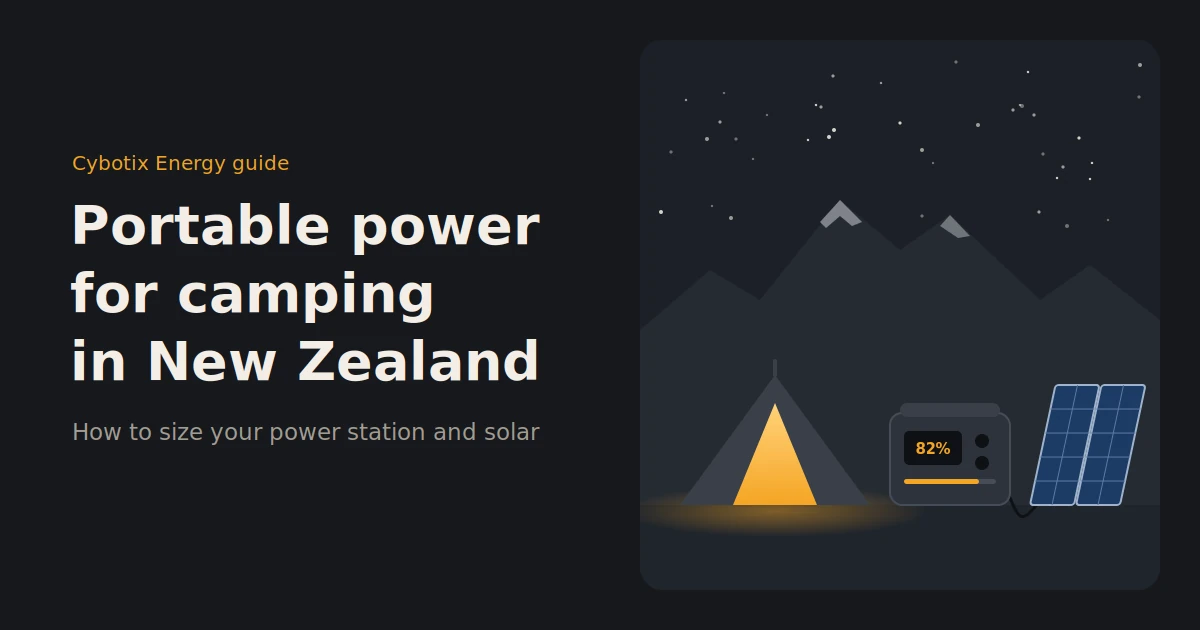
A portable power station for camping in NZ gives you quiet, fume-free power for a fridge, lights and devices, and with a solar panel it can keep going for days. The hard part is choosing the right size. Too small and it’s flat by the second night. Too big and you’re hauling 25 kg across the campground for no reason.
Portable Power Station for Camping NZ
This guide shows you how to work out what you’ll actually run, size a power station and solar setup to match, and handle NZ-specific details like DOC campsites, cold nights and winter sun.
The short answer
For most NZ camping trips, a 500–1,000Wh LiFePO4 power station will run a compressor fridge, lights and phones for one to two days. Add a 100–200W solar panel and, in decent sun, it can keep going for several days. Campervans, CPAP users and longer trips may need 1,500Wh or more.
The single biggest factor is your fridge. Lights and phones barely register. A fridge runs day and night, so size your power station around it, then add solar to stretch the trip.
Why campers are choosing power stations over generators
Power stations are silent, produce no fumes and need no fuel, so you can use them inside a tent or van and at campsites with quiet hours. Generators still win for heavy loads over long periods, but for typical camping needs, a battery and a solar panel are simpler and more pleasant to live with.
Power station pros:
- Silent, so no complaints from the next site and no drone during dinner
- No fumes, so it’s safe to use inside a tent, van or awning
- No petrol to carry, store or spill in the boot
- Recharges from solar, your car or a powered site
- Clean power suited to phones, laptops, cameras and CPAP machines
Power station cons:
- Limited capacity, so heavy loads like kettles and heaters drain it quickly
- Higher upfront cost than a small generator
- Relies on sun or driving to recharge on long, off-grid trips
For most campers, the trade-off is easy. A generator suits a building site. A power station suits a campsite.
What will you actually run? A camping power audit
Before choosing a power station, add up what you’ll run in a day. Most campers use 300–700Wh a day, and a 12V compressor fridge usually accounts for more than half of that. Kettles, induction cooktops and heaters are the loads that empty a battery fast.
The figures below are typical estimates. Your gear may use more or less, so check labels or measure with the power station’s display.
| Device | Typical power draw | Typical daily use |
|---|---|---|
| 12V compressor fridge (40–50L) | 40–60W while the compressor runs | 300–600Wh, depending on the weather |
| LED camp lights | 5–10W | 20–40Wh for an evening |
| Phone charge | 10–20W | About 15Wh per charge |
| Camera or drone battery | 30–60W while charging | 20–60Wh per battery |
| Laptop charge | 45–65W | 50–80Wh per charge |
| CPAP (no heated humidifier) | 20–60W | 160–480Wh per night |
| 12V electric blanket | 40–60W | 80–120Wh to pre-warm the bed |
| USB or 12V fan | 10–30W | 60–180Wh on a warm night |
| Electric kettle (1L) | 1,800–2,400W | About 110Wh per boil |
| Induction cooktop | 1,200–2,000W | 600–1,000Wh for 30 minutes |
Worked example: a family weekend
For two adults and two kids at a DOC campsite:
- Fridge: about 400Wh
- Lights for the evening: about 30Wh
- Four phone charges: about 60Wh
- One camera battery: about 30Wh
That’s roughly 520Wh a day, or about 1,040Wh across two days.
How to size your power station
Size your power station on three things: capacity in watt-hours for how long it lasts, output in watts for what it can run at once, and weight for how far you’ll carry it. Capacity matters most for camping. Output only matters if you plan to run high-power gear like a kettle.
Capacity (Wh): how long it lasts
Use this simple formula:
Capacity needed = daily use × days without recharging ÷ 0.85
The 0.85 allows for energy lost in conversion. For the family weekend above:
- 520Wh a day × 2 days = 1,040Wh
- 1,040 ÷ 0.85 = about 1,220Wh
Without solar, that family would need a unit of around 1,200Wh or more. With a solar panel topping it up each day, an 864Wh unit like the BLUETTI AC70P can cover the same weekend.
Output (W) and surge: what it can run
Output is the maximum load the power station can run at once. A fridge, lights and phones together rarely exceed 200W, so almost any unit handles them.
High-power gear is different. A 2,000W kettle needs a power station rated for at least that much. The AC70P is rated at 1,000W, so it suits fridges, lights, laptops and CPAP machines but not a full-size kettle. Larger units like the BLUETTI Premium 200 V2, rated at 2,700W, can run kettles and induction cooktops, though each use takes a noticeable chunk of battery.
Weight: how far you’ll carry it
It’s easy to overlook until you’re walking it from the car park:
- Around 10 kg: comfortable to carry short distances. The AC70P weighs about 10.2–10.7 kg, depending on the spec sheet.
- Over 20 kg: best kept in a campervan, caravan or ute. The Premium 200 V2 weighs about 24 kg.
Which size suits your camping style?
Match the power station to how you camp. Tent campers without a fridge can go small. Families running a fridge suit something around 800–1,200Wh. Campervans and caravans running more gear benefit from 1,500Wh or more, where weight matters less.
| Camping style | Typical capacity | Suggested solar | Example | Approx. weight |
|---|---|---|---|---|
| Weekend tent camping, no fridge | 300–600Wh | 60–100W panel | A compact power station | 4–7 kg |
| Family car camping with a fridge | 800–1,200Wh | 100–200W panel | BLUETTI AC70P (864Wh) | About 10 kg |
| Remote hunting or fishing, several days | 800–1,200Wh | 200W panel | BLUETTI AC70P (864Wh) | About 10 kg |
| CPAP user, one or two nights | 800Wh or more, depending on the machine | 100–200W panel for longer trips | BLUETTI AC70P (864Wh) | About 10 kg |
| Campervan or caravan, extended trips | 1,500–2,500Wh | 200–400W of panels | BLUETTI Premium 200 V2 (2,073.6Wh) | About 24 kg |
If you use a CPAP, check its power use with the heated humidifier off and on. A heated humidifier can use several times more power overnight. Ask your equipment supplier or doctor before changing how you use your machine.
Solar charging at camp: what NZ sun really gives you
A 200W solar panel can produce roughly 700–1,000Wh on a clear New Zealand summer day, enough to cover a fridge and devices. In winter, expect around a third to half of that. Face your panel north, keep it out of shade, and adjust the angle through the day.
Here’s the maths for a 200W panel:
| Season | Approx. peak sun hours | Rough daily output (200W panel) |
|---|---|---|
| Clear summer day | 5–7 hours | 700–1,000Wh |
| Spring or autumn | 3–5 hours | 450–750Wh |
| Winter, especially in the South Island | 2–3 hours | 300–450Wh |
These assume about 75% of the panel’s rated output once heat, angle and dust are taken into account. Cloud, shade and short days can cut it much further.
Getting the most from your panel
- Face it north. In New Zealand the sun tracks across the northern sky, so a north-facing panel produces the most.
- Avoid shade. Even a branch shading part of the panel can cut output sharply. Set up in the open, away from tents and trees.
- Adjust the angle. Tilt the panel towards the sun, and re-angle it a couple of times a day if you can.
- Match your power station’s input. The AC70P accepts up to 500W of solar input, so you could run more than one panel on longer trips.
For winter or South Island trips, plan for less solar and more battery, or top up by driving.
NZ campsite rules and practicalities
Many campgrounds limit generator use or set quiet hours, and a silent power station sidesteps both. Freedom camping rules depend on your vehicle and location, not on how you power it. On cold nights, keep your power station somewhere sheltered, as most can’t charge below 0°C.
DOC campsites and holiday parks
Most DOC campsites are unpowered, and many campgrounds and holiday parks restrict generators or ask for quiet in the evenings and early mornings. Rules vary by site, so check before you go.
A power station is silent and fume-free, so it fits in at sites where a generator wouldn’t. You can run a fridge through the night without disturbing anyone.
Freedom camping and self-contained vehicles
In general, you can only freedom camp on council land in a vehicle certified as self-contained, and certification now requires the newer green warrant. Freedom camping is also banned or restricted in many DOC areas.
A power station doesn’t change any of this. Self-containment is about toilets, water and waste, not power. Check the rules for each spot with the local council or DOC before you set up.
Cold nights
LiFePO4 power stations work in the cold but don’t like charging in it. The AC70P, for example, can discharge down to -20°C but should only be charged between 0°C and 40°C.
On frosty nights in places like the Mackenzie Country or Central Otago:
- Keep the power station inside the tent, van or car rather than on frozen ground.
- Wait until the morning sun has warmed it before solar charging.
- Expect slightly less usable capacity in very cold weather.
Tips to make your battery last longer at camp
The easiest gains come from your fridge and your inverter. Pre-chill the fridge at home, run it from a 12V DC outlet, switch off AC output when you’re not using it, and keep both the fridge and the power station in the shade. Topping up while you drive helps too.
- Pre-chill the fridge at home. Cool it and its contents on mains power before you leave, so the battery isn’t doing the hard work on day one.
- Use 12V DC for the fridge. Most camping fridges run on 12V. Plugging into the power station’s 12V outlet avoids the energy lost converting to AC and back.
- Turn off the AC inverter when idle. The inverter uses power just by being switched on. If nothing’s plugged into the AC outlets, turn them off.
- Keep things in the shade. A fridge in direct sun works much harder, and power stations charge best below 40°C.
- Don’t over-chill. Setting the fridge at 3–4°C rather than near freezing noticeably reduces how often the compressor runs.
- Charge while you drive. The AC70P can charge from your car’s 12V or 24V socket. It’s slow, but a few hours on the road adds useful energy.
- Charge to full before you leave. Start every trip at 100%, either from the wall at home or at a powered site.
FAQs
What size power station do I need for camping?
For most trips with a 12V fridge, around 800–1,200Wh is a good fit. Without a fridge, 300–600Wh is often enough. Work out your daily use, multiply by the days between recharges, and divide by 0.85.
How long will a power station run a camping fridge?
A typical 40–50L compressor fridge uses around 300–600Wh a day, depending on the weather and how often it’s opened. An 864Wh power station like the AC70P can run one for roughly one to two days without solar, and longer with a panel.
Can a power station run a CPAP all night?
Yes, in most cases. A CPAP without a heated humidifier often uses 160–480Wh over eight hours, so an 800Wh-plus unit can usually cover one or two nights. Check your machine’s power use, as humidifiers add a lot.
Can I charge a power station from my car?
Yes. Most power stations, including the AC70P, can charge from a 12V car socket. It’s slower than wall or solar charging, so treat it as a top-up while you drive.
Are generators allowed at DOC campsites?
Rules vary by site. Many campgrounds restrict generators or set quiet hours, so check the rules for your campsite before you go. A battery power station avoids the issue, as it’s silent and fume-free.
Can I leave a power station in the sun?
It’s best not to. Like phones and laptops, power stations work and charge best when kept cool. Keep the unit in the shade and only put the solar panel in the sun.
Power your next trip quietly
The right camping setup starts with your fridge, adds a solar panel for longer trips, and stays light enough to carry. Get the size right and you’ll have cold drinks, charged phones and quiet evenings, wherever you pitch up.
Browse BLUETTI power stations and solar panels at Cybotix Energy, with NZD pricing including GST. Not sure which size suits your trips? Get in touch with our New Zealand team, tell us what you want to run, and we’ll help you size a setup.