You’ve booked flights to Queenstown for a week of camping, or to Rarotonga for a fortnight off-grid. The tent’s sorted. The camera gear’s sorted. Then you look at your power station sitting by the door and wonder whether it can come too.
So, can I take a power station on a plane? For almost every model on the market, the answer is no. Not in your carry-on, and not in checked luggage. The reason comes down to one number printed on the label: watt-hours.
This guide explains the airline limits, shows you how to check any battery yourself, and covers the practical options NZ travellers use to get power where they’re going.
The short answer
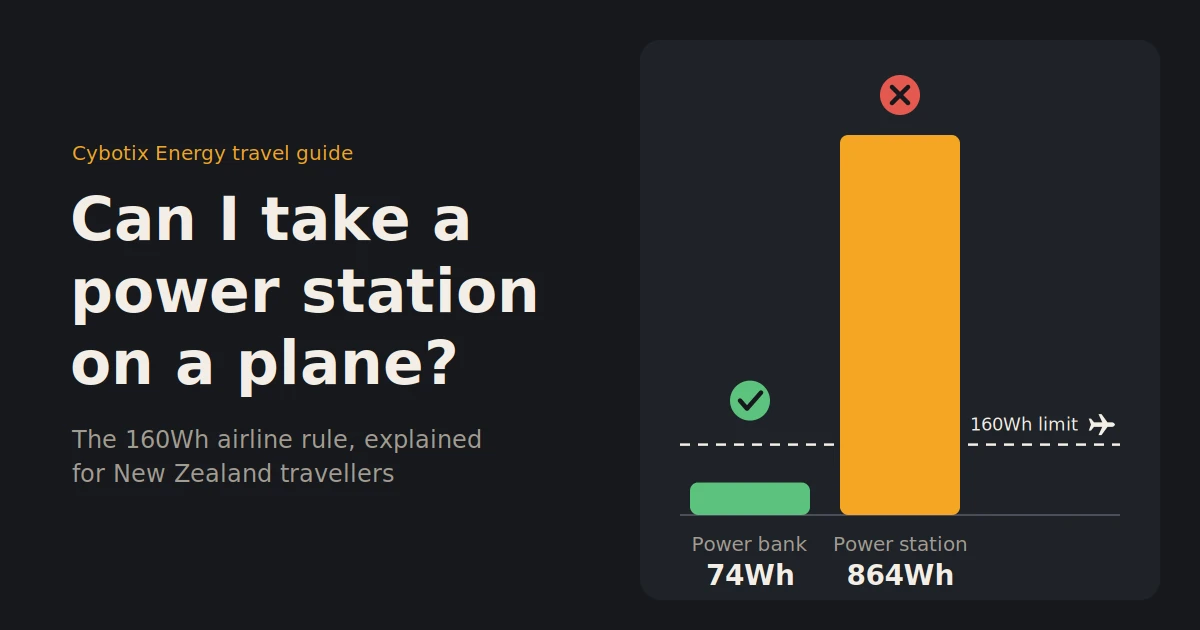
Most portable power stations can’t go on a passenger plane. Airlines cap lithium-ion batteries at 160Wh, and even compact power stations usually hold several hundred watt-hours. Only batteries up to 160Wh can fly, and spare batteries over 100Wh come with extra conditions.
To put that in perspective, a typical phone power bank holds around 70Wh. A compact power station like the BLUETTI AC70P holds 864Wh, more than five times the absolute cabin limit. Larger home-backup units hold 2,000Wh or more.
There’s no workaround at the check-in counter. Switching it off, packing it carefully or putting it in the hold doesn’t change the rule.
Why airlines limit lithium batteries
Lithium batteries can overheat and catch fire if they’re damaged, faulty or short-circuited. On a plane, there’s nowhere to pull over. Airlines limit battery size because the bigger the battery, the more energy it can release if something goes wrong.
The process behind battery fires is called thermal runaway. One overheating cell heats the cells around it, and the reaction can spread through the whole pack. It produces intense heat and toxic smoke, and it’s hard to stop once it starts.
That’s why the rules are written in watt-hours (Wh). Watt-hours measure how much energy a battery stores, which is a direct guide to how much energy a fire could release. Physical size, brand or price don’t come into it.
It also explains why spare batteries belong in the cabin, not the hold. Cabin crew are trained and equipped to deal with a smoking device at a passenger’s seat. A fire inside a suitcase in the cargo hold can go unnoticed until it’s much harder to control.
LiFePO4 doesn’t change the rules. Many power stations, including BLUETTI models, use lithium iron phosphate (LiFePO4) cells. These are more thermally stable than many other lithium chemistries. Airline rules don’t distinguish between them, though. A LiFePO4 battery over 160Wh is treated exactly like any other lithium-ion battery over 160Wh.
The watt-hour limits explained
Airline battery rules fall into three bands: up to 100Wh, 100–160Wh, and over 160Wh. The lower your battery’s rating, the fewer conditions apply. Above 160Wh, a lithium-ion battery isn’t allowed on passenger flights at all.
These bands follow international dangerous goods standards, so most airlines use the same thresholds. The details, such as how many batteries you can carry, vary by airline.
Up to 100Wh
This covers nearly all phone power banks and most laptop batteries. You can carry them in the cabin without asking the airline first. Air New Zealand, for example, allows up to two power banks of 100Wh or less per person.
100Wh to 160Wh
This band includes large laptop power banks, some camera and drone batteries, and a handful of very small power stations. Conditions apply, and they differ between airlines. Air New Zealand accepts up to two spare batteries in this range per person, in carry-on only, and asks you to declare devices with these batteries at check-in. Other airlines, such as Qantas and Jetstar, ask for approval before you fly.
Over 160Wh
Batteries above 160Wh aren’t allowed in carry-on or checked bags on passenger aircraft. This is where almost every portable power station sits, from compact camping units to large home-backup models.
Carry-on vs checked bags
Spare lithium batteries and power banks must travel in the cabin. Packing them in checked luggage isn’t allowed, whatever their size. Devices with a battery built in, like a laptop, have their own rules, but a power station is treated as a battery, not a device you happen to be carrying.
How to check your power station’s watt-hours
Look for the Wh rating on the label, usually on the base or back of the unit, or in the user manual. Power stations almost always list capacity in watt-hours. If a battery only shows milliamp-hours (mAh), you can convert it with a simple formula.
The formula is:
Wh = mAh × V ÷ 1,000
Here’s a worked example for a common 20,000mAh power bank rated at 3.7V:
- Multiply 20,000 by 3.7. That gives 74,000.
- Divide by 1,000. That gives 74Wh.
- 74Wh is under 100Wh, so it can fly in your carry-on without approval.
One catch: use the battery’s rated voltage, usually 3.6V or 3.7V, not the 5V USB output printed nearby. Using 5V overstates the capacity and can make a legal power bank look like it’s over the limit.
For power stations, the conversion is rarely needed. The capacity is part of the product name or spec sheet, such as 864Wh or 2,048Wh, and that number alone tells you it can’t fly.
If you can’t find a rating anywhere on a battery, airline staff may refuse it. A clear, readable label matters.
What can fly and what can’t: comparison table
The table below shows how common batteries line up against the airline limits. If your battery is over 160Wh, it stays on the ground. Under 100Wh, it goes in your carry-on without approval.
| Battery or device | Typical capacity | Carry-on | Checked bag | Airline approval |
|---|---|---|---|---|
| 10,000mAh phone power bank | About 37Wh | Yes | No | Not needed |
| 20,000mAh phone power bank | About 74Wh | Yes | No | Not needed |
| Large laptop power bank | 100–160Wh | Yes, with conditions | No | Varies by airline |
| BLUETTI AC70P power station | 864Wh | No | No | Not available |
| BLUETTI B230 expansion battery | 2,048Wh | No | No | Not available |
| BLUETTI Apex 300 power station | 2,764.8Wh | No | No | Not available |
Power bank capacities assume a 3.7V rated cell voltage. Always check the label on your own battery, and your airline’s current rules, before you fly.
NZ airline rules at a glance
Air New Zealand, Qantas and Jetstar all refuse lithium-ion batteries over 160Wh, so no power station flies on any of them. Where they differ is how they handle power banks once you’re on board. Several airlines have tightened those rules since late 2025.
| Airline | Over 160Wh | 100–160Wh spares | Using a power bank on board |
|---|---|---|---|
| Air New Zealand | Not accepted | Up to 2, carry-on only | Not during taxi, take-off or landing; no charging from seat power |
| Qantas and QantasLink | Not accepted as baggage | Prior approval needed; max 2 power banks | Not allowed at any point |
| Jetstar | Not accepted as baggage | Prior approval needed; max 2 power banks | Not allowed at any point |
A few details are easy to miss:
- Keep power banks within reach. Air New Zealand doesn’t allow power banks in overhead lockers. Keep them in your seat pocket, under the seat in front or on you.
- Flying to the Pacific? Fiji Airways and many Asian carriers have also restricted in-flight power bank use. If your trip includes a connection, check each airline’s rules, not just the first one.
- Rules change. Airline battery policies have shifted several times in the past year. Check your airline’s dangerous goods page in the week before you fly.
The practical takeaway: you can still take a power bank for your phone. You just can’t count on topping up from it mid-flight.
What to do instead
If your power station can’t fly, you have five realistic options. You can fly with a small power bank, pack only your solar panel, drive and take the ferry, ship the station ahead as dangerous goods, or source power at your destination. The right choice depends on how long you’re away and how much power you need.
1. Fly with a power bank under 100Wh
For a short trip where you only need to charge phones, earbuds and a camera, a power bank is enough. A 20,000mAh model covers several phone charges and flies in your carry-on without approval. Charge it at the airport or once you land, as many airlines no longer let you use it in flight.
2. Pack the solar panel, not the battery
A folding solar panel has no battery inside, so lithium battery rules don’t apply to it. Panels and cables can usually go in checked luggage. Check your airline’s size and weight limits, as large rigid panels may count as oversized baggage.
This works well if you’re also arranging a battery at the other end. You keep the gear that’s easy to fly with and source the part that isn’t.
3. Drive and take the ferry
Travelling between the North and South Islands? The Cook Strait ferries are the most practical way to bring your power station with you. Leave it secured in your vehicle on the vehicle deck. Interislander doesn’t allow dangerous goods as hand luggage and asks you to tell staff about them at check-in, so mention the power station when you arrive. Large quantities may need a declaration before sailing, so check the operator’s current dangerous goods limits when you book.
4. Ship it ahead by courier
Power stations are classed as lithium-ion batteries for transport (UN3480, Class 9 dangerous goods). That means not every courier service will take them, and those that do may use road freight only and charge extra. Allow more time than a standard parcel, and keep the original packaging if you can.
5. Buy or hire at your destination
For longer stays, or if you’re relocating, it often makes more sense to have a power station delivered to where you’re going. You avoid the courier process and arrive to a unit that’s ready to charge. Some campervan and bach rentals also include portable power, so it’s worth asking before you book.
Common mistakes that get batteries confiscated
Most battery problems at the airport come from a handful of avoidable mistakes. The most common is assuming “portable” means “flyable”. A battery that’s refused at security is usually surrendered on the spot, so it pays to check before you leave home.
- Assuming portable means allowed. “Portable” describes how easy something is to carry, not whether it meets aviation rules. A 10 kg power station is portable. It still can’t fly.
- Packing batteries in checked luggage. Spare batteries and power banks must go in your carry-on. Bags with batteries hidden inside can be pulled aside and opened, and you may miss your flight sorting it out.
- Confusing mAh with Wh. A 26,800mAh power bank sounds big, but at 3.7V it’s about 99Wh, just under the limit. Always convert, or look for the Wh figure.
- Worn or missing labels. If staff can’t read the rating, they may refuse the battery. Keep labels clean, and carry a screenshot of the spec sheet as backup.
- Not checking every airline on your trip. A connection on a stricter carrier can catch you out, especially on flights through Asia or the Pacific.
FAQs
Can I take a BLUETTI on a plane?
No. The BLUETTI power stations we stock all hold well over 160Wh, which is the limit for lithium-ion batteries on passenger flights. The compact AC70P, for example, holds 864Wh. They can’t go in carry-on or checked luggage.
Can I check in a power station if it’s switched off?
No. The limit is based on the battery’s capacity, not whether it’s switched on. A power station over 160Wh is refused in checked bags whether it’s on, off or fully discharged.
Is a 20,000mAh power bank allowed on Air New Zealand?
Yes. At a typical 3.7V, a 20,000mAh power bank is about 74Wh, under the 100Wh threshold. Pack it in your carry-on, not your checked bag, and keep it out of the overhead locker.
What’s the largest battery I can take on a plane?
For lithium-ion batteries, 160Wh is the maximum on passenger flights. Spare batteries between 100Wh and 160Wh come with conditions, such as a limit of two and, on some airlines, prior approval.
Can I take a solar panel on a plane?
Usually, yes. A solar panel on its own has no battery, so lithium battery rules don’t apply. Check your airline’s size and weight limits, as larger panels may count as oversized baggage.
Can I bring a power station on the Interislander?
Yes, in your vehicle. Keep it secured in the vehicle on the vehicle deck, and let staff know at check-in. Dangerous goods aren’t allowed as hand luggage on Interislander, so don’t carry it onto the passenger decks.
Plan your power around the trip, not the flight
Your power station can’t fly, but your trip doesn’t have to go without it. Drive it there, ship it ahead, or have one waiting when you arrive. Pack a small power bank for the flight itself.
If you’re planning a road trip, a campervan setup or power for a remote bach, browse BLUETTI power stations and LONGi solar panels at Cybotix Energy. Not sure which size suits your trip? Get in touch with our New Zealand team, tell us what you need to run and for how long, and we’ll help you pick a setup that fits.