You’ve found one on a US site for noticeably less than the local price, and the listing says nothing useful about voltage. The question is whether you’re about to save a few hundred dollars or buy an expensive paperweight.
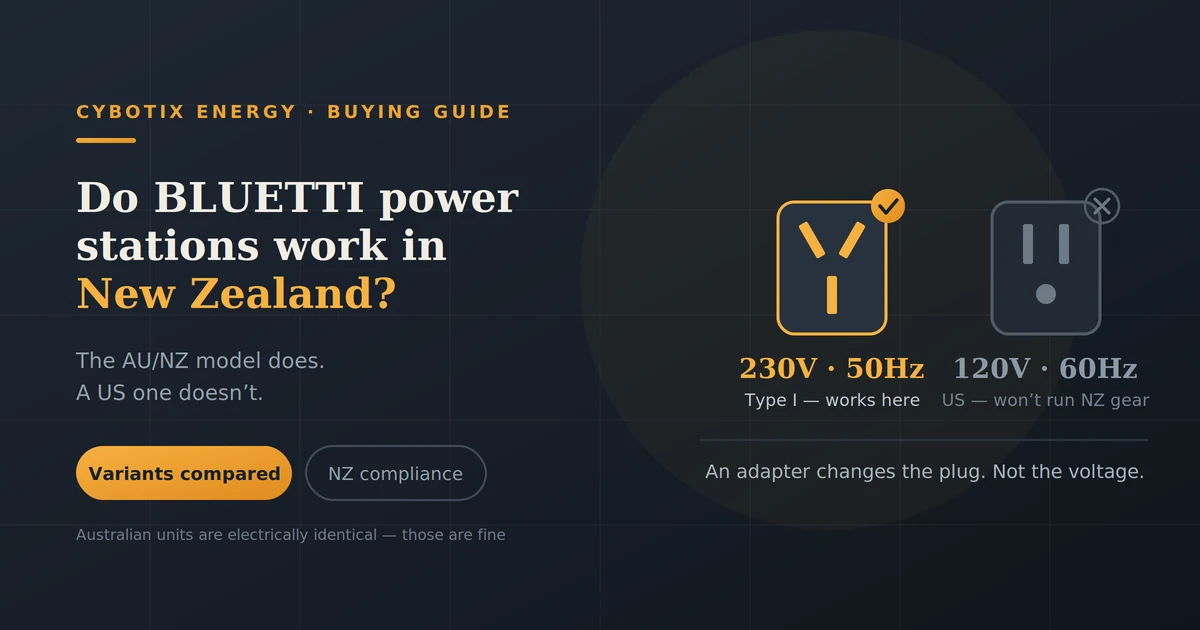
Do BLUETTI power stations work in New Zealand? The AU/NZ variant does, exactly as designed. A US model does not and no plug adapter fixes it, because the problem isn’t the plug.
Here’s what actually differs, and how to check a listing before you order.
Do BLUETTI power stations work in New Zealand?
It depends entirely on which regional variant you buy.
- AU/NZ model 230V, 50Hz, Type I sockets. Works here as intended.
- EU/UK model correct voltage and frequency, wrong sockets at both ends.
- US model outputs 120V at 60Hz. Your appliances won’t run properly, and its charger expects 120V input.
New Zealand runs 230V ±6% at 50Hz, using Type I plugs defined by AS/NZS 3112. Any power station you buy has to output that, not just plug into it.
The three things that have to match
People think about this as a plug problem. It isn’t the plug is the least of it.
Voltage: 230V
This is the one that matters most, and it’s easy to miss because it works in the opposite direction from what you’d expect.
A power station doesn’t just receive power. It produces it. The AC sockets on the unit are generating mains voltage for your appliances.
A US model generates 120V. So when you plug your NZ kettle, fridge or power tool into it, that appliance receives 120V instead of the 230V it needs. Most simply won’t run. Some will run badly. Motors and heating elements behave unpredictably on half their design voltage.
A travel adapter changes the shape of the plug. It does nothing to the voltage.
Frequency: 50Hz
New Zealand runs at 50Hz; the US runs at 60Hz. Modern electronics mostly tolerate either, but anything with a motor or a timer is designed around one or the other. Running a 50Hz motor on 60Hz, or the reverse, affects speed and heat.
On its own, frequency is a secondary concern. Combined with the voltage mismatch, it’s part of why a US unit isn’t a workable option here.
Plug type: Type I, at both ends
Two separate connections, and both matter:
- The sockets on the unit your NZ appliances need to physically plug in
- The charging input the unit’s own AC charger has to plug into an NZ wall socket
An EU model gets voltage and frequency right but fails both of these. You’d need adapters on the output sockets and a solution for charging it. Workable in principle, annoying in practice, and it leaves you with a device that isn’t quite set up for where it lives.
What actually happens if you import a US model
Concretely, rather than in theory:
- The AC outlets deliver 120V. Your appliances receive roughly half the voltage they expect.
- Most won’t start. Anything with a compressor, motor or heating element is the worst affected.
- The sockets are the wrong shape anyway NEMA, not Type I so you’d be running everything through adapters.
- The included charger expects 120V input. Plugging it into a 230V wall socket is not something to attempt.
- The DC and USB outputs still work normally, because DC isn’t region-specific.
That last point is the only consolation. You’d own a large, expensive USB charger.
A step-down transformer theoretically bridges some of this. In practice you’d be adding a heavy, lossy box to a device you bought for portability, to work around a problem you could have avoided at the listing stage.
Regional variants compared
| AU/NZ | EU/UK | US | |
|---|---|---|---|
| AC output voltage | 230V | 230V | 120V |
| Frequency | 50Hz | 50Hz | 60Hz |
| Socket type on unit | Type I | Type F / Type G | NEMA |
| Charging input | NZ wall socket | EU/UK socket | US socket |
| NZ appliances run properly | Yes | Yes, via adapters | No |
| Usable here | Yes | With friction | Not practically |
[PLACEHOLDER: verify the exact variants and socket configurations for the models you stock.]
What about the solar input?
Good news, and it’s the part people worry about unnecessarily: solar is DC, so it isn’t region-locked the way AC is.
A solar panel produces DC at a voltage determined by the panel, not by the country. What matters is:
- Connector type MC4 is the common standard, and adapters are straightforward
- Voltage window the panel’s output must fall inside the charge controller’s accepted range
- Current limit don’t exceed the input’s rated amps
So panels bought anywhere will generally work with a unit bought anywhere, provided the numbers line up. That’s a genuine difference from the AC side.
What varies by country is what panels actually produce. Our guide to how solar panels perform through a New Zealand winter covers the seasonal reality here, which is the binding constraint rather than compatibility.
Electrical compliance in New Zealand
This is the part most retail content gets wrong, including some that should know better.
New Zealand runs two separate compliance regimes, and they use different marks:
Electrical safety sits under WorkSafe and the electrical safety regulations. Declared articles require certification, and certified products must carry a unique certification marking issued as part of that process. Appliances must be marked with 230V, or a voltage range including 230V. Notably, WorkSafe states that while the RCM is mandatory under the Australian EESS rules, it is not recognised in New Zealand for electrical safety certification.
Radiocommunications and EMC sit under RSM, and there the RCM is the compliance mark to look for.
So “it has an RCM sticker” answers one question and not the other. If compliance matters to you and for anything connected to your home’s wiring or used in a workplace, it should the right move is to ask the supplier what certification the specific model holds for New Zealand, and to check WorkSafe’s guidance rather than relying on a marketplace listing.
This is general information, not compliance advice. WorkSafe and RSM publish the authoritative guidance.
Why this matters beyond the paperwork
Two practical consequences people overlook:
- Insurance. If non-compliant electrical equipment contributes to a fire or damage claim, that’s a conversation you don’t want to be having.
- Resale. A unit that isn’t configured or certified for New Zealand is harder to sell on, and you’ll be explaining why.
Warranty and support if you import
The savings calculation usually ignores this.
- Warranty claims go offshore. You’re shipping a unit that may weigh 20kg or more, internationally, at your cost.
- Lithium batteries have shipping restrictions, which complicates returns considerably.
- The Consumer Guarantees Act applies to New Zealand suppliers. Buying from a foreign marketplace generally puts you outside that protection, leaving you with whatever the platform offers.
For a $300 accessory, importing is a reasonable gamble. For a unit costing well into four figures with a lithium battery inside, the risk profile is different.
Is an Australian unit fine?
Yes, genuinely. Australia and New Zealand share AS/NZS 3112, 230V and 50Hz. An Australian-market BLUETTI is electrically identical to a New Zealand one and will work here without adapters or workarounds.
I’d rather say that plainly than imply only local stock works, because it’s true and you’d find out anyway.
What still differs:
- Warranty servicing you’re dealing with an Australian retailer, which is far better than a US one but still not local
- Shipping a heavy item across the Tasman, and lithium shipping rules apply
- Who you call when something doesn’t work
If you find a good Australian price and you’re comfortable with those trade-offs, that’s a legitimate option. The electrical question is settled.
What these units are actually good for here
Briefly, since this is a compatibility article rather than a sizing one:
- Storm outages, which is the main driver for most NZ buyers
- Rural properties where restoration takes longer
- Baches and campsites with no mains supply
- Small business premises with equipment or stock to protect
Sizing is a separate question, and our guide to what a 500Wh power station will run covers the arithmetic.
Before you buy four checks
Each of these takes thirty seconds on a listing:
- Find the AC output voltage. It must say 230V, or a range including 230V. If it says 120V, stop.
- Check the socket type. Type I is what you want. NEMA or Schuko means the wrong variant.
- Check the charging input. The unit’s own charger needs to plug into an NZ wall socket.
- Confirm who handles warranty and where the unit would have to go.
If a listing doesn’t state the output voltage, ask before ordering. A seller who can’t answer that question quickly is telling you something.
FAQs
Will a US BLUETTI work in New Zealand with an adapter?
No. A plug adapter changes the plug shape, not the voltage. A US unit outputs 120V, so your NZ appliances won’t run properly from it.
Do BLUETTI power stations come with NZ plugs?
The AU/NZ variant does Type I sockets and a charger that plugs into an NZ wall outlet. Other regional variants don’t.
Can I use an Australian BLUETTI model in New Zealand?
Yes. Australia and New Zealand share the same plug standard, voltage and frequency, so an Australian unit is electrically identical.
Do I need a voltage converter?
Not if you buy the AU/NZ variant. If you’ve already imported a US unit, a step-down transformer is a workaround rather than a fix, and adds weight and losses.
Will solar panels bought overseas work?
Generally yes solar is DC and isn’t region-locked. Check the connector type, voltage window and current limit rather than the country.
Is it cheaper to import one?
Sometimes on sticker price. Factor in shipping, duties, GST, the warranty situation and the risk of buying the wrong variant, and the gap usually narrows or reverses.
How do I tell which variant a listing is?
Look for the AC output voltage in the specifications. 230V means it’s for a 230V market; 120V means it isn’t.
Send us the listing before you buy
If you’ve found a unit somewhere and you’re not sure which variant it is, send the link. We’ll tell you whether it’ll work here including when the answer is that an Australian listing is a perfectly good option