On one side, a power bank that fits in your pocket for under $150. On the other, a power station with proper NZ sockets for $1,000 or more. Both promise to keep you powered when the grid isn’t around. So which one do you actually need?
If you’re asking whether you need a 230V power station in New Zealand, the answer depends on what you want to plug in. Some gear needs real mains-style power from a standard socket. A lot of it doesn’t: it runs happily from USB or 12V, which is cheaper, lighter and more efficient.
This guide helps you work out which camp you’re in, so you buy what you need and nothing more.
The short answer
You need a 230V power station if you want to run normal NZ mains appliances from a standard plug: a household fridge-freezer, TV, laptop charger, kitchen gadget or power tool. If you only charge phones and laptops over USB-C, or run 12V camping gear like a 12V fridge and lights, a power bank or 12V battery may be all you need.
A quick test: look at the plug on each thing you want to power.
- A standard NZ three-pin plug → you need 230V AC output.
- A USB or USB-C cable → a power bank or any power station’s USB ports will do.
- A 12V car-style plug → a 12V battery or the 12V port on a power station will do.
If your list mixes all three, which it often does for home backup, a 230V power station covers everything in one unit.
230V AC vs 12V DC vs USB: what each can run
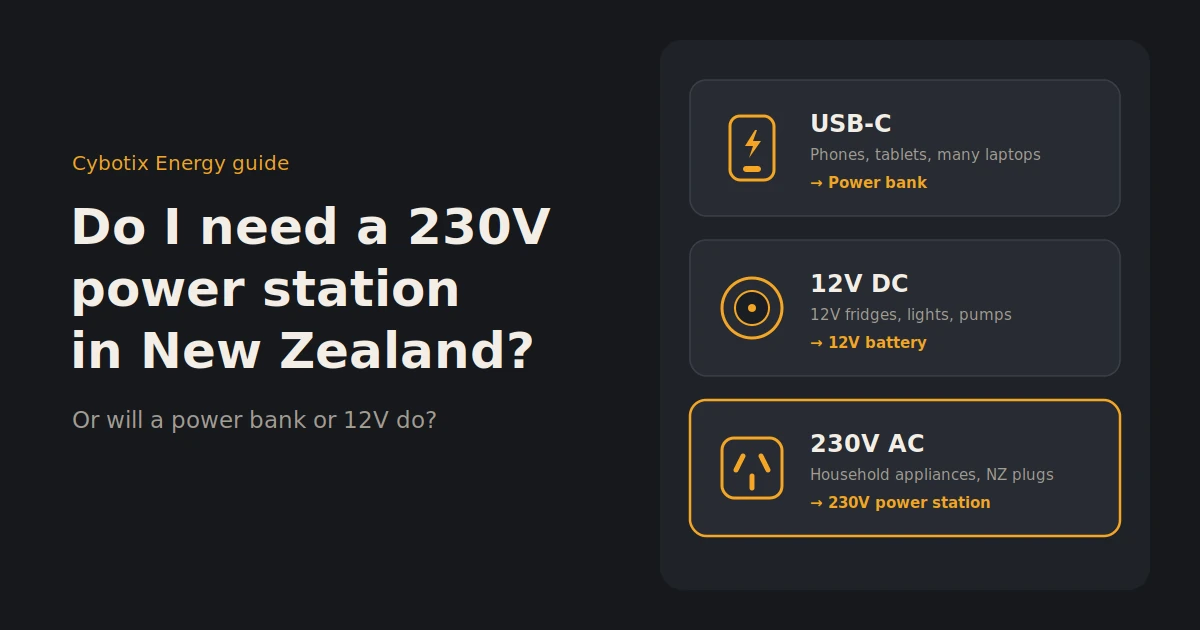
A power station’s outputs fall into three groups. 230V AC sockets run anything with a standard NZ plug. 12V DC outputs run camping and vehicle gear. USB ports charge phones, tablets and, through USB-C, many laptops. Most of what you own falls into one of these.
| Output | Plug type | Typical NZ examples |
|---|---|---|
| 230V AC | Standard NZ three-pin (Type I) | Household fridge-freezer, TV, laptop power brick, microwave, power tools, electric blanket |
| 12V DC | Car-style socket, or DC barrel connectors | 12V camping fridges, 12V lights, some pumps and fans, tyre inflators |
| USB-A and USB-C | USB cable | Phones, tablets, eReaders, cameras, headlamps, many laptops via USB-C |
Some devices can use more than one. A laptop might charge from its 230V power brick or straight from USB-C. A CPAP machine may have an optional 12V DC adapter from its manufacturer. Knowing which options your gear supports is the key to choosing the right setup.
When you need 230V AC
You need 230V AC output when something you want to run only has a standard NZ plug, with no USB or 12V option. That’s most household appliances, so 230V is almost essential for home power-cut backup, and useful for power tools and kitchen gear when you’re away from the grid.
Common reasons NZ buyers need 230V:
- Power-cut backup at home. Your household fridge-freezer, modem’s power pack, lamps, TV and electric blanket all use standard plugs.
- Medical equipment with a mains plug. Many CPAP machines plug into the wall as standard. Some offer a 12V option, so check with your supplier.
- Power tools and chargers. Drills, saws and battery chargers for tool kits usually need 230V.
- Kitchen and comfort appliances. A small blender, rice cooker or electric blanket at the bach, within the power station’s output rating.
- Anything you don’t want to adapt. If you’d rather not buy 12V versions of what you already own, 230V lets you use your existing gear.
High-wattage heating appliances, like kettles and heaters, are a separate question. Many draw more than a mid-size power station can supply, even with 230V sockets.
When you probably don’t need 230V
If your list is mostly phones, laptops, a 12V camping fridge and LED lights, you may not need 230V at all. Modern USB-C charges most laptops directly, and camping gear is often built for 12V. In those cases, a power bank or 12V battery can be lighter, cheaper and more efficient.
Phones, tablets and laptops
USB-C Power Delivery can charge most phones, tablets and many laptops directly, with no 230V power brick needed. Many laptops charge at 65–100W over USB-C, so check the wattage your laptop needs and that your power bank or power station can supply it. The AC70P, for example, has two 100W USB-C ports.
Camping with a 12V fridge
Many camping fridges are designed to run from 12V. A 12V battery, or the 12V car outlet on a power station, runs them directly, without converting to 230V and back.
Lights and small gear
LED camp lights, headlamps, fans and tyre inflators often come in USB or 12V versions that sip power.
Power bank vs 12V battery vs 230V power station
A power bank is the cheapest and lightest, but only charges USB devices. A 12V battery runs camping gear well but usually needs some wiring and lacks NZ sockets. A 230V power station costs the most and weighs more, but runs almost everything from one box.
| USB power bank | 12V lithium battery | 230V power station | |
|---|---|---|---|
| Runs | Phones, tablets, laptops via USB-C | 12V fridges, lights, pumps | 230V appliances, plus USB and 12V |
| NZ three-pin sockets | No | No, unless you add an inverter | Yes |
| Typical capacity | Small | Medium to large | Medium to very large |
| Weight | Pocket to bag-sized | Heavy for its size | From about 10 kg for a 1,000Wh class unit |
| Set-up | None | Often needs cables, fuses and a charger | Plug and play |
| Charging options | USB | Depends on your setup | Wall, solar, car and sometimes generator |
| Best for | Day trips and travel | Permanent van or camper setups | Home backup, baches and mixed gear |
Many people end up with more than one. A power bank lives in the daypack, while a power station covers the campervan and home outages.
Why running DC on DC saves energy
Batteries store DC power. Converting it to 230V AC through an inverter loses some energy as heat, and the inverter also draws a little power just by being switched on. Running USB and 12V devices from DC outputs avoids most of that loss, so your battery lasts longer.
In an independent test of BLUETTI’s AC70, a close sibling of the AC70P, around 93% of the battery’s capacity came out through the USB-C ports and around 87% through the 12V outlet. Converting to 230V AC typically delivers less again, which is why many runtime calculations assume roughly 85% usable.
Practical takeaways, even if you buy a 230V power station:
- Charge laptops from USB-C rather than plugging in their 230V power brick.
- Run a 12V fridge from the 12V outlet instead of through an AC adapter.
- Switch off the AC inverter when nothing needs 230V, to avoid standby losses.
- Use 230V only for what genuinely needs it.
If you do need 230V: what to check
If 230V is on your list, make sure the power station is the NZ/AU version with Type I sockets and 230V output, uses a pure sine wave inverter, and has enough rated and surge watts for your biggest appliance. Then choose a capacity that covers how long you need it to run.
- NZ/AU version. It should have Type I sockets that take NZ plugs and 230V output. US versions run at 120V with US sockets and aren’t designed for NZ.
- Pure sine wave output. This gives clean power for laptops, TVs, fridges and medical equipment.
- Rated and surge watts. Rated output must cover what you’ll run at the same time; surge covers start-up spikes from fridges and motors. The AC70P, for example, is rated at 1,000W.
- Capacity in watt-hours. This decides how long it lasts. A 1,000Wh class unit suits overnight essentials; 2,000Wh or more suits longer outages.
- A good mix of outputs. USB-C and 12V outlets on the same unit let you run DC gear efficiently.
- Local warranty and support from an NZ seller.
Real NZ scenarios
The right answer changes with how you’ll use it. Home backup almost always needs 230V. A day tramp needs only a power bank. A weekend with a 12V fridge can go either way. A bach or a work site usually benefits from a 230V power station with plenty of capacity.
| Scenario | What you’re powering | Do you need 230V? | Suggested setup |
|---|---|---|---|
| Storm power cut at home | Fridge-freezer, modem, lights, phones | Yes | 230V power station, 1,000–2,000Wh or more |
| Day tramp or road trip | Phone, headlamp, camera | No | USB power bank |
| Weekend camping with a 12V fridge | 12V fridge, lights, phones | Not necessarily | 12V battery, or a power station’s 12V and USB outputs |
| Bach without mains power | Lights, TV, laptop, small appliances | Usually | 230V power station plus solar panels |
| Tradie on a job site | Battery tool chargers, lights | Yes | 230V power station with enough rated output |
| CPAP away from home | CPAP machine | It depends | Check whether the machine has a 12V option; otherwise a 230V power station |
If two or more of these describe you, a 230V power station is usually the simplest single answer, because it covers 230V, 12V and USB in one unit.
FAQs
Do I need a 230V power station or will a power bank do?
If you only charge phones, tablets and USB-C laptops, a power bank will usually do. If you want to run anything with a standard NZ plug, such as a fridge-freezer, TV or power tool charger, you need a 230V power station.
Can a power bank run a fridge?
Generally no. Power banks are designed for USB devices and don’t have the capacity or the outputs for a fridge. A 12V camping fridge can run from a 12V battery or a power station’s 12V outlet, and a household fridge needs 230V.
Can I run a 230V appliance from a 12V battery?
Only with an inverter, which converts 12V DC to 230V AC. That adds cost, wiring and energy losses, and permanent installs in vehicles should be done properly. A 230V power station has the inverter built in.
Is a 230V power station worth it for camping?
It is if you want to run 230V gear, like a laptop power brick, electric blanket or small appliances, or if you also want home backup. If your camping gear is all USB and 12V, a 12V battery or the DC outputs on a smaller unit may be enough.
Can I charge my laptop without 230V?
Often, yes. Many laptops charge over USB-C at 65–100W. Check your laptop’s required wattage, and use a power bank or power station with a USB-C port that can supply it.
What’s the difference between 230V and 12V power stations?
A 230V power station has a built-in inverter and NZ sockets, so it runs household appliances, and most also include 12V and USB outputs. A 12V-only battery runs 12V gear directly but can’t power anything with a standard plug.
Buy for what you’ll actually plug in
Start with your gear, not the spec sheet. If everything you own charges over USB or runs on 12V, keep it simple. If you need to run anything with a standard NZ plug, especially for home backup, a 230V power station with USB-C and 12V outputs covers it all in one unit.
Browse BLUETTI power stations with 230V, 12V and USB outputs at Cybotix Energy, with NZD pricing including GST. Not sure whether you need 230V? Send our New Zealand team a list of what you want to run, and we’ll tell you honestly.