Your installer says no consent needed. Your neighbour swears they had to apply for something. A forum thread says it depends on your council, and someone else mentions a form for the lines company you’ve never heard of.
Do You Need Council Consent for Solar Panels in NZ?
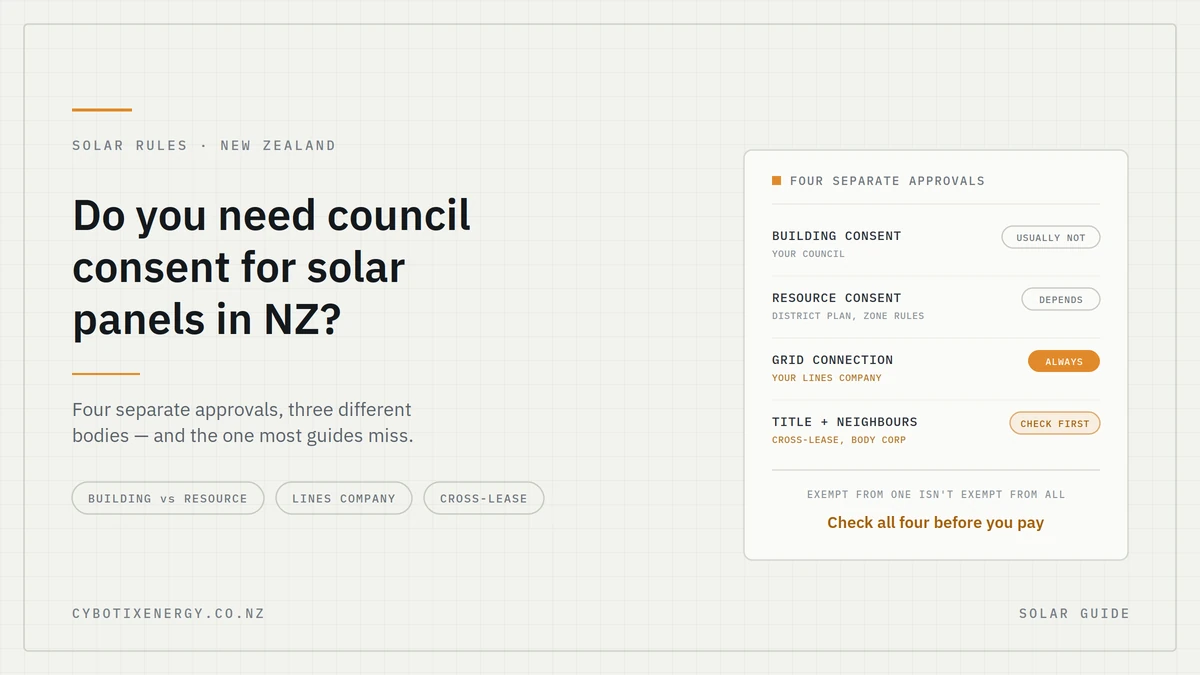
They can all be right at once, because “do you need council consent for solar panels in NZ” isn’t one question. There are up to four separate approvals in play, they’re issued by different organisations under different laws, and most guides only answer one of them. Here’s the full picture, and where the actual traps sit.
The short answer
Most standard roof-mounted residential solar in New Zealand doesn’t require building consent, because it falls under an exemption in the Building Act. But that’s only one of the approvals involved resource consent can apply in some zones, grid connection always needs sign-off from your lines company, and your property title may impose its own requirements.
Exempt from building consent doesn’t mean exempt from everything.
“Council consent” is actually two separate things
People use “consent” as one word, but building consent and resource consent are different systems asking different questions. Building consent asks whether the work is structurally and technically sound. Resource consent asks whether it’s permitted at that location at all.
You can need one without the other. Sorting out which you’re dealing with makes the rest of this straightforward.
| Building consent | Resource consent | |
|---|---|---|
| Governed by | Building Act 2004 | Resource Management Act, via your district plan |
| Decided by | Your council as Building Consent Authority | Your council’s planning function |
| Asks | Is it structurally sound and Code-compliant? | Is this activity allowed here? |
| Typical solar trigger | Structural work, ground-mounted arrays, roof strengthening | Heritage listings, special character areas, height or visibility rules |
| How often it applies to standard rooftop solar | Usually not | Usually not, but depends heavily on your zone |
If an installer tells you “you don’t need consent,” ask which one they mean. A good installer will know the difference immediately.
When roof-mounted solar usually doesn’t need building consent
Standard panels fixed to an existing, structurally adequate roof are generally covered by an exemption in Schedule 1 of the Building Act. That’s why most residential installs proceed without a consent application.
The word doing the work in that sentence is adequate.
What the exemption assumes about your roof
An exemption isn’t a free pass on quality. Exempt work still has to comply with the Building Code the exemption removes the paperwork, not the standard. In practice that means:
- Your existing roof structure can carry the additional load, including wind uplift on the array
- Fixings and penetrations maintain weathertightness
- The installation is done competently and to manufacturer specification
If any of those is in doubt, the exemption isn’t the right path.
When you’re outside the exemption
- Older roofs and lightweight framing, particularly on pre-1980s houses where the structure wasn’t designed with additional load in mind
- Large or heavy arrays relative to the roof they’re going on
- Any strengthening work required to make the roof suitable that work is consentable in its own right
- Unusual mounting arrangements that alter the roof structure
When you probably do need consent
Four situations move you from “generally exempt” to “make the phone call.” None of them is exotic between them they cover a decent share of New Zealand housing.
Ground-mounted arrays
Panels on a frame in the paddock or the back lawn are a structure, not a roof alteration. Depending on size, height and your district plan, ground mounts can require building consent, resource consent, or both. Rural properties with space often assume this is the easy option; it’s frequently the more regulated one.
Heritage and special character areas
Scheduled heritage buildings and special character overlays commonly restrict visible equipment on street-facing roof planes. Auckland, Wellington and Dunedin all have overlays that affect large numbers of ordinary residential properties you don’t need a listed villa to be caught by one.
Sometimes the answer is a rear-facing array rather than no array. Ask early, because it shapes the system design.
Structural work to the roof
If the assessment finds your roof needs strengthening before it can take the load, that strengthening is building work requiring consent. This is one of the more common surprises in older housing stock.
Battery storage, depending on configuration
Where and how a battery is installed can bring its own requirements around placement, enclosure and fire separation. A portable unit sitting on the floor is a different proposition from a wall-mounted system wired into your switchboard.
The approval nobody warns you about: your lines company
Any solar system that connects to the grid needs a distributed generation application approved by your local lines company. This is separate from anything the council does, it applies even when no consent is required, and it is not optional.
This is the step that catches people out, because it isn’t “council” and it isn’t “electrical” it’s a third party most homeowners have never dealt with.
Your lines company depends on where you live: Vector in Auckland, Wellington Electricity, Orion in Christchurch, Powerco, Aurora, Unison and others regionally. Smaller residential systems generally go through a simpler approval pathway than larger ones.
What you need to know practically:
- Your installer normally lodges it on your behalf confirm that in writing rather than assuming
- Your inverter must meet the applicable grid-connection standard, which is why the make and model matter to the network company
- Ask to see the approval before you make final payment
- Connecting without it can lead to a requirement to disconnect
The New Zealand traps that catch more people than the Building Act
Here’s the part almost nobody writes about, and it stops more installs than structural rules do: what your title says, and what your neighbours have to agree to.
Cross-lease titles
Cross-lease is common across Auckland and older suburbs nationwide. Under most cross-lease arrangements, alterations to the exterior of your dwelling require the written consent of the other lessees your neighbours regardless of what the council says.
That consent is a separate legal step. If you’re on cross-lease and your solar quote makes no mention of it, that’s a gap worth raising before you pay a deposit.
Unit titles and apartments
In a unit title development, the roof is typically common property. That means body corporate approval, and often a formal resolution rather than an informal nod. Timeframes depend on when the body corporate meets, which can add months to a project.
Subdivision covenants
Newer developments sometimes carry land covenants restricting roof-mounted equipment, or specifying colour, placement and visibility from the street. These sit as consent notices on your title, not in the district plan, so a council search won’t necessarily surface them.
Read your title. If you can’t find it, your lawyer or a title search will.
Renting
You’ll need written landlord permission, and a conversation about what happens at the end of the tenancy. Most tenants in this position are better served by portable options more on that below.
The electrical side is separate again
All electrical work must be carried out by a licensed electrical worker, who issues the appropriate certification on completion. That’s a legal requirement under electrical safety regulations, independent of any consent question, and it applies whether or not a building consent was needed.
Grid-connected solar wiring is not a DIY job. Beyond the legal position, incorrect work can energise lines that network crews believe are dead. Leave it to someone licensed and keep the certification with your house records a future buyer’s lawyer will ask for it.
The option with no consent question at all: portable and plug-in solar
Portable solar panels and power stations don’t attach to your building and don’t connect to the grid, so they sit outside the consent framework entirely. No building consent, no resource consent, no lines company application, no body corporate resolution.
Be clear about what this is and isn’t. A portable setup won’t offset a whole household’s power bill the way a properly sized rooftop array will the two aren’t substitutes. What it does is deliver usable solar power with no approvals, no installer, no roof penetrations, and it moves house with you.
Genuinely useful if you’re:
- Renting, and a permanent install isn’t on the table
- On a cross-lease or unit title, and waiting on consent that may not come
- On a heritage property where roof-mounted panels are restricted
- Running a bach, sleepout or shed with no grid connection worth wiring
- Testing the idea before committing to a full system
If that’s your situation, the portable solar and power station range at Cybotix Energy is worth a look, with NZD pricing including GST.
A practical checklist before you commit
Run these six checks before you pay a deposit on any rooftop system. Together they take an afternoon and they surface almost every problem that shows up later.
- Check your title type. Freehold, cross-lease or unit title this determines whether you need anyone else’s written consent.
- Read your title for covenants and consent notices, particularly on properties in newer subdivisions.
- Check your council’s district plan for heritage listings or special character overlays covering your address. Most councils have an online property search.
- Confirm structural adequacy in writing, including who assessed it.
- Ask who lodges the lines company application, and get confirmation you’ll see the approval.
- Confirm who issues the electrical certification, and keep a copy with your house documents.
Get all six in writing from your installer. A competent one will answer without hesitation; hesitation is itself an answer.
FAQs
Do I need building consent for solar panels in NZ?
Usually not for standard panels on an existing, structurally adequate roof that work generally falls under a Building Act exemption. Consent is more likely if your roof needs strengthening, if the array is ground-mounted, or if the installation involves structural alteration. Confirm with your council, as interpretation can vary.
Do I need resource consent for solar panels?
Generally no, but it depends on your district plan. Heritage listings, special character overlays and some height or visibility rules can trigger a resource consent requirement even where building consent isn’t needed. Check your property against your council’s planning maps.
Can I install solar panels on a heritage or character home?
Often yes, but with conditions commonly restrictions on visibility from the street, which can mean rear-facing panels only. Ask your council’s planning team early, because the answer changes how the system is designed rather than simply whether it’s allowed.
Do I need council approval for a solar battery?
It depends on how and where it’s installed. Placement, enclosure and wiring can all bring requirements, and a wall-mounted system wired into your switchboard is treated differently from a portable unit sitting on the floor. Check with your council and your installer.
Can I install solar panels myself?
No, not the electrical work. All electrical work must be done by a licensed electrical worker who certifies it on completion. Grid-connected solar also requires a lines company approval that’s normally lodged by a qualified installer.
Do I need permission from my neighbours or body corporate?
On a cross-lease title, usually yes exterior alterations typically require the written consent of the other lessees. On a unit title, body corporate approval is generally required because the roof is common property. On a standard freehold title, neighbours have no say.
What happens if I install solar without the right approvals?
Consequences vary by which approval was missed. Unapproved building work can appear on a LIM report and cause problems when you sell; connecting to the grid without lines company approval can result in a requirement to disconnect. Both are far more expensive to resolve afterwards than to do properly upfront.