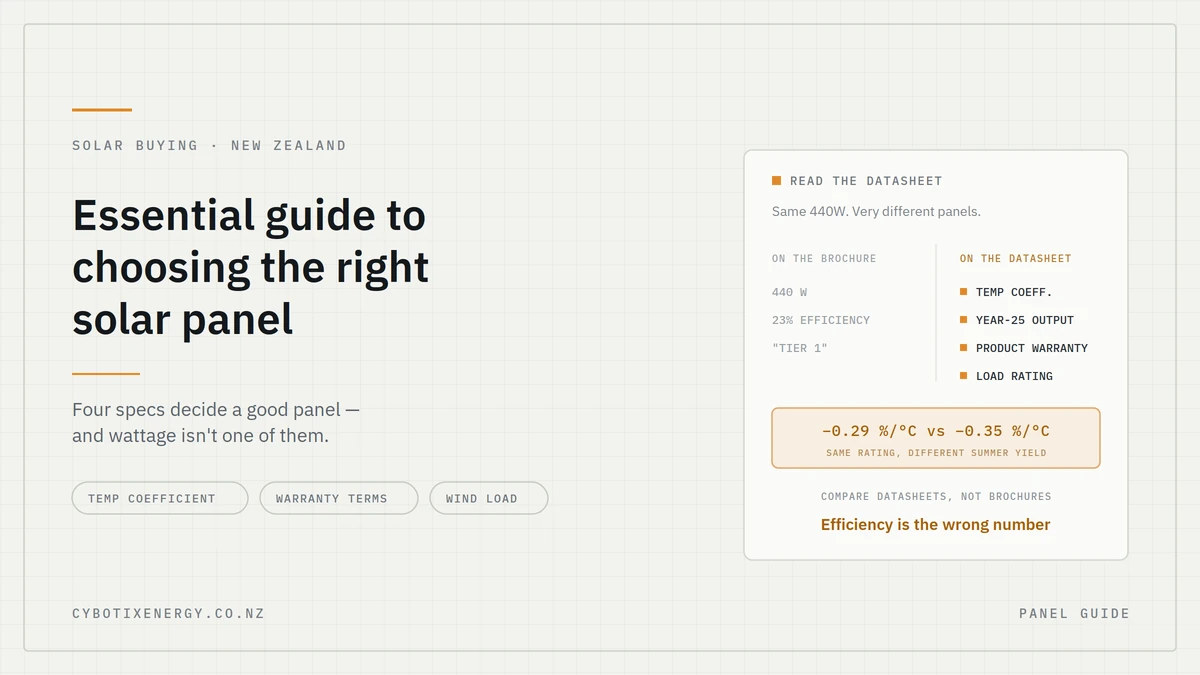
Three quotes on the table. All of them say 440W. The panel brands are different, two of them you’ve never heard of, and the prices are hundreds of dollars apart per panel. Nothing in the paperwork explains why.
How to Choose the Right Solar Panel for Your NZ Home
Choosing the right solar panel for your home comes down to four specifications, and wattage isn’t one of them. The numbers that decide whether you’re happy in year twelve sit further down the datasheet and once you know which ones to read, comparing quotes takes about ten minutes.
The four specs that actually decide a good panel
Temperature coefficient, degradation rate, warranty structure and mechanical load rating. Those four separate a well-built panel from a cheap one. Efficiency matters mainly when your roof space is limited, and wattage tells you what the panel produces in a laboratory rather than on your roof in February.
Get those four right and the rest is detail.
Efficiency: the most over-rated number on the datasheet
Efficiency measures how much power a panel produces per square metre. That’s it. It doesn’t measure quality, longevity or value and two 440W panels produce the same 440W whether one is 21% efficient and the other 23%.
The more efficient panel is simply smaller.
When efficiency genuinely matters
- Small or complex roofs where usable area is the binding constraint
- Roofs broken up by dormers, chimneys, skylights or vents
- Limited north-facing area, and you want maximum capacity on the good plane
- Heritage or character restrictions limiting where panels can go
In those situations, paying for higher efficiency buys you real capacity you couldn’t otherwise fit.
When it doesn’t
If you have plenty of clear roof, efficiency is close to irrelevant. You’ll fit the kW you need either way; the higher-efficiency array just covers less area doing it. Paying a premium for that when roof space isn’t scarce is buying a solution to a problem you don’t have.
Installers lead with efficiency because it’s a single impressive-sounding number. Ask what your usable roof area actually is before you let it drive the decision.
Temperature coefficient: the spec that matters most in a New Zealand summer
Panels are rated at 25°C. On a still, sunny day a roof-mounted panel can reach 60–70°C, and output falls as temperature rises. The temperature coefficient tells you how much you lose per degree which means it decides your real output on exactly the days you generate most.
This is the most under-discussed spec in residential solar.
What the number means in practice
You’ll see something like −0.29%/°C or −0.35%/°C on the datasheet. It’s the percentage of rated output lost for every degree above 25°C.
Take a panel running at 60°C — that’s 35 degrees above test conditions. At −0.35%/°C you’ve lost around 12% of rated output. At −0.29%/°C, closer to 10%. Across an array, across every hot afternoon, across 25 years, that gap compounds into real generation.
A panel with a modest efficiency figure and an excellent temperature coefficient often out-produces the reverse in actual NZ conditions.
Why roof-mounted panels run so hot
Dark roof surfaces absorb heat, and the panel sits in that thermal environment with limited airflow behind it. Mounting standoff the gap between panel and roof affects how much heat escapes. A tight-mounted array on a dark tile roof runs hotter than the same panels on rails with clear airflow.
Worth asking your installer what standoff their mounting system provides. It’s a small design detail with a measurable yield effect.
Cell technology: what’s actually on the market
Monocrystalline is the residential standard now. The meaningful choice today is between established PERC cells and newer N-type technologies, with bifacial as a specialist option.
Monocrystalline vs polycrystalline
Largely a settled question. Polycrystalline panels the blue, speckled ones have been displaced from residential use by monocrystalline, which offers better efficiency and better temperature behaviour at prices that are now comparable.
If a quote offers polycrystalline in 2026, ask why.
PERC vs N-type
PERC has been the mainstream monocrystalline technology for years and remains a sound, well-proven choice. N-type cells TOPCon and similar are the newer generation, generally offering better temperature coefficients, lower annual degradation and less first-year light-induced degradation.
They usually cost more. Whether that premium pays depends on your electricity rate and how long you’ll own the house. For a long-term hold in a hot, sunny location, the better temperature behaviour is a genuine advantage. For a modest system on a budget, PERC is not a compromise you’ll regret.
Bifacial panels
Bifacial modules generate from the rear face as well as the front, picking up reflected light. They’re excellent on ground mounts, over light-coloured surfaces, and in commercial installations with reflective roofing.
On a standard residential roof, mounted close to dark underlay, the rear face sees very little. The premium rarely pays back in that configuration so treat bifacial as a ground-mount option rather than a general upgrade.
| PERC mono | N-type (TOPCon etc.) | Bifacial | |
|---|---|---|---|
| Efficiency | Solid, well-proven | Typically higher | Varies; depends on rear gain |
| Temperature coefficient | Good | Generally better | Similar to base cell type |
| Annual degradation | Standard | Typically lower | Similar to base cell type |
| First-year drop | Slightly higher | Generally lower | Similar |
| Relative cost | Lower | Premium | Premium |
| Best suited to | Most residential roofs | Hot sites, long-term holds | Ground mounts, reflective surfaces |
Degradation and warranty: reading the fine print properly
Every panel comes with two separate warranties, and buyers conflate them constantly. The product warranty covers the physical panel defects in materials and workmanship. The performance warranty guarantees a minimum output over time. They’re different lengths and they mean different things.
An installer saying “25-year warranty” is usually quoting the performance one.
What a performance warranty actually promises
It has three components worth comparing:
- First-year degradation the initial drop, often around 1–2%
- Annual degradation thereafter commonly quoted between roughly 0.25% and 0.55% per year depending on technology
- Guaranteed output at end of term the percentage of original rating still promised at year 25 or 30
That last figure is the honest comparison point. A panel guaranteeing a higher percentage at year 25 is making a stronger claim about its own longevity, and manufacturers don’t offer those numbers casually.
Product warranty length is the real quality signal
Performance warranties cluster around similar numbers because they’re a marketing baseline. Product warranties don’t. A manufacturer backing the physical panel for 15, 20 or 25 years is telling you something about their build confidence and it’s the warranty you’re more likely to actually use.
Who honours it in New Zealand?
The question almost nobody asks. A 25-year warranty is worth precisely as much as the entity honouring it.
Ask your installer directly:
- Is there a New Zealand importer or distributor for this brand?
- Who processes a claim the installer, the distributor, or an overseas office?
- What happens if the installer’s business closes?
- Has this manufacturer been in the NZ market long enough to have a track record here?
Solar manufacturers have exited markets before. A brand with no local presence is a warranty you may have to enforce from 10,000 kilometres away.
The New Zealand conditions your panels have to survive
Our UV levels, wind zones and coastal exposure place demands on panels that buying advice written for Europe or North America simply doesn’t account for.
UV intensity
New Zealand experiences notably high peak UV for its latitude a combination of thinner ozone, clean air with low particulate levels, and the Earth being closest to the sun during our summer. Panels here are exposed to more UV stress than the same panels in comparable northern latitudes.
That matters over decades, not immediately. UV degrades encapsulants, backsheets and frame coatings, and it’s an argument for build quality and materials over headline wattage.
Wind zone and mechanical load
Panels carry front and rear mechanical load ratings, and your site’s wind zone determines what’s adequate. Wellington, exposed Canterbury sites in a nor’wester, and coastal properties anywhere all sit at the demanding end.
This is a safety and warranty issue rather than a performance one an underspecified array in a high wind zone is a liability. Mounting system, rail spacing and fixing count form part of the same calculation, so ask for the wind rating of the system, not just the panel.
Salt spray and coastal corrosion
If you’re within a few kilometres of the sea which describes a large share of New Zealand housing salt mist resistance certification is worth confirming. Frames, fasteners and junction boxes all corrode faster in coastal air, and it’s the mounting hardware that usually fails first.
Hail, snow and temperature range
Rear load ratings matter more for alpine and Central Otago properties, where snow loading is a real design factor. For most of the country this is a lower priority than wind and salt.
Physical fit: the constraints people forget
Panel dimensions and weight affect the design as much as the electrical specs do. Modern panels have grown steadily, and a larger panel can be harder to tile onto a broken-up roof plane without wasting area.
Things worth checking:
- How the panels tile onto your actual roof planes a slightly smaller panel sometimes fits more capacity on an awkward roof
- Weight per square metre on older roofs, particularly where the structure wasn’t designed with an array in mind
- Frame height and mounting compatibility with your installer’s chosen rail system
- Aesthetics all-black panels cost more and generally run slightly hotter than silver-framed equivalents. If appearance matters to you that’s a fair trade, but know you’re buying looks rather than performance.
What “Tier 1” does and doesn’t mean
Tier 1 is a bankability ranking, not a quality grade. It classifies manufacturers whose panels have been used in large projects financed by major banks without third-party guarantees. It says the company is financially substantial. It says nothing directly about how the panel performs on your roof.
That doesn’t make it useless. A financially stable manufacturer is more likely to exist in 20 years to honour a warranty, which matters. But an installer using “Tier 1” as shorthand for “high quality” is using it wrong, and it’s worth knowing that when you hear it.
Look at the datasheet instead. It tells you far more.
How to compare two quotes on panels alone
Do this before you compare price, not after.
- Get the exact make and model number for each quote. “High-efficiency panels” is not an answer.
- Download both datasheets from the manufacturer’s website, not the installer’s brochure.
- Compare temperature coefficient. Lower absolute value is better.
- Compare guaranteed output at year 25, not just the warranty length.
- Compare product warranty length — the physical panel, not the performance guarantee.
- Check mechanical load rating against your wind zone.
- Ask who handles a warranty claim in New Zealand.
- Then look at the price, knowing what the difference actually buys.
Sometimes the cheaper panel is the right call. This process tells you when.
A note on what we supply
Being straight about it: Cybotix Energy supplies LONGi panels, so we have a commercial interest here. The criteria above are brand-agnostic on purpose apply them and you might reasonably land somewhere else, and that’s a fine outcome.
What we’d rather you didn’t do is choose on wattage and price alone, because that’s how people end up with an array they’re unhappy with in year ten. If you want a second opinion on specific models, get in touch with the make and model from your quotes.
If your question is really how many panels rather than which ones, our guide to sizing a solar system for a New Zealand home covers that separately.
FAQs
What’s the best solar panel for a New Zealand home?
There isn’t a single best panel it depends on your roof area, wind zone, coastal exposure and budget. For most homes, prioritise a low temperature coefficient, a strong year-25 output guarantee, a long product warranty, and a brand with genuine New Zealand warranty support.
Does panel efficiency really matter?
Only when roof space is limited. Efficiency determines how much area a given wattage occupies, not how much power you get. With plenty of clear roof, a lower-efficiency panel produces exactly the same output it just takes more space.
What’s the difference between product and performance warranty?
The product warranty covers the physical panel against defects. The performance warranty guarantees a minimum output percentage over time. They’re often different lengths, and when an installer says “25-year warranty” they usually mean the performance one.
Are N-type panels worth the extra cost?
Often, for hot sites and long-term ownership, because of better temperature behaviour and lower degradation. For a modest system on a tight budget, quality PERC panels remain a sound choice. Compare the year-25 guarantee on both and see what the premium actually buys.
How long do solar panels last in New Zealand?
Panels are typically warranted for 25 to 30 years of performance and often keep producing beyond that with gradual decline. In practice, mounting hardware in coastal areas and the inverter usually need attention well before the panels do.
What does Tier 1 mean for solar panels?
It’s a bankability ranking about a manufacturer’s financial stability and use in bank-financed projects not a quality or performance certification. It’s useful as a rough signal that the company will still exist to honour a warranty, and not much more.
Do I need special panels if I live near the coast?
Confirm salt mist resistance certification for both the panels and the mounting hardware. Corrosion typically attacks frames, fasteners and junction boxes before it affects the cells, so the mounting system matters as much as the panel choice.