Two browser tabs open. One is an installer’s quote for a wall-mounted battery system with a five-figure number at the bottom. The other is a portable power station at around two thousand dollars. Both pages say “home backup.” Neither explains why they’re twenty thousand dollars apart.
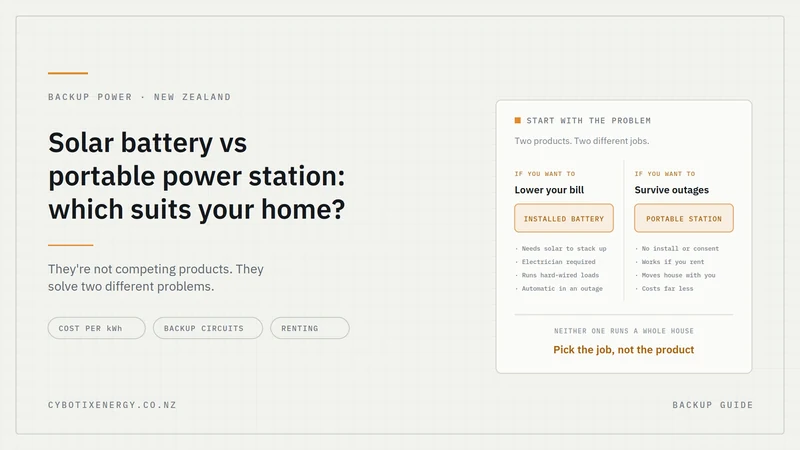
The reason is that the solar battery vs portable power station comparison isn’t really a comparison at all. They solve different problems. One is mostly a bill product that happens to do backup; the other is purely a backup product that does nothing for your bill. Work out which problem you have and the decision resolves itself quickly.
The short answer: what problem are you actually solving?
If you want to reduce your power bill and you have solar, an installed battery is the product. If you want the fridge, the internet and some lights running through an outage, a portable power station does that for a fraction of the price with no installation at all.
Most people asking this question want the second thing and are being quoted for the first.
They’re not the same category
Both are lithium batteries with inverters attached. That’s where the similarity ends. The difference is whether it’s wired into your house, and what it’s optimised to do.
What an installed solar battery does
It’s wired into your switchboard by an electrician. It stores energy from your solar panels, or from the grid during cheaper periods and discharges it automatically when you need it. During an outage, it powers a designated set of backup circuits without you doing anything.
It runs continuously, in the background, as part of your home’s electrical system.
What a portable power station does
It’s an appliance. You plug things into it. It charges from a wall socket or from solar panels, and it powers whatever you connect to it, wherever you put it.
No wiring, no electrician, no consent, no switchboard work. Also no automatic operation, and no meaningful effect on your power bill.
Why the confusion exists
Both categories market themselves as “home backup,” and both quote capacity in kilowatt-hours. The words look interchangeable. But an installed battery is designed to shift energy through the day and lower a bill, with backup as a feature while a portable station exists almost entirely for the hours when the power is out.
The comparison that actually matters
Set the marketing aside and compare them on the things that change your decision.
| Installed home battery | Portable power station | |
|---|---|---|
| Upfront cost | High — often five figures installed | From around $1,000 to $5,000 |
| Cost per usable kWh | Lower at larger capacities | Higher, but no install cost |
| Installation | Registered electrician, switchboard work | None — plug it in |
| Consent implications | Possible, depending on placement | None |
| Outage behaviour | Automatic on backup circuits | Manual, unless UPS-capable |
| What it powers | Designated circuits, including hard-wired items | Anything you plug into it |
| Expandable | Usually, within the system’s limits | Yes, on modular units |
| Portable | No | Yes — bach, van, worksite |
| Suits renters | No | Yes |
| Reduces your power bill | Yes, especially with solar | Not meaningfully |
| Moves house with you | No | Yes |
Cost: where each one wins
Installed batteries generally cost less per usable kilowatt-hour once you’re buying significant capacity. Portable units cost more per kWh but carry no installation cost at all so at small capacities they’re often cheaper overall, and the crossover happens as your capacity requirement grows.
Knowing roughly where that crossover sits is the whole cost argument.
What you’re paying for with an installed system
- The battery itself
- A hybrid or battery inverter
- Electrical work by a registered electrician
- Backup circuit configuration at the switchboard
- Sometimes switchboard upgrades, enclosure work or a new sub-board
The hardware is only part of it. On some quotes, installation is a substantial share of the total.
What you’re paying for with portable
The unit. That’s the list.
No install, no electrician, no consent application, no waiting for a booking. You order it, it arrives, you charge it, it works.
The bill-reduction question
Here’s where honesty matters more than enthusiasm.
With solar, an installed battery has a real case. You store what your panels generate during the day and use it in the evening instead of buying it back at retail rates. That’s genuine self-consumption, and it’s the scenario batteries were designed for.
Without solar, an installed battery is arbitraging time-of-use pricing charging when power is cheap, discharging when it’s expensive. That can work depending on your plan and your usage pattern, but the margin is thinner and the payback period is long. Anyone presenting it as an obvious saving is skipping the arithmetic.
A portable power station doesn’t reduce your bill at all. It’s an outage product. If bill reduction is your goal, this isn’t the category and we’d rather say that than sell you one for the wrong reason.
What each one can actually run
Neither backs up your entire house. That’s the expectation gap that surprises people, particularly those paying the most.
An installed system powers a designated set of backup circuits chosen at installation typically lighting, the fridge, some power points, maybe the internet. Not the whole switchboard. A portable unit powers whatever you plug into it, which means anything with a plug and nothing without one.
The loads both struggle with
Anything that makes heat empties any battery quickly:
- Electric hot water cylinders — around 3kW, continuous
- Whole-home heating — heat pumps are efficient but still substantial over hours
- Ovens, elements, kettles — brief but heavy
- Clothes dryers
This isn’t a limitation of one product or one brand. It’s the physics of storing energy in a box, and it applies at both ends of the price range.
Where installed systems pull ahead
Two genuine advantages. Capacity you can install considerably more than you’d sensibly carry. And hard-wired loads a heat pump, a bore pump, hard-wired lighting. You can’t plug those into a portable unit, and for rural properties that pump is often the whole reason for buying backup.
If your question is how many kilowatt-hours you actually need, our guide to sizing home battery backup covers the maths separately.
The outage experience: automatic vs manual
An installed system with backup circuits switches over on its own, often quickly enough that you notice the lights flicker rather than go out. A portable unit generally needs you to plug things into it unless it’s a model with UPS-style switchover on connected loads.
That difference matters more than the spec sheets suggest.
Why it matters at 2am
A freezer that quietly defrosts overnight because nobody heard the power go off. A home office where a dropped connection costs a morning’s work. A medical device you’d rather not think about.
Automatic operation is worth paying for in proportion to how much you don’t want to think about it.
Where portable has closed the gap
Some portable units offer very fast switchover for devices plugged into them, so a router, modem and computer stay running through a cut without interruption. It’s genuinely useful and worth being precise about what it covers: the things plugged into that unit, not the house.
Set it up in advance with your router and modem connected, and you’ve solved the most annoying part of a short outage for a few hundred dollars.
Installation, consent and the rental question
An installed battery is prescribed electrical work requiring a registered electrician, and depending on placement and enclosure it can bring consent considerations. A portable power station requires nothing you take it out of the box and use it.
What’s involved in installing a home battery
A registered electrician, switchboard work, backup circuit configuration, and a discussion about where the unit physically goes garages get cold in winter, and batteries have operating temperature ranges. Depending on the installation, there may be consent implications, which we cover in our guide to solar and battery consents.
Budget time as well as money. Installation involves a booking, an inspection, and paperwork you’ll want to keep.
If you rent
Roughly a third of New Zealand households rent, and for renters the answer is simple: portable, without qualification. You can’t install a fixed battery in a house you don’t own, most landlords won’t fund one, and if they did it wouldn’t move with you.
A portable power station goes in the car when you shift flats. It’s not a compromise for a renter it’s the only sensible option, and it does the outage job perfectly well.
If you’re planning to move
An installed battery stays with the house. Whether it adds a corresponding amount to your sale price is genuinely uncertain the market for battery-equipped homes in New Zealand is still young.
A portable unit is an asset you keep, and one that’s still useful at the next place.
Three scenarios, three answers
You have solar and want to use more of it yourself. Installed battery. This is the case where the economics genuinely work: store daytime generation, use it in the evening, buy less at retail rates. Portable units can’t do this in any meaningful way.
You want the fridge, internet and lights through a two-day storm outage. Portable. You’ll spend a fraction of the price for essentially the same practical outcome, and you can take it to the bach. Buying a fixed system purely for outage cover is expensive for what you get.
You’re rural with a bore pump and frequent multi-day outages. Probably installed — and this is the case where we’d steer you away from what we sell most of. Your pump is hard-wired, its startup surge is significant, and multi-day outages need capacity that gets awkward to carry. A hybrid system with solar is likely the better answer.
[PLACEHOLDER: a real customer example — what they chose, why, and whether it met expectations six months later. One anonymised case would be more evidence than anything else ranking on this query.]
The sequencing option nobody mentions
Buying a portable unit now doesn’t rule out an installed system later. For a lot of households, that’s the sensible order.
Solve the outage problem cheaply this winter. Watch what you actually use and which loads you genuinely miss. Then decide, with real information, whether a fixed system is worth the spend — and if you add solar in the meantime, the case for a battery gets considerably stronger.
The portable unit doesn’t become redundant either. It keeps earning its place at the bach, on trips, on worksites, and as the thing you lend a neighbour when their power’s out and yours isn’t.
Pros and cons at a glance
Installed home battery
For: Automatic operation, larger capacity, powers hard-wired loads, genuinely reduces bills with solar, no thinking required during an outage.
Against: High upfront cost, electrician and possible consent, fixed to the property, long payback without solar, still only covers designated circuits.
Portable power station
For: No installation, no consent, immediate use, portable, suits renters, moves house with you, far cheaper for outage cover.
Against: Higher cost per kWh, manual operation unless UPS-capable, can’t power hard-wired items, limited capacity, no bill reduction.
FAQs
Is a home battery worth it in New Zealand?
With solar, often yes you store daytime generation and use it in the evening instead of buying at retail rates. Without solar, the case rests on time-of-use arbitrage and the payback is considerably longer. Run the numbers against your own plan rather than a national average.
Can a portable power station run my whole house?
No, and neither does an installed battery those back up selected circuits, not everything. A portable unit powers what you plug into it, which for most households means the fridge, internet, lights and devices. Heating and hot water are out of reach for both.
Do I need an electrician for a portable power station?
No. You plug appliances directly into it. You only need a registered electrician if you want backup wired into your home’s circuits, which is a different product and a different job.
Which is cheaper, a home battery or a portable power station?
Portable is far cheaper upfront and has no installation cost. Installed systems generally cost less per usable kilowatt-hour at larger capacities. For outage cover alone, portable usually wins; for capacity and bill reduction, installed pulls ahead.
Can I use a portable power station if I rent?
Yes, and it’s the practical option for renters. Nothing is attached to the property, no permission is needed, and it comes with you when you move.
Will a battery pay for itself without solar panels?
It can, but slowly, and it depends heavily on your electricity plan and usage pattern. Without solar you’re only shifting when you buy power, not replacing it. Treat any confident payback claim with caution and check the assumptions.
Can I add a home battery later if I buy portable now?
Yes. They’re independent purchases, and buying portable first is a reasonable way to solve the immediate problem while you work out whether a fixed system is justified. The portable unit stays useful afterwards.