The panels went on the roof in October. The first bill arrived and it had dropped by about a third. Not nothing, but not what the sales conversation implied either.
That gap is almost never about the appliances. Working out what home appliances you can run with solar power in New Zealand isn’t really a question about wattage solar can run practically anything in your house. It’s a question about timing. Your panels produce most of their power in the middle of the day, and most households use most of theirs at breakfast and dinner. Close that gap and the savings follow.
What Appliances Can You Run With Solar Power
The short answer
Solar can power essentially any household appliance, from a phone charger to an oven. The constraint isn’t the appliance it’s whether it’s running when the sun is up. Without a battery, anything you use after dark comes from the grid regardless of how many panels you have.
The timing problem nobody explains before you buy
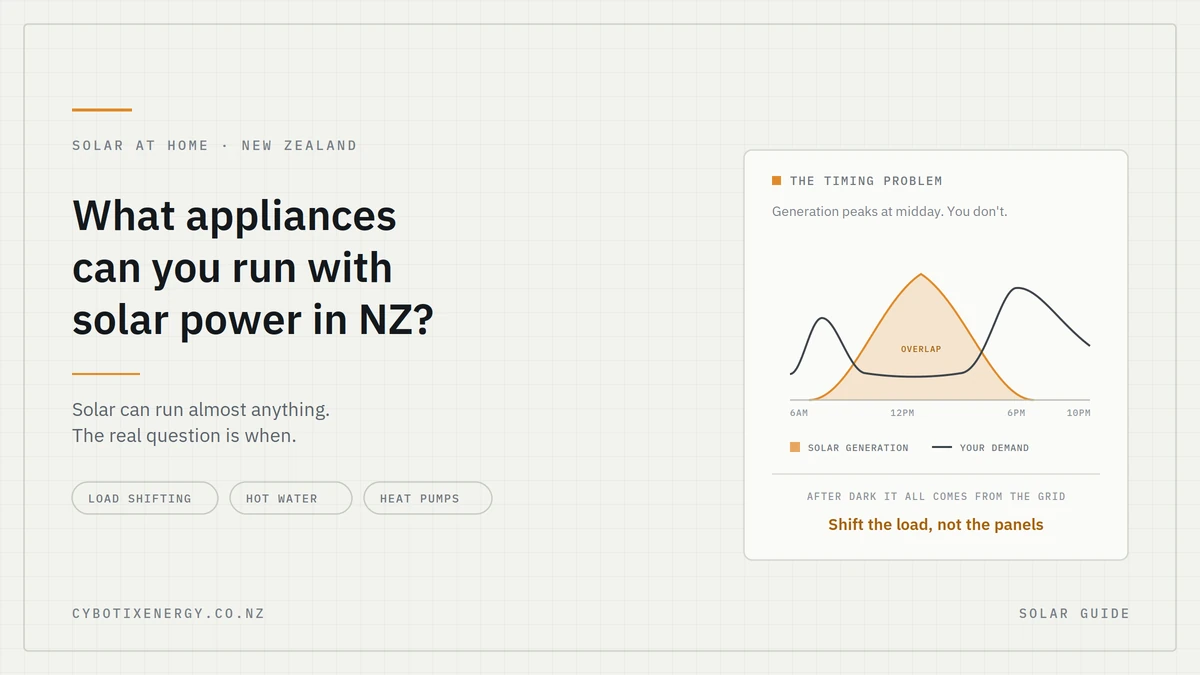
Solar generation follows a bell curve peaking around midday. Household demand follows a different shape entirely a morning spike, a daytime trough while everyone’s out, then a large evening peak. Those two curves barely overlap in a typical home.
Understanding that mismatch is the difference between being pleased with your system and being disappointed by it.
When your panels produce
Output climbs from sunrise, peaks around solar noon, and falls away toward sunset. Season matters enormously in New Zealand: shorter days, a lower sun angle and more cloud mean winter production is a fraction of summer.
Orientation and shading shape the curve too. A north-facing array peaks sharply at midday; east-west arrays produce a flatter curve that catches more of the morning and evening which, given the timing problem, is sometimes the better trade.
When your house actually uses power
A typical New Zealand household looks like this: a spike from about 6.30 to 8.30am as showers, kettles and toasters fire up. Then a long trough while people are at work and school. Then the big one roughly 5pm to 9pm, with cooking, heating, hot water recovery, laundry, TV and lighting all at once.
The evening peak is usually the largest, and it starts as your generation is falling away.
What that means without a battery
Anything running after dark comes from the grid. Full stop, regardless of array size.
That’s the sentence worth understanding before you sign a quote. A bigger array doesn’t move generation into the evening it just exports more surplus at midday, which under most retailer buy-back rates earns you considerably less than what you pay to import it back at 7pm.
Appliances that suit solar well
The best candidates are anything you can control the timing of, plus the background loads that run continuously. Both are already aligned with when your panels produce, or can be made to be.
Anything you can time-shift
This is where the free wins are:
- Dishwasher — almost every model has a delay start
- Washing machine — same, and a midday cycle also dries better outside
- Clothes dryer — heavy load, but a daytime one is a solar load
- Hot water cylinder — the single biggest opportunity in most homes
- Pool pump — no reason at all for it to run at night
- EV charging — if the car is home during the day
None of that requires new hardware. It requires using the delay timers you already have.
Always-on background loads
Fridge, freezer, router, modem, standby devices. Individually small, but collectively they run 24 hours a day, and a decent share of that consumption happens during daylight.
A fridge-freezer typically uses somewhere around 1kWh a day because the compressor cycles rather than running constantly. Roughly half of that falls in daylight hours covered by your panels without you doing anything.
Households that do best
Solar economics are strongest for households that are home during the day: retirees, shift workers, people working from home, and families with young children. If someone’s there at 1pm, the generation gets used instead of exported.
If the house is empty from 8am to 6pm every weekday, your self-consumption will be lower which is exactly the case where load shifting and storage matter most.
The appliance-by-appliance table
Figures below are typical ranges. Check your own rating plates, because draw varies substantially between models.
| Appliance | Typical draw | Daily use (approx.) | Solar-friendly? | Notes |
|---|---|---|---|---|
| Fridge-freezer | 100–200W cycling | ~1kWh | Yes | Runs continuously, partly on solar automatically |
| Chest freezer | 80–150W cycling | 0.6–1kWh | Yes | Same as above |
| Wi-Fi router and modem | 15–25W | ~0.4kWh | Yes | Small but constant |
| Washing machine | 500–2,000W | 0.5–1kWh per load | Yes, if timed | Use the delay start |
| Dishwasher | 1,200–1,800W | 1–1.5kWh per load | Yes, if timed | Delay start |
| Clothes dryer | 2,000–3,000W | 2–4kWh per load | Only midday | Heavy; line-dry when you can |
| Heat pump | 500–1,500W | Varies widely | Yes | Efficient — see below |
| Plug-in resistive heater | 1,500–2,400W | Very high | Poor | Inefficient use of stored energy |
| Electric hot water cylinder | ~3,000W | 4–8kWh | Yes, if timed | Biggest single opportunity |
| Oven | 2,000–3,000W | 1–2kWh per use | Lunch yes, dinner no | Brief but heavy |
| Induction hob | 1,500–3,500W | Varies | Lunch yes, dinner no | Same |
| Kettle | 2,000–2,400W | ~0.3kWh | Neutral | Short bursts, minor either way |
| Microwave | 800–1,500W | Low | Yes | Brief use |
| TV | 60–150W | 0.3–0.8kWh | Evening — grid | Modest but evening-heavy |
| Computers | 50–300W | Varies | Yes if daytime | Ideal for home workers |
| Pool pump | 750–1,500W | 3–8kWh | Yes | Run it midday, always |
| EV charging | 1,800–7,000W+ | 5–30kWh | Yes if home in daylight | Large, controllable load |
The big three: hot water, heating and cooking
These three dominate a New Zealand power bill, and each responds to solar differently. Getting them right matters more than everything else on the list combined.
Hot water: the biggest opportunity
For most NZ homes with an electric cylinder, hot water is the single largest load on the bill. It’s also the easiest to shift, because a hot water cylinder is a thermal battery you already own it stores energy as heat and holds it for hours.
The standard setup heats overnight or on demand. Shifting that heating cycle into the middle of the day means it runs on your own generation instead of imported power. A simple timer is enough for many households; a solar diverter, which sends surplus generation to the element rather than exporting it, is more precise.
If you’re replacing a cylinder anyway, heat pump hot water uses considerably less electricity for the same result worth pricing.
Heating: heat pumps yes, resistive no
This is the distinction that surprises people. A heat pump doesn’t create heat; it moves it from outside to inside, which is why it delivers several units of heat for each unit of electricity consumed. A plug-in resistive heater converts electricity to heat one-for-one.
That efficiency difference is why a heat pump is a reasonable solar load and a plug-in heater isn’t. Running a 2,400W heater through a winter evening will consume more energy than a modest array produces on a good winter day and it’ll be doing it after dark anyway.
Practical tactic: use the heat pump to warm the house during the afternoon while you’re still generating, so you need less heating during the evening peak. Thermal mass in the building does the rest.
Cooking: brief but heavy
Ovens, elements and kettles draw a lot for short periods. That’s manageable on solar at lunchtime and effectively impossible at 6.30pm without storage.
Batch cooking at the weekend, or preparing dinner components at lunchtime, genuinely helps if you’re inclined that way. Most people won’t rearrange their lives around it and that’s fine, because cooking is a smaller share of the bill than hot water or heating.
What solar struggles with
Being straightforward about the limits:
- Evening-heavy loads without a battery. Cooking dinner, heating the lounge, drying clothes at 8pm all grid power.
- Resistive heating through winter. High demand, low generation, at the same time of year.
- Overnight anything. Obviously, but worth stating.
Winter is the real test
Everything works against you at once: shorter days, a lower sun angle, more cloud, and higher household demand for heating and hot water. A system sized on summer figures will disappoint in July.
Our guide to sizing a solar system for a New Zealand home covers how to account for that properly.
The whole-house misconception
Solar reduces what you buy from the grid. It doesn’t disconnect you from it not unless you’ve built a genuine off-grid system with substantial storage, which is a different project at a different price.
A well-sized grid-connected system with sensible load shifting typically covers a meaningful share of a household’s consumption. It doesn’t cover all of it, and anyone implying otherwise is overselling.
How to actually shift your load into daylight
None of this requires buying anything. Work through it over a weekend.
- Set the dishwasher’s delay start to run around midday rather than after dinner.
- Do the same with the washing machine. Bonus: things dry better outside during the day.
- Put a timer on the hot water cylinder so it heats in the early afternoon. This is the highest-value change on the list for most homes.
- Move the pool pump to daylight hours if you have one.
- Charge everything during the day — laptops, tool batteries, the EV if it’s home.
- Pre-heat or pre-cool the house in the afternoon so the evening needs less.
- Line-dry when you can, and run the dryer at midday when you can’t.
- Check your monitoring app after a fortnight and see what changed.
Where a battery changes the answer
A battery stores daytime generation and releases it in the evening, which is when most households use most of their power. It changes the question from “what can I run at midday” to “what can I run at 7pm.”
That’s the fix for the timing problem, and it’s why hybrid systems suit New Zealand homes better than pure grid-tie arrays. It also adds cost, and the payback depends on your electricity rate, your usage pattern and how much of your generation you’re currently exporting.
Our guides to sizing home battery backup and choosing between an installed battery and a portable power station cover that decision in detail.
A realistic day in a solar-powered NZ home
A three-bedroom house in spring, north-facing 6kW array, no battery, someone home during the day:
- 7.00am — Kettle, toaster, showers, lights. Generation minimal. Mostly grid.
- 9.00am — Generation climbing. Fridge, router, laptop. Solar covering the background load.
- 11.00am — Washing machine on delay start finishes its cycle. Solar.
- 12.30pm — Peak generation. Dishwasher running, laptop, fridge cycling. Solar, with surplus exporting.
- 1.30pm — Hot water cylinder timer kicks in for its heating cycle. Solar, using surplus that would otherwise export.
- 3.00pm — Heat pump on to warm the house before evening. Solar.
- 5.30pm — Generation falling. Cooking starts. Mix, tipping toward grid.
- 7.00pm — Oven, lights, TV, heating. Grid.
- 10.00pm — Fridge, standby loads. Grid.
The shifts at 11am, 12.30pm, 1.30pm and 3pm are the ones doing the work and all four are free.
FAQs
Can solar power run my whole house in New Zealand?
It can run any individual appliance, but running your entire household consumption solely on solar requires substantial storage and generation an off-grid system rather than a typical rooftop install. A grid-connected system reduces what you buy rather than eliminating it.
Will solar run my heat pump?
Yes, and heat pumps are among the better solar loads because they move heat rather than generating it, using far less electricity than a resistive heater for the same warmth. Running it during the afternoon while you’re still generating is the efficient approach.
Can I heat my hot water with solar power?
Yes, and it’s usually the highest-value change you can make. Shifting the cylinder’s heating cycle into the middle of the day with a timer, or fitting a solar diverter, uses your own generation instead of imported power.
How many panels do I need to run a washing machine?
A washing machine uses roughly 0.5–1kWh per load, so a modest array covers it comfortably during daylight. The important part isn’t panel count it’s using the delay timer so the cycle runs at midday rather than after dinner.
Can solar power run an oven or induction hob?
At lunchtime, yes. At 6.30pm, not without a battery. Both draw heavily for short periods, which a decent array handles during peak generation but can’t supply after dark.
Does solar work in winter in New Zealand?
Yes, but at substantially reduced output shorter days, a lower sun angle and more cloud all reduce generation exactly when household demand rises. Size your expectations on winter figures rather than summer ones.
Do I need a battery to use solar for evening appliances?
Effectively, yes. Without storage, anything running after dark draws from the grid. A battery shifts daytime generation into the evening peak, which is when most households use most of their power.