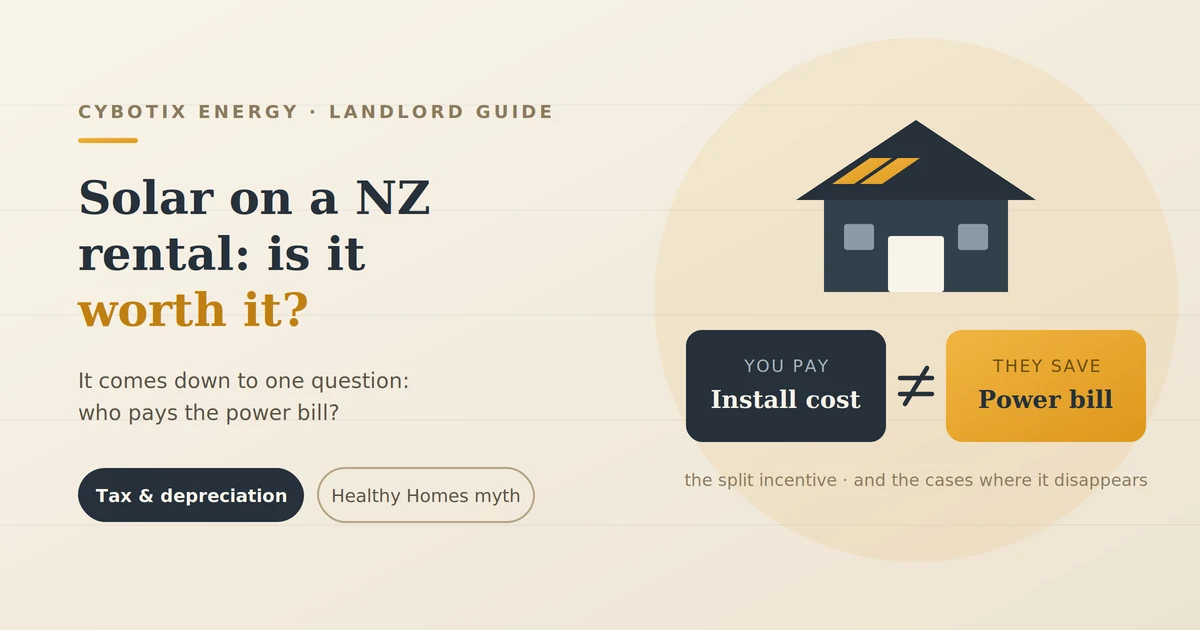
You pay for the panels. Your tenant gets the cheaper power bill.
That’s the awkward arithmetic sitting under every conversation about solar panels for rental properties in NZ, and it’s why the honest answer isn’t a straight yes. It’s a different answer depending on one question: who pays the power bill at that property?
Solar Panels for Rental Properties NZ
Get that clear and the rest follows quickly. Here’s the framework, the tax treatment, and the cases where it genuinely stacks up.
Is solar worth it on a New Zealand rental property?
It depends almost entirely on who receives the savings. Where you pay the power student flats, all-inclusive tenancies, short-stay accommodation the case can be strong. In a standard long-term tenancy where the tenant pays their own bill, the financial case on generation savings alone is weak.
That doesn’t make it a bad decision. It makes it a different kind of decision a property improvement and positioning play rather than an energy investment. Judge it on the right basis and you’ll be far less disappointed.
The split incentive: the problem at the centre of this
In an owner-occupied home, solar is clean. You buy the panels, you use the power, you keep the savings. Cost and benefit sit with the same person.
A rental breaks that link. You fund a system that reduces someone else’s outgoings. Economists call this the split incentive, and it’s the main reason solar is far less common on rentals than on owner-occupied homes despite the roofs being identical.
It’s worth naming plainly because most solar marketing aimed at landlords quietly ignores it. Any payback figure calculated from power-bill savings assumes those savings come to you. On a standard tenancy, they don’t.
No, Healthy Homes doesn’t require solar
This comes up constantly, so let’s settle it. The Healthy Homes Standards cover heating, insulation, ventilation, moisture ingress and drainage, and draught-stopping. Electricity generation isn’t in them. There’s no solar requirement for rentals, and nothing currently signalling one is coming.
If someone selling you a system implies otherwise, that’s a reason to be more careful about everything else they tell you.
Who it actually works for
Sort by who banks the savings and the picture clarifies immediately:
| Tenancy type | Who banks the savings | Strength of case | The catch |
|---|---|---|---|
| Standard long-term tenancy | Tenant | Weak on generation alone | You fund savings you don’t receive |
| Power included in rent | Landlord | Strong | You carry consumption risk |
| Student / room-by-room flat | Landlord (usually) | Strong | High, unpredictable daytime use |
| Short-stay / Airbnb | Landlord | Strongest | GST threshold changes the whole picture |
| Commercial or mixed-use | Landlord or tenant | Depends on lease | Lease terms decide everything |
When the landlord pays the power the strong case
If power is included in the rent, the split incentive disappears. You’re back to the owner-occupier situation: you fund the system, you receive the savings, and every kilowatt-hour generated is money you don’t spend.
Short-stay and holiday accommodation is the strongest version of this. Occupancy peaks in summer, which is exactly when generation peaks the seasonal curves line up rather than fighting each other. Guests also use power during the day, so self-consumption is high and you export less at low buy-back rates.
Student flats and room-by-room tenancies where power is bundled also work, with one caveat: you’re now carrying consumption risk. If the household runs heaters with the windows open, solar reduces a bill that’s larger than it should be rather than fixing the underlying problem.
Standard long-term tenancies the honest assessment
If your tenant pays their own power, don’t build the business case on generation savings. They aren’t yours.
What you’re actually buying is a more attractive property with lower running costs, some depreciation benefit, and a contribution to capital value. Those are real. They’re just slower and harder to quantify than a payback calculation, and they won’t produce the numbers a solar quote shows you.
How the tax treatment actually works
Solar on a rental is a capital improvement, not a deductible repair. You can’t deduct the install cost in the year you spend it. You can depreciate the system against rental income over time, which is a meaningful benefit but a slower one than most people expect.
This section is general information, not tax advice. Rates and rules here have changed repeatedly in recent years, and the classification of your specific install is a question for a chartered accountant.
Why you can’t deduct the cost in year one
A new system is an improvement to the property, so the expenditure is capitalised and depreciated rather than written off immediately. Getting this wrong on your first return is a common error.
EECA’s published commercial-scale modelling cites a 16% diminishing value rate based on a 10-year asset life, with a straight-line equivalent around 10.5%. Your accountant or a registered chattels valuer will confirm the right rate for your install.
A chattels or plant valuation at install time typically costs a few hundred dollars, and that cost is itself deductible. It locks in a defensible depreciation position rather than leaving your accountant to estimate.
Note also that residential rental losses are ring-fenced. If the property already runs at a loss, additional depreciation increases that loss and carries forward rather than offsetting other income now.
The GST trap
Standard residential rental income is GST-exempt, so most landlords aren’t GST-registered which means you can’t claim back the 15% GST on the install. A $14,000 system costs you $14,000, full stop.
Short-stay accommodation flips this. Once turnover crosses the GST registration threshold, the picture changes materially. If you’re running an Airbnb at volume, this is worth modelling properly before you buy.
Interest on borrowed funds
If you finance the install, interest on that borrowing is deductible against rental income under the current rules, which strengthens the case for funding it from debt rather than cash. Confirm the current position with your accountant this is precisely the rule that has moved most in recent years.
Ways around the split incentive
None of these are perfect. All are worth knowing:
Rent reflecting lower running costs. A property with lower power bills can support a higher rent. But you can’t increase rent arbitrarily or immediately the Residential Tenancies Act limits increases to once every 12 months, with notice. This works at re-letting more cleanly than mid-tenancy.
- Pros: recovers some value, straightforward
- Cons: constrained by the market, slow, limited by law
Include power in the rent. Removes the split incentive entirely and makes the property simpler to let.
- Pros: you receive every kilowatt-hour of benefit
- Cons: you carry consumption risk with no control over usage
Third-party ownership. A provider owns the system and sells power to the occupant, removing your capital cost.
- Pros: no upfront spend
- Cons: uncommon in New Zealand residential, and the contract terms need reading carefully
Treat it as a property improvement. Judge it on letting speed, tenant quality, vacancy reduction and capital value rather than as an energy project.
- Pros: an honest framing that matches what you actually receive
- Cons: hard to quantify, doesn’t produce a neat payback number
What landlords get wrong
- Not telling the insurer. Most landlord policies cover solar when it’s installed by a qualified installer with a Certificate of Compliance issued. An undisclosed install can compromise cover. Disclose it.
- Assuming rent can rise straight away. It can’t. Plan around re-letting.
- Sizing for consumption you don’t control. In an owner-occupied home you size to a known load profile. In a rental, tenants change and so does usage.
- Treating buy-back rates as fixed. Export rates are set by retailers and can change. A payback built on today’s buy-back is built on a moving number.
- Ignoring the winter dip. Generation bottoms out in the months your tenants use most power. Our guide to how solar panels perform through a New Zealand winter covers what that looks like by region.
Running the numbers on your own property
Work through it in this order:
- Install cost, GST inclusive, since you probably can’t reclaim it.
- Realistic annual generation for your region and roof, not the national average.
- Who receives the savings this is the step that decides everything else.
- Self-consumption versus export. Exported power earns buy-back rates well below retail. On a tenanted property with daytime vacancy, export share can be high.
- Depreciation benefit at your marginal rate, allowing for ring-fencing.
- Capital value contribution, which is real but rarely recovers the full install cost on a short hold.
If steps 3 and 4 both point the wrong way tenant pays, most generation exported the financial case is thin and you should decide on other grounds or not at all.
The non-financial case
Worth weighing honestly, because for many landlords this is where the decision actually gets made.
Letting advantage. Lower running costs are a genuine selling point in a competitive rental market. Faster letting and reduced vacancy have real value, even though it’s awkward to put a number on.
Tenant quality and tenure. Tenants who value efficiency tend to stay longer. Turnover is expensive.
Capital value. Solar contributes to sale value, though rarely the full install cost, and less on a short hold.
Future-proofing. EV charging at rentals is becoming a more common expectation. A property already generating is better placed.
None of these justify a system on their own. Together, on a property you intend to hold, they shift a marginal decision.
FAQs
Do landlords have to install solar in NZ?
No. The Healthy Homes Standards cover heating, insulation, ventilation, moisture and draught-stopping not electricity generation. There’s no solar requirement for rentals.
Can I increase the rent after installing solar?
Not immediately. Rent increases are limited to once every 12 months with proper notice under the Residential Tenancies Act. Re-letting is usually the practical point to reflect it.
Can I claim solar panels as a tax deduction?
Not as an immediate deduction a new system is a capital improvement. Landlords can generally depreciate it against rental income over time. Confirm the treatment with your accountant.
Who gets the power bill savings?
Whoever pays the bill. On a standard tenancy that’s your tenant, which is the central issue with solar on rentals.
Does solar add value to a rental property?
It contributes to value and can help a property let faster, but it rarely recovers the full install cost at sale, particularly over a short holding period.
Do I need to tell my insurer?
Yes. Most landlord policies cover solar installed by a qualified installer with a Certificate of Compliance, but an undisclosed install can compromise your cover.
Is solar better on a short-stay property?
Generally yes. You pay the power, guests use it during the day, and summer occupancy lines up with peak generation. GST registration also changes the numbers in your favour.
Work out which case yours is
The useful first step isn’t a quote. It’s establishing who pays the power at that property, what the roof can realistically produce, and whether you are holding long enough for the slower benefits to arrive.