You’re looking at a box that costs a few hundred dollars, wondering whether it covers a weekend at a DOC campsite or a night without power at home.
Here’s the honest version, and it’s the thing most pages won’t tell you: a 500Wh power station runs devices, not appliances. Phones, a laptop, lights, a router, a CPAP all comfortably. A fridge through the night, or a jug of boiling water on demand no. Understanding which side of that line your needs fall on decides whether this is the right size or a returned purchase.
What can a 500Wh power station run?
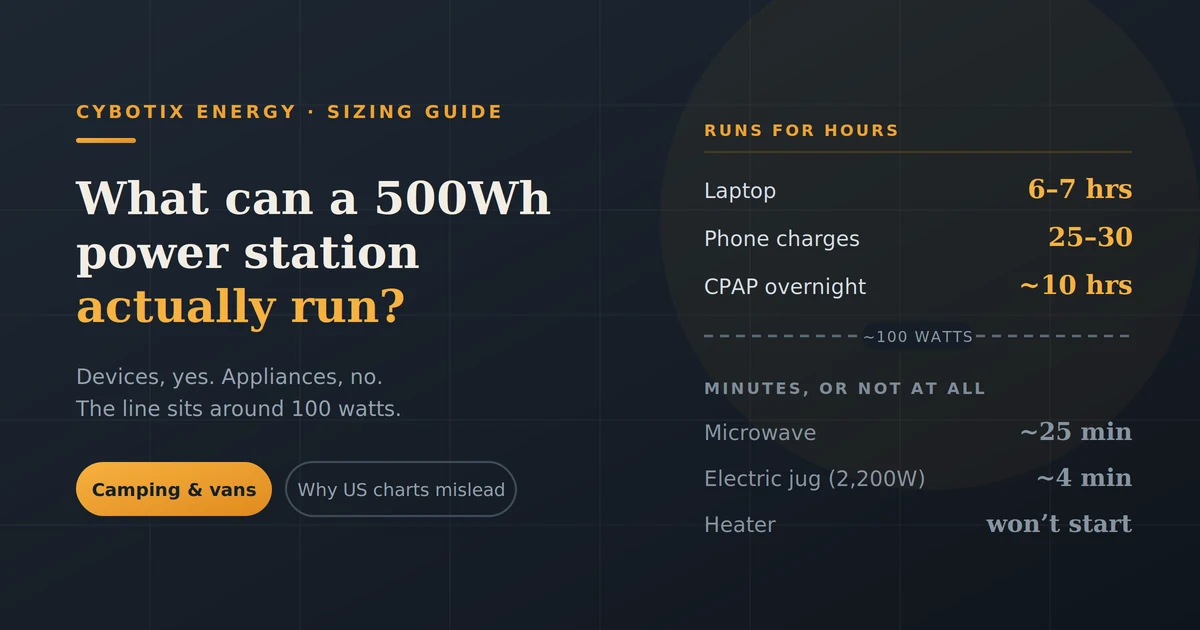
After conversion losses you get roughly 425Wh of usable energy. That translates to:
- Phone charges: 25–30
- Laptop: 6–7 hours of use
- LED camp lights (10W): 40+ hours
- Router or modem: around 40 hours
- CPAP without humidifier: roughly 10 hours, so a full night
- Portable camping fridge: 12–18 hours depending on conditions
- Electric jug: about 4 minutes of boiling one or two boils, total
Notice how the list falls apart at the end. That’s the pattern worth understanding.
Devices, not appliances
There’s a clean dividing line at this capacity, and it’s around 100 watts.
Under 100W phones, laptops, lights, routers, fans, CPAP machines. These run for hours, and 500Wh feels generous.
Over 1,000W jugs, heaters, toasters, hair dryers, microwaves. These drain the whole thing in minutes, and 500Wh feels useless.
In between a portable fridge, a small TV, a fan. Usable, but you’re watching the numbers.
That’s why the honest way to think about this size is as a large, mains-capable battery for your gear rather than a small generator for your house. If your list is phones, a laptop, lights and charging things, this is the right tier. If your list has the word “fridge” or “heater” in it, keep reading but expect to size up.
Why American runtime charts overstate things here
This trips up New Zealand buyers constantly, and almost nobody mentions it.
Most “what can a 500Wh power station run” content online is written for the United States, which runs on 120V. New Zealand runs on 230V, and our appliances are generally higher wattage than their American equivalents.
The clearest example is an electric jug:
| Appliance | Typical US | Typical NZ |
|---|---|---|
| Electric jug / kettle | ~1,500W | 2,000–2,400W |
| Portable heater | ~1,500W | 2,000–2,400W |
| Hair dryer | ~1,500W | 1,800–2,200W |
A US chart saying “a 500Wh unit boils a kettle six times” is describing a different kettle from the one in your kitchen. Ours boil faster but draw considerably more while doing it and at 2,400W, many New Zealand jugs will exceed the continuous output rating of a unit this size entirely, meaning it won’t run at all rather than running briefly.
What to do instead: read the label on your own appliances. It’s printed on the back or underside, either in watts or as volts and amps. Multiply volts by amps if you only get the latter. That number is the one that matters, not a figure from an American review site.
Runtime by appliance
Based on roughly 425Wh usable, using typical New Zealand wattages:
| Appliance | Typical draw | Realistic runtime |
|---|---|---|
| Phone charge | 15W | 25–30 full charges |
| LED camp light | 10W | 40+ hrs |
| Router / modem | 10W | ~40 hrs |
| CPAP (no humidifier) | 40W | ~10 hrs |
| Laptop | 65W | 6–7 hrs |
| Small fan | 40W | ~10 hrs |
| 32″ TV | 50W | ~8 hrs |
| Portable camping fridge | 45W average (cycles) | 12–18 hrs |
| Electric blanket | 60W | ~7 hrs |
| Household fridge | 48W average (cycles) | 8–9 hrs |
| Microwave | 1,000W | ~25 min total |
| Electric jug | 2,200W | ~4 min, may exceed output |
| Portable heater | 2,000W+ | Exceeds output |
What it won’t do
Two categories, and it’s worth being blunt about both.
Anything that makes heat. Jugs, heaters, toasters, hair dryers, hot plates. Electricity becomes heat with no efficiency trick available, so these draw enormous power for as long as they’re on. At New Zealand wattages, several will exceed the unit’s output rating outright.
A household fridge overnight. The maths technically works 8 to 9 hours but that’s the whole battery gone on one appliance, with nothing left for lights or phones, and you’d be flat by morning. If keeping food cold through an outage is your goal, this is the wrong size.
The practical workaround for camping is the same one that works everywhere: use gas for heat. A gas burner boils water and cooks without touching the battery, which frees the entire capacity for the things only electricity can do.
Camping, vans and baches
This is where a 500Wh unit genuinely shines, and it’s the strongest use case in New Zealand.
DOC campsites mostly have no power. Freedom camping has none by definition. A weekend away with phones, a couple of lights, a camera battery and maybe a laptop sits comfortably inside 425Wh with room spare and the unit is light enough to carry from the car to the site.
Running a portable fridge the honest maths
A 12V camping fridge draws around 45W on average once it’s cold, cycling rather than running constantly. That’s 12 to 18 hours on a full charge, and less in a hot Northland summer where it cycles more.
So for a two-night trip with a fridge, you need a recharge plan. Either:
- A folding solar panel, which in summer will comfortably keep up
- Charging from the car while driving between spots
- Accepting the fridge runs from the vehicle and the power station handles everything else
That last option is usually the sensible one. Run the fridge off the vehicle’s system and use the power station for devices it plays to what each does well.
CPAP at a campsite
A common and genuinely important use case. Most CPAP machines draw 30–60W without the humidifier, so a 500Wh unit covers a full night with margin, often two.
Two things matter: turn the humidifier off if you can, as it’s a heating element and can triple the draw; and run from DC if your machine supports it, which skips the inverter and wastes less energy. Check your machine’s specifications rather than assuming.
As storm backup
After the last few years, plenty of New Zealanders are thinking about outages. Be realistic about what this size covers.
It will comfortably handle: phones charged, the router running so you have internet if the exchange is up, torches and lamps, a laptop, and a radio.
It will not handle: keeping food cold overnight, any heating, or cooking.
That’s not nothing losing contact and light is a big part of what makes an outage miserable. But if your goal is riding out a multi-day storm with a working fridge, you want 1,000Wh at minimum and realistically 2,000Wh. Buying 500Wh for that job leads to disappointment.
A sensible pairing at this size: the power station for devices, a gas burner for cooking and boiling, a chilly bin with ice for food, and stored water. That combination costs less than a bigger battery and handles more.
500Wh compared with other sizes
| Size | Weight | Realistically covers | Best for |
|---|---|---|---|
| Power bank (100Wh) | 0.5 kg | Phones only | Day trips, flights |
| 300Wh | 4 kg | Phones, lights, a few laptop hours | Minimal camping |
| 500Wh | 6–8 kg | Devices for a weekend, CPAP, camp fridge for a day | Camping, vans, device backup |
| 1,000Wh | 12 kg | Above + fridge overnight or longer fridge runs | Serious camping, light outage backup |
| 2,000Wh | 20+ kg | Household essentials through an outage | Home backup |
[PLACEHOLDER: verify weights and capacity tiers against current stock.]
If you’re on the fence between 500Wh and 1,000Wh, the deciding question is whether a fridge is on your list. If it is, go up.
Recharging it
From the wall: typically 1–3 hours depending on the model’s input rating.
From the car: slow, but useful if you’re driving between campsites anyway. Expect several hours.
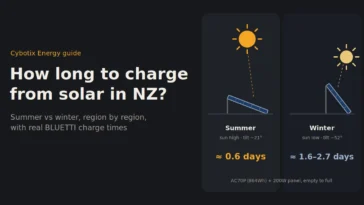
From solar: a folding 100–200W panel will refill a 500Wh unit in a day of good New Zealand sun, allowing for the usual 70–80% real-world derate on panel ratings.
Seasonally, that varies a lot. A panel that comfortably refills the unit in January will struggle in June, especially in the South Island our article on how solar panels perform through a New Zealand winter covers the regional figures. For summer camping it’s rarely an issue.
What to check before buying at this size
- Continuous output rating, not just capacity. Check it against your highest-wattage device. At 500Wh, output is often 500–600W, which rules out most NZ jugs and heaters regardless of battery size.
- Surge headroom if you’re running anything with a motor or compressor.
- The ports you’ll actually use. USB-C PD wattage matters if you’re charging a laptop; 12V output matters for a camping fridge.
- Weight, if you’ll carry it from the car park to a campsite.
- LiFePO4 chemistry for longer cycle life and better tolerance of regular use.
FAQs
Will a 500Wh power station run a fridge?
A portable camping fridge, yes 12 to 18 hours. A household fridge, technically 8 to 9 hours, but that consumes the entire battery and leaves nothing for anything else.
Can it boil a jug?
Barely, and possibly not at all. New Zealand jugs typically draw 2,000–2,400W, which exceeds the continuous output of most units this size. Use gas for boiling.
How many phone charges do you get from 500Wh?
Around 25 to 30 full charges for a typical smartphone, which is why this size suits group trips well.
Is 500Wh enough for camping?
For a weekend of devices, lights and charging, comfortably. Add a fridge and you’ll want solar to keep up or a larger unit.
Can I run a CPAP overnight?
Yes, usually with margin most machines draw 30–60W without the humidifier. Switch the humidifier off and check your machine’s specifications.
How long does it take to recharge from solar?
A 100–200W folding panel will refill it in a day of good sun. Expect considerably longer in winter, particularly in the South Island.
Is it enough for a power cut?
For phones, lights, the router and a laptop, yes. For keeping food cold or running heating, no that needs 1,000Wh at minimum.
Work out which side of the line you are on
The question isn’t really “what can a 500Wh power station run.” It’s whether your list is devices or appliances. Devices, and this size is generous. Appliances, and you’ll want more.