The power goes out and you reach for the tap. Nothing. No shower, no toilet flush, no water for the stock — because on tank or bore supply, no power means no pump.
So: can solar power run a water pump? Yes, and there are two quite different ways to do it. One is cheaper, simpler and more reliable than most people expect. The other keeps the pump you already have. Which suits you depends on your property, not on which one a supplier wants to sell.
Here’s how to work it out.
Can solar power run a water pump?
Yes, by either of two routes:
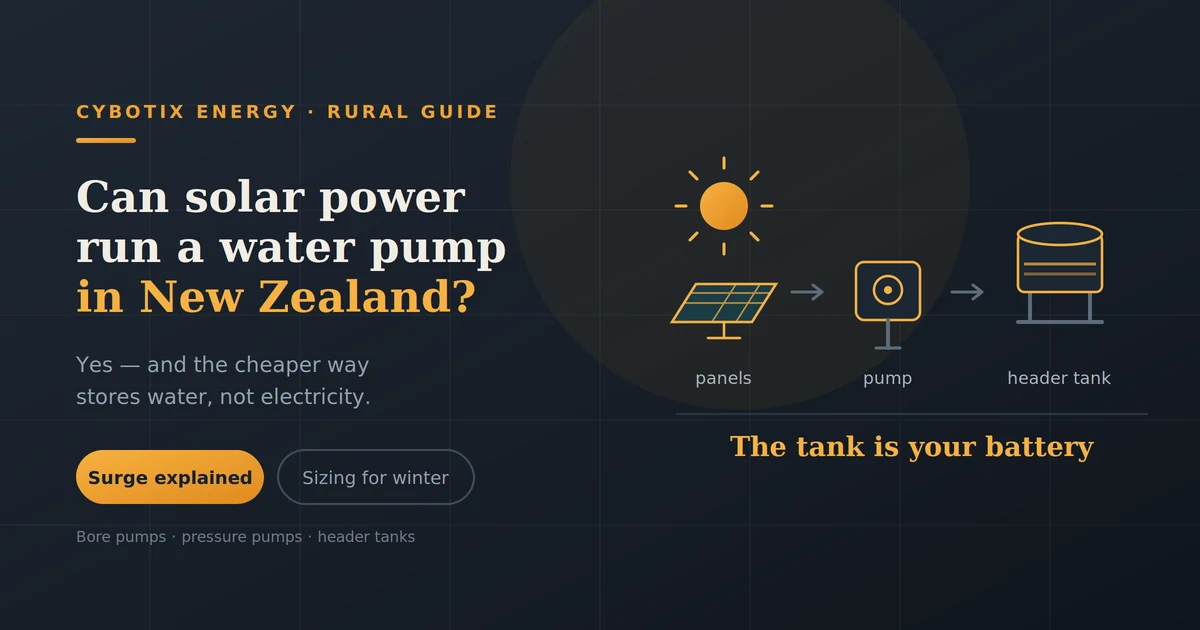
- A dedicated DC solar pump running straight off panels during daylight, usually into a storage tank. No battery, fewer parts, lower cost.
- Your existing AC pump run from a battery and inverter, so it works on demand day or night.
The first is how most off-grid and rural water systems have been done for decades. The second is what people usually ask about, and it’s the more expensive answer.
There’s also a third option most guides skip entirely, covered below: pump into a header tank and let gravity do the rest.
Surge: the number that decides everything
Before capacity, before panels, before anything check surge.
A pump motor draws a brief spike on startup, typically 3–7× its running wattage. A 750W pressure pump can pull 3,000W or more for a second or two. If your inverter or power station can’t supply that spike, the pump won’t start at all no matter how much battery sits behind it.
This is the failure mode people hit first, and it’s completely separate from running out of power.
Where to find your pump’s ratings
Look for the plate on the motor housing. You’ll find watts, or volts and amps to multiply together. Note:
- Running watts normal operation
- Locked rotor amps (LRA) or starting current, if listed this is the surge figure
- Horsepower, on older pumps: roughly 750W per HP as a running figure
If LRA isn’t printed, assume the high end of the range and size accordingly.
Soft starters
A soft starter ramps the motor up rather than slamming it on, which cuts the startup spike substantially. On a large existing pressure pump this can be the difference between a workable backup system and an impossible one.
They’re not free and not universal compatibility depends on the motor. Worth asking about before concluding your pump can’t be backed up.
The two approaches compared
| DC solar pump | Battery + inverter on existing AC pump | |
|---|---|---|
| Pumps at night | No, daylight only | Yes |
| Needs a battery | No | Yes |
| Needs a storage tank | Yes | Optional |
| Keeps your existing pump | No | Yes |
| Upfront cost | Lower | Higher |
| Complexity | Low panels, controller, pump | Higher battery, inverter, wiring |
| Cloudy days | Reduced output; tank covers the gap | Runs on stored charge |
| Install | Plumber + solar install | Registered electrician required |
| Failure points | Few | More |
DC solar pumps are widely available with MPPT controllers, brushless motors and dry-run protection, sized from a couple of hundred watts up to a few kilowatts depending on bore depth and flow.
The honest summary: if you have somewhere to put a tank, the DC pump route is usually cheaper and more reliable. If you can’t store water, you need the battery.
Store water, not electricity
Here’s the insight that changes what most people buy.
A battery stores energy so you can pump on demand. A tank stores the water you already pumped and it’s far cheaper per day of autonomy.
Run the comparison. Pumping 500 litres to a height of 10 metres takes roughly 0.014 kWh of actual work, and real pumps are maybe 40–50% efficient, so call it 0.03–0.04 kWh. Trivial energy. But to pump it on demand at 2am in July, you need a battery and inverter sized for the surge, which is a much more expensive piece of equipment than the tank holding the water.
A 5,000-litre tank costs a fraction of the battery bank needed to pump that much water on demand and it keeps working when the battery is flat.
How much tank do you need?
Work from daily use. A typical New Zealand household uses somewhere around 150–200 litres per person per day, less if you’re careful.
- Two people, 3 days autonomy: roughly 1,200 litres
- Four people, 3 days: roughly 2,400 litres
- Four people, plus stock or garden: more, depending entirely on the stock
Most rural properties already have a main tank. The question is usually whether you can add elevated storage, not whether you need storage at all.
When gravity feed works, and when it doesn’t
Gravity gives you roughly 1 bar of pressure per 10 metres of height. A header tank 10 metres above the house gives about the same pressure as mains supply. At 3 metres, you’ll get flow but it’ll feel weak fine for toilets and garden taps, disappointing for a shower.
If your land has a rise, this is close to free. If it’s flat, you’re looking at a tank stand or a small pressure pump on the outlet, which draws far less than lifting water from a bore.
How much power does your pump actually use?
Less than you’d think in total, because pumps run in short bursts.
| Pump type | Typical running draw | Typical daily use |
|---|---|---|
| Surface pressure pump | 500–1,000W | 0.5–1.5 kWh |
| Shallow well / jet pump | 500–1,200W | 0.5–1.5 kWh |
| Submersible bore pump (shallow) | 750–1,500W | 1–2 kWh |
| Submersible bore pump (deep) | 1,500–3,000W | 2–4 kWh |
| Small DC solar pump | 200–800W | Matched to daylight |
Indicative ranges. Bore depth and flow rate move these considerably.
The reason daily consumption is modest: a pressure pump might run 30–60 minutes total across a day, not continuously. So a 750W pump averages well under 100W over 24 hours. The method for working this out properly is in our guide to calculating runtime.
Sizing solar for a water pump
Panels rarely deliver their rated output. Plan on 70–80% after heat, angle, dust and controller losses.
New Zealand peak sun hours run around 4–5 in summer and closer to 2–3 in winter, with the South Island lower than the north.
Worked example household on a shallow bore, needs 1.5 kWh/day:
Winter, 2.5 peak sun hours, 75% derate
1,500Wh ÷ (2.5 × 0.75) = 800W of panel
Same property in summer needs roughly half that. Which tells you the important thing: size for winter, or accept that winter is when you’ll be short. Our article on how solar panels perform through a New Zealand winter has the regional figures.
This is another argument for tank storage. With three days of water stored, a run of dull winter days stops being a problem you’re drawing down the tank, not the battery.
What New Zealand conditions do to this
Winter is the binding constraint. Generation bottoms out in June and July, and your water use doesn’t. Size for the worst month.
Bore depth drives power. Lifting water 60 metres takes far more energy than lifting it 10. If you’re on a deep bore, the numbers get considerably larger and a dedicated DC bore pump with a good controller becomes more attractive.
Storm outages are the use case. The days you most need this working are the days with least sun, so stored water matters more than stored electricity.
Frost. Exposed pipework and above-ground pumps need protection in colder districts. Not a solar issue, but it’s the thing that actually fails.
Keeping your existing pump versus buying a solar one
Keeping your existing AC pump
- No plumbing changes, no new equipment in the bore
- Works on demand, day or night
- Needs an inverter rated for surge, plus battery
- Registered electrician required for any hard-wiring
- Often the more expensive path, particularly with a large pressure pump
Adding a dedicated DC solar pump
- Cheaper for the same daily volume
- No battery, fewer failure points
- Daylight only — requires a tank
- New equipment, possibly a new bore installation
- Your existing pump stays as the mains-powered option
A middle path worth considering: keep the existing pump for normal use, and add a small DC pump plus tank for outages. You get essential water without sizing a battery system around a surge you’d rather avoid.
Pressure pumps, cycling, and why a pressure tank helps
Small but genuinely useful.
If your pressure pump starts every time someone runs a tap for a few seconds, it’s cycling starting, running briefly, stopping. Each start draws the surge, wastes energy, and wears the motor.
A properly charged pressure vessel holds a reservoir of pressurised water so small draws don’t start the pump at all. Fewer starts means less energy, less surge, and a longer-lived pump.
Two things to check: that you have one, and that its air charge is correct. They lose pressure over time and most people never check. It’s a ten-minute job that reduces the load on whatever backup system you install.
What this costs, roughly
Indicative only bore depth, existing infrastructure and site access move these a lot.
| Approach | Rough cost band |
|---|---|
| Small DC solar pump + panels + controller | Lowest |
| Add a header tank to an existing setup | Low to mid |
| Battery + inverter backup for an existing pressure pump | Mid to high |
| Deep bore DC system with large array | High |
FAQs
Can a solar panel run a water pump directly?
Yes, DC solar pumps run straight off panels through a controller, with no battery. They pump while the sun’s up, usually into a tank.
What size solar panel do I need for a water pump?
Divide your daily watt-hours by peak sun hours and a 0.75 derate. For a household needing 1.5 kWh/day in a NZ winter, that’s roughly 800W of panel.
Will solar run my pump at night?
Only with a battery. Without one, pump during the day into a tank and draw from storage at night which is cheaper and more reliable.
Do I need an electrician?
For anything hard-wired to an existing pump circuit, yes, a registered electrician. A plug-in power station used with a pump on a standard socket is different, but check the pump’s surge against the unit’s rating first.
Will it work in winter?
Yes, with less output. Winter generation in New Zealand is a fraction of summer, so size for June rather than January, or store more water.
Is a pressure tank worth it?
Yes. It reduces how often the pump starts, which saves energy, reduces surge events and extends pump life.
Get it sized for your property
The answer depends on four things: what your pump draws, how deep your water is, how much you use a day, and whether you have somewhere to put a tank.
Send us those and we’ll work through it honestly including telling you when more tank beats more battery, which is more often than you’d expect. You can see the panel and storage range at Cybotix Energy.