Three quotes for the same roof. One is $40,000 cheaper than the others. Nobody will explain why.
That gap is almost never margin. It’s scope work that’s in two of the proposals and quietly absent from the third, which you’ll discover when the structural report lands or the switchboard turns out to be full. So the useful question isn’t what commercial solar panels cost in 2026. It’s what a complete installation actually includes, and how to tell whether the number in front of you covers it.
This is the itemised version. Bring your quotes.
The short answer: Commercial Solar Installation Costs in NZ
Commercial systems are priced per watt installed, and the cost per watt falls as the system gets larger a 200kW array costs meaningfully less per watt than a 30kW one. But a $/W figure is only comparable between quotes when the same scope sits behind it, and it usually doesn’t.
Convert every quote to $/W before you do anything else. It’s the only way to compare a 40kW proposal against a 90kW one.
Where the money actually goes
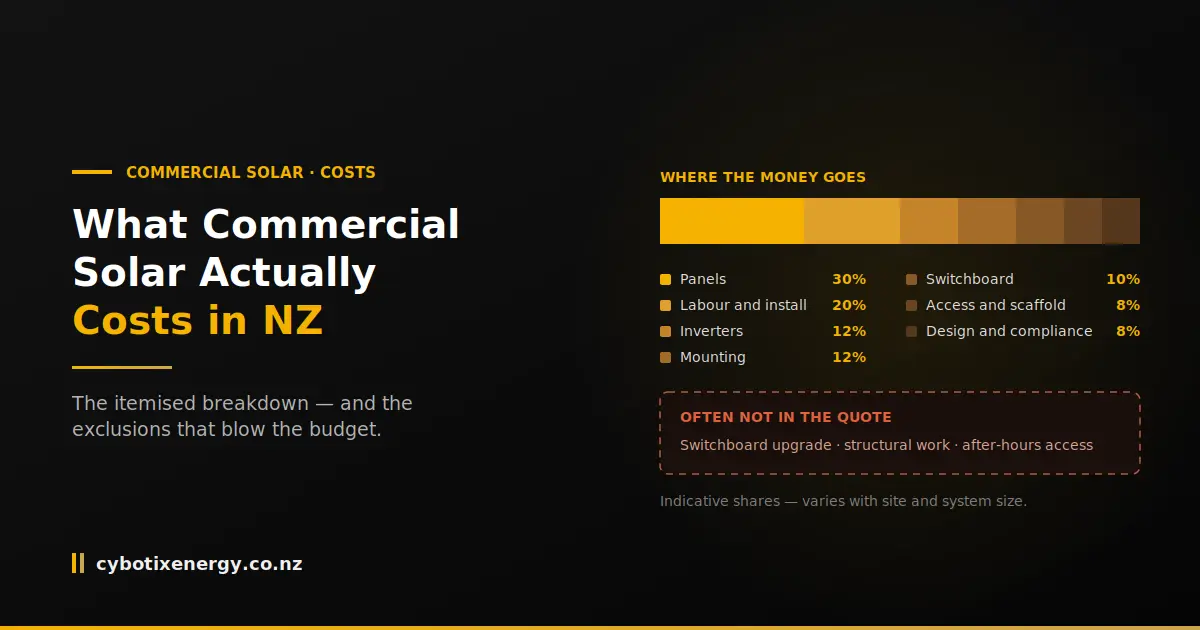
Panels are roughly a third of the project. The rest is inverters, mounting, cabling, electrical work, access, engineering and compliance and that’s where quotes diverge. Understanding the split tells you which line items to interrogate.
| Cost component | Rough share of total | What makes it vary |
|---|---|---|
| Panels | ~25–35% | Module tier, efficiency, warranty terms |
| Inverters | ~10–15% | String vs central, brand, monitoring capability |
| Mounting and racking | ~10–15% | Roof type, wind loading, ballast vs penetration |
| DC and AC cabling | ~5–10% | Run lengths, cable sizing, containment |
| Switchboard and protection | ~5–15% | Existing board capacity — the biggest wildcard |
| Access and scaffolding | ~5–15% | Building height, roof pitch, safety requirements |
| Engineering and design | ~3–8% | Structural assessment, electrical design |
| Network application | ~1–5% | Distributor process, study requirements at scale |
| Labour and installation | ~15–25% | Site complexity, staging, working hours |
| Commissioning and certification | ~2–5% | Testing, documentation, sign-off |
Shares are indicative and shift considerably with system size and site.
Why panels are the smallest surprise in the quote
Modules are close to a commodity. Prices are visible, competitive and broadly similar between reputable suppliers.
Which means “we’re using cheaper panels” almost never explains a dramatically cheaper quote. If one proposal is 30% below the others, the difference is far more likely to be sitting in the mounting, the switchboard work, or the access not in the glass.
The line items that create the spread
Three components account for most of the variance between quotes:
- Switchboard and protection. If your existing board can’t take the connection, someone has to upgrade it. Whether that’s inside the quote is the single biggest source of surprise.
- Access and scaffolding. A single-storey warehouse roof and a three-storey rooftop are entirely different jobs at the same kilowatt rating.
- Structural work. An engineer’s assessment can turn up strengthening requirements that nobody priced.
Ask each installer, in writing, whether these are included, excluded, or provisional.
The costs that aren’t in the quote you’re reading
The most common budget overruns come from scope sitting outside a standard proposal. Switchboard upgrades, roof remediation, structural strengthening, network study fees and after-hours work are all real costs that frequently appear as exclusions in the fine print.
Get each one addressed explicitly before you sign.
Switchboard and protection upgrades
Commercial buildings often have boards that are full, aged, or not configured for generation. Adding solar can require new protection devices, a board upgrade, or in some cases a substantially larger piece of work.
This is checkable in advance. Have someone look at your board before you’re comparing final numbers, so it’s a known cost rather than a variation.
Roof condition and structural strengthening
An array has a 25-year design life. If your roof has five years left, you’re either doing the roof first or paying to remove and reinstall the array later which costs far more than the delay saves.
Structural assessment on commercial buildings is normal, and occasionally it identifies strengthening work. Budget for the assessment; treat the strengthening as a possibility rather than a shock.
Access, scaffolding and height
Height and pitch drive safety requirements, and safety requirements drive cost. Edge protection, scaffolding, harness systems and lift hire are legitimate expenses, not padding and a quote that omits them on a difficult roof is a quote that will change.
Network fees and export limiting
Connecting generation to the network involves an application, and at commercial scale it can involve a connection study with its own fee. Some connections require export-limiting hardware or controls.
Working around your operating hours
If you can’t have installers on the roof during trading hours, the work gets staged, done after hours, or both. Either way it costs more and takes longer.
Raise it at quoting stage. An installer who prices for weekday access and then discovers you’re a retail site will come back with a variation.
Why two quotes for the same system differ by tens of thousands
Usually scope, not margin. Five factors explain most of the gap: equipment tier, what’s included versus excluded, the DC-to-AC ratio, warranty and maintenance terms, and who carries the compliance work.
Once you normalise for those, most quotes land much closer together and the outlier usually turns out to be missing something.
A checklist for making quotes comparable
- Convert each to $/W. Total price divided by system size in watts.
- Confirm identical scope. List every exclusion from every quote side by side.
- Compare warranties separately. Panel, inverter and workmanship warranties are three different things with three different lengths.
- Check the yield estimate’s assumptions. Two installers can quote the same array and forecast very different annual generation. Ask what shading, orientation and degradation they assumed.
- Ask what happens if the structural report requires work. Is it your cost, theirs, or a variation at a stated rate?
- Establish who handles the network application and certification, and whether that’s priced in.
Six questions. They routinely move a $40,000 spread down to a few thousand
Ongoing costs nobody budgets for
Solar isn’t a one-off purchase. Across 25 years, expect cleaning, monitoring, at least one inverter replacement, an insurance adjustment and some maintenance. A payback figure that ignores all of it is optimistic.
Inverter replacement is the big one
Panels typically carry performance warranties measured in decades. Inverters don’t. Over a 25-year system life you should plan for at least one inverter replacement and possibly two.
That’s a real capital cost arriving partway through the payback period, and it belongs in any honest financial model. If a proposal’s payback calculation doesn’t mention it, ask.
Cleaning, monitoring and insurance
- Cleaning. Rain does a reasonable amount of the work in NZ, but coastal salt, rural dust and bird activity all justify periodic cleaning. Frequency depends entirely on your site.
- Monitoring. Usually included with the inverter, sometimes as a subscription. Worth confirming which.
- Insurance. Adding a substantial roof-mounted asset generally means notifying your insurer and often an adjusted premium. Cheaper to establish now than to discover during a claim.
The number that actually matters: cost per kWh generated
Comparing quotes on total price or even on $/W misses the point, because a cheaper system that generates less isn’t cheaper. Divide lifetime cost by lifetime generation and the ranking between quotes frequently changes.
This is the metric that separates a serious buyer from a price shopper, and almost nobody applies it.
How to work it out from a quote
Take the installer’s estimated annual generation, multiply by the system life they’re claiming, and apply a degradation allowance. Then divide total lifetime cost including that inverter replacement by total lifetime kWh.
You’ll get a cents-per-kilowatt-hour figure you can compare directly against what you currently pay your retailer. That comparison is the whole investment case in one number.
Two assumptions to challenge: the annual yield estimate, and whether degradation has been accounted for at all.
What reduces the cost, and what doesn’t
Scale genuinely reduces cost per watt bigger systems spread fixed costs like design, access and network application across more capacity. The tax treatment available to businesses reduces the effective cost materially. Cheap equipment usually doesn’t reduce anything except the warranty.
What genuinely helps:
- Going bigger, if your consumption justifies it. Fixed costs don’t scale with kilowatts.
- Depreciation and GST recovery. A business buying a depreciable asset and recovering GST faces a materially lower effective cost than a household worth working through with your accountant.
- Combining with other roof work. If the roof needs attention anyway, doing both at once saves on access.
- Timing around your own capital cycle rather than an installer’s end-of-quarter.
What usually doesn’t:
- Budget equipment. The saving is small relative to project cost and the warranty exposure is long.
- Skipping the structural assessment. It’s not a saving, it’s a deferred cost with interest.
- Undersizing to reduce the quote. Cost per watt rises as size falls, so a smaller system is often worse value per unit generated.
You can see the panel and inverter options we supply at Cybotix Energy.
Pros and cons of spending more upfront
Paying for the higher tier:
- Longer equipment warranties on the components most likely to fail
- Better documented installations, which matters for insurance and resale
- An installer likely to still exist when you need the workmanship warranty
- Higher-efficiency panels mean more capacity from a constrained roof
Against:
- More capital tied up, and a longer nominal payback
- The premium isn’t always justified mid-tier equipment from established manufacturers is often the sensible middle
- Marketing frequently prices “premium” above what the specification supports
- A longer warranty is worth nothing if the issuing company doesn’t survive
The honest position: pay for the inverter, the mounting and the installer. Panels are where the diminishing returns set in fastest
FAQs
How much does a 100kW commercial solar system cost in New Zealand?
Pricing is quoted per watt installed, and cost per watt falls as size rises, so a 100kW system costs less per watt than a 30kW one. Always compare on $/W with identical scope rather than on headline price.
Why do commercial solar quotes vary so much?
Almost always scope rather than margin. Switchboard upgrades, access and scaffolding, and structural work are the three items most often included in one quote and excluded from another.
What’s typically excluded from a commercial solar quote?
Switchboard upgrades, roof remediation, structural strengthening, network study fees and after-hours installation. Ask about each explicitly and get the answer in writing.
Will I need a switchboard upgrade?
Possibly. Older commercial boards often lack the capacity or configuration to accept generation. Have your board assessed before you finalise quotes so it’s a known cost rather than a variation.
Is it cheaper per watt to install a bigger system?
Yes, generally. Design, access, network application and mobilisation are largely fixed, so spreading them across more capacity lowers the cost per watt provided your consumption justifies the extra generation.
What are the ongoing costs of commercial solar?
Periodic cleaning, monitoring, an insurance adjustment, some maintenance, and at least one inverter replacement across a 25-year life. That last one is the significant item and belongs in any payback calculation.
How do I compare solar quotes fairly?
Convert each to cost per watt, list every exclusion side by side, compare the three warranty types separately, challenge the yield assumptions, and then work out cost per kWh generated over the system’s life.