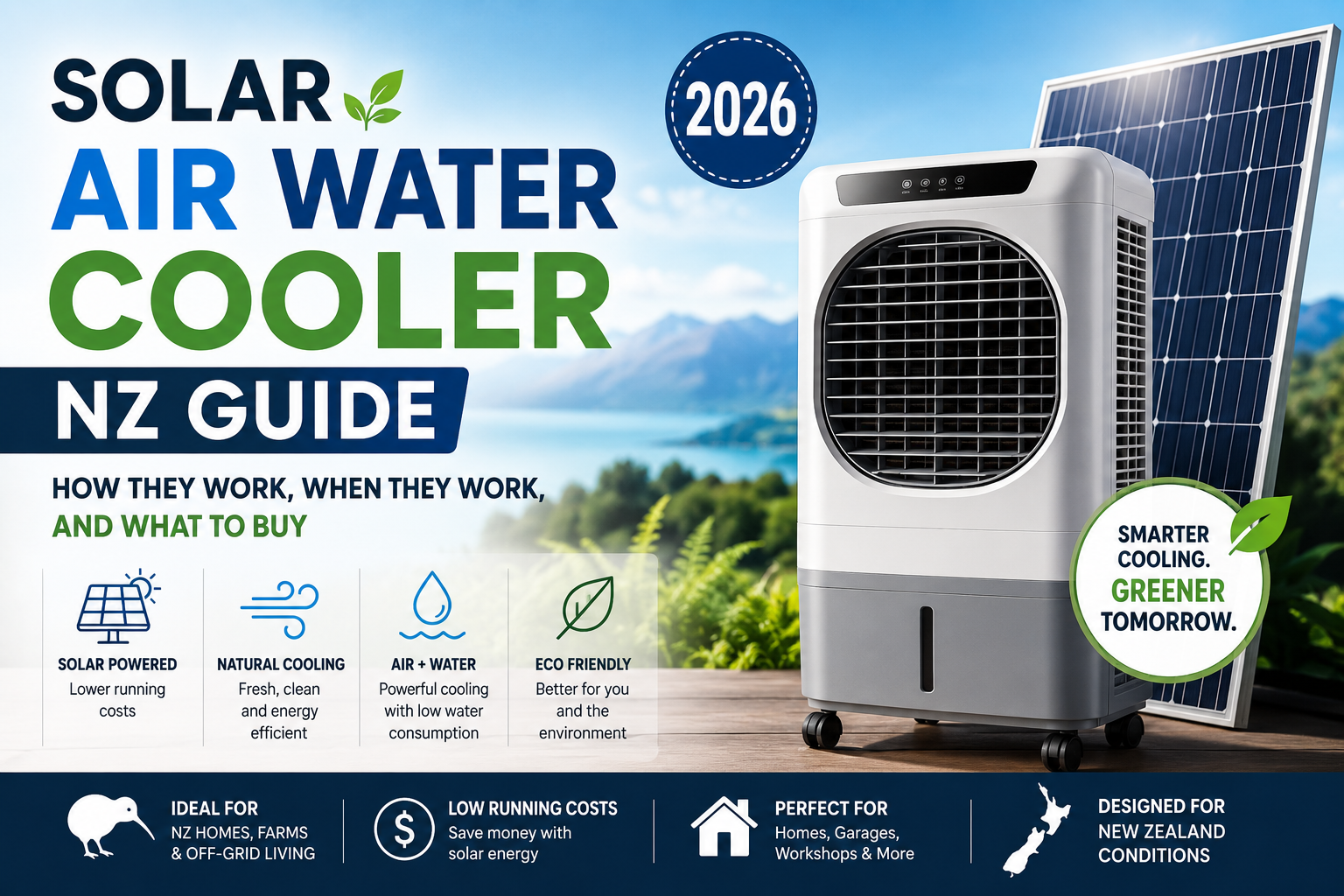
There’s a category of NZ spaces that heat pumps will never reach: the bach with no grid connection, the tin-roof workshop that hits 35°C by lunchtime, the campervan parked in full February sun. A solar air water cooler an evaporative cooler running on solar power instead of mains is built for exactly these spaces. It can drop the air temperature by several degrees using nothing but sunlight and tap water. But it only works well in the right conditions, and most articles selling them won’t tell you that. This guide will.
What is a solar air water cooler?
A solar air water cooler is an evaporative cooler a unit combining a fan, a water tank, and water-soaked cooling pads powered by a solar panel or a solar-charged battery instead of mains electricity. It cools air by evaporating water into it, drawing a fraction of the power an air conditioner needs.
That last point is what makes solar practical here. A portable air conditioner draws 1,000–2,500 watts, which would need a small rooftop array and serious battery storage to run off-grid. A typical solar air water cooler draws somewhere between 60 and 200 watts comfortably within reach of a single portable panel or a modest 12V battery setup.
You’ll see these sold under several names: solar air cooler, evaporative cooler, swamp cooler, or desert cooler. Same machine, same physics.
How solar evaporative cooling actually works
Warm air is pulled through pads soaked with water. Evaporating that water absorbs heat from the air, so the air comes out the other side cooler and slightly more humid. The solar part simply powers the fan and the small water pump the cooling itself is free.
The evaporation principle
It’s the same effect that chills you when you step out of the sea into a breeze. Water changing from liquid to vapour absorbs a large amount of heat energy physicists call it the latent heat of vaporisation; the rest of us call it wet-towel-on-the-neck cooling.
An evaporative cooler industrialises this. A small pump keeps honeycomb cellulose pads (or in cheaper units, aspen or foam pads) saturated with water from the tank. The fan pulls hot, dry air through those wet pads, evaporation strips heat out of it, and the cooled air blows into your space. No compressor, no refrigerant gas, no outdoor unit.
Where the solar part fits
The only electrical loads are a DC fan motor and a tiny circulation pump. Two common configurations:
- Direct solar: panel connects to the cooler; it runs whenever the sun shines which is conveniently also when you want cooling.
- Solar + battery: panel charges a 12V battery or portable power station; the cooler runs day or night. This is the setup that suits NZ baches and campervans, because hot evenings are when a cooler earns its keep.
Sizing rule of thumb: a cooler drawing 100W needs roughly a 150–200W panel to run continuously in variable NZ sun, or a battery buffer to smooth over cloud.
The honest catch: humidity decides everything
Evaporative cooling performance depends entirely on how dry the incoming air is. In dry air, a good unit can drop temperatures by 8–12°C. In humid air, that shrinks to 2–4°C, because air already loaded with moisture can’t absorb much more evaporation. This single fact should drive your buying decision.
Here’s what that means around New Zealand:
- Works well: Central Otago, inland Canterbury, the Mackenzie Country, Wairarapa and Hawke’s Bay during dry spells anywhere summer air is hot and dry. These regions get genuinely impressive results.
- Works moderately: Nelson, Marlborough, inland Waikato on drier days. Expect useful but not dramatic cooling.
- Marginal: Auckland, Northland, coastal Bay of Plenty in sticky late-summer humidity. On a muggy 26°C Auckland day, an evaporative cooler adds airflow and a small temperature drop pleasant, but it will not feel like air conditioning, and the added moisture can make an enclosed room feel clammy.
One more rule that follows from the physics: evaporative coolers need airflow through the space. Unlike aircon, which wants a sealed room, an evaporative cooler works best with a window or door cracked open so humid air can escape. Run one in a sealed room and performance falls off within the hour as humidity builds.
None of this is a reason to avoid them it’s a reason to buy them for the right job. In a ventilated shed, an open garage, a patio, or a dry-climate bach, they’re superb value. As a heat pump substitute in a closed Auckland lounge, they’ll disappoint.
Solar air water cooler vs heat pump vs portable aircon vs fan
| Solar air water cooler | Heat pump / split AC | Portable aircon | Pedestal fan | |
|---|---|---|---|---|
| Typical power draw | 60–200W | 800–2,500W | 1,000–2,500W | 40–75W |
| Runs off-grid / solar | Yes, easily | Only with a large solar + battery system | Rarely practical | Yes |
| Cooling effect (dry air) | 8–12°C drop | Precise, thermostat-set | Precise, thermostat-set | None (perceived only) |
| Cooling effect (humid air) | 2–4°C drop | Unaffected — also dehumidifies | Unaffected | None |
| Purchase price (typical NZ) | $150–$700 | $2,500–$5,000+ installed | $600–$1,500 | $30–$150 |
| Running cost | Near zero on solar | Moderate | High | Very low |
| Installation | None — plug and go | Professional install | Window venting kit | None |
| Water use | ~1–4 L/hour | None | None | None |
| Best for | Off-grid, ventilated & outdoor spaces, dry regions | Sealed living spaces, year-round use | Renters needing real AC | Air movement on a budget |
The honest summary of that table: a heat pump is the better machine for a sealed home you live in year-round — nothing here disputes that. A solar air water cooler wins wherever a heat pump is impossible, uneconomic, or overkill.
What to look for in a solar air water cooler
Until then, judge any unit on these six numbers:
- Airflow (m³/h or CFM). The single most important spec. As a rough guide, aim for airflow that cycles your space’s air volume 20–30 times per hour — a 3m × 4m × 2.4m sleepout (~29 m³) wants roughly 600–900 m³/h.
- Tank capacity vs runtime. A 5–6L tank typically runs 3–5 hours before refilling; larger 15–30L units run most of a day. Match tank size to how long you’ll be away from a tap.
- Power draw vs your panel. Check the DC draw in watts and size your panel at 1.5–2× that figure for real-world NZ sun, or confirm your power station’s output covers it.
- Battery buffer. If evening use matters — and in a sleepout it will you need storage, not just a panel.
- Pad material. Honeycomb cellulose pads cool better and last longer than foam. Cheaper units skimp here, and it shows in performance.
- Water consumption. Expect roughly 1–4 litres per hour depending on size and heat. On tank water at a bach, that’s worth budgeting for.
Where a solar air water cooler makes real sense in NZ
Anywhere with heat, ventilation, and no easy mains power that’s the sweet spot. These use cases come up again and again:
- Off-grid baches and sleepouts — cooling that runs on the solar setup you already have, without the inverter load of an aircon.
- Sheds, workshops and garages — big, leaky, un-insulated spaces where aircon is hopeless anyway and doors are open regardless. This is arguably the best use case in the country.
- Campervans and caravans — low draw suits 12V systems; run it off the house battery while parked.
- Patios, decks and outdoor dining — evaporative units are one of the only technologies that cool outdoor air at all.
- Greenhouses and grow rooms — cooling plus humidity is a feature here, not a bug; growers use evaporative cooling deliberately.
- Worksites and events without power — portable, no generator required, no refrigerant handling.
FAQs
Do solar air coolers really work?
Yes within the limits of the physics. In hot, dry air they can lower temperatures by 8–12°C using only sunlight and water. In humid air the effect drops to a few degrees. They’re genuinely effective in the right conditions and the wrong choice in a sealed, humid room.
Is a solar air cooler better than an air conditioner?
Not for a sealed home an aircon or heat pump cools further, dehumidifies, and holds a set temperature. A solar air water cooler wins on running cost (near zero), off-grid capability, zero installation, and outdoor or ventilated spaces where aircon simply doesn’t work.
Do evaporative coolers work in humid places like Auckland?
Only modestly. Expect a 2–4°C drop plus fan airflow on a muggy day, and keep a window open so humidity can escape. In drier regions like Central Otago or inland Canterbury, the same unit performs several times better.
How much water does a solar air water cooler use?
Typically 1–4 litres per hour depending on the unit’s size, the heat, and how dry the air is. A small personal unit with a 5L tank runs a few hours per fill; large units carry 15–30L tanks for all-day use.
Can a solar air cooler run at night?
Yes, if it’s paired with a battery or portable power station charged during the day. Direct panel-only setups stop when the sun does worth knowing, since evenings are often when you want cooling most.
Where can I buy a solar air cooler in NZ?
Through NZ-based solar and off-grid equipment retailers. Buying locally gets you NZ consumer-law cover and support for matching the cooler to your panel or battery setup Cybotix Energy stocks solar cooling and off-grid power gear with NZ-based advice.