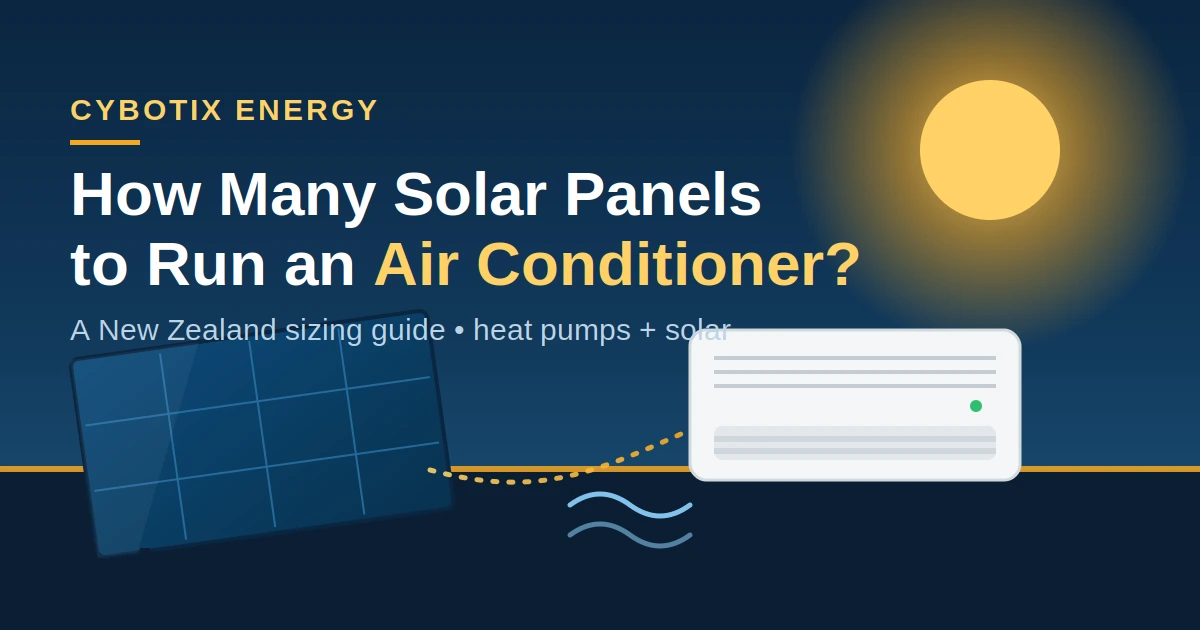
How Many Solar Panels to Run an Air Conditioner: Your heat pump is the biggest single load in most Kiwi homes after hot water. Run it through a muggy Auckland February or a frosty Otago July and you feel it on the bill. So the obvious question comes up fast: how many solar panels do you need to run an air conditioner, and can the panels on your roof actually carry that load?
The honest answer is “it depends” but not in a hand-wavy way. It depends on four things you can measure: how much power your AC draws, how many hours you run it, how much sun your region gets, and whether you want cooling only while the sun’s up or right through the night. Get those four numbers and the panel count falls out of a simple calculation. Let’s work through it for New Zealand conditions.
The short answer: How Many Solar Panels to Run an Air Conditioner
Most New Zealand homes need roughly 3 to 8 panels (400W each) to run a single heat pump during strong daytime sun, or 6 to 12 panels plus a battery if you want cooling that carries into the evening. A small bedroom unit sits at the low end; a large open-plan or ducted system sits at the top.
That range assumes modern 400W panels and real NZ sun hours. The exact figure hinges on your unit’s size and how long it runs, which is where the maths comes in.
What determines how many panels you need
Four variables drive the whole calculation. Nail these and everything else is arithmetic.
Your air conditioner’s power draw
The number that matters is the electrical input in watts, not the cooling or heating output. A heat pump rated to deliver 6 kW of heat might only draw 1.5 kW of electricity, because it moves heat rather than creating it that’s the magic of a coefficient of performance (COP) above 3.
Typical NZ figures:
- Small high-wall unit (bedroom): around 1 kW input, roughly 4–6 kWh a day in use
- Medium lounge unit (~5 kW output): around 1.5 kW input, roughly 5–10 kWh a day
- Large open-plan or ducted system (7 kW+): 2 kW or more, 12–20 kWh a day
Cooling mode usually draws slightly less than heating, unless you’re pushing the indoor temperature far below a very hot outdoor day.
NZ sun hours by region
Peak sun hours (PSH) tell you how many hours of “full-strength” sun your panels effectively get. New Zealand averages a solid resource — <cite index=”4-1″>NZ receives about 4 kWh/m² per day, comparable to southern France.</cite>
But the seasonal swing is brutal, and it gets worse the further south you go. <cite index=”4-1″>In Auckland, June output is 28% of the January peak. In Christchurch it is 18%, and in Dunedin just 16%.</cite> Auckland’s annual average lands at <cite index=”9-1″>4.3 peak sun hours per day annually, ranging from 1.97 in June to 6.66 in January.</cite>
This matters enormously for AC. In summer, when you most want cooling, your panels are at their best. In winter, when you want heating, they’re at their weakest — so a system sized for summer cooling will fall short of covering winter heating unless you plan for it.
Panel wattage
Panel size sets how many units you physically need. <cite index=”28-1″>Standard residential modules now range from 370 to 440 watts per panel, with efficiency ratings between 19% and 23%.</cite> This guide uses 400W as the baseline. Choose 440W+ panels and you need slightly fewer; older or smaller panels push the count up.
Daytime use vs battery storage
This is the big fork in the road. Solar only produces while the sun shines. If you run your AC in the afternoon heat, panels can feed it directly. If you want it cooling the bedroom at 10pm, that energy has to come from somewhere either a battery you charged during the day, or the grid.
For most grid-connected NZ homes, the smart play is to self-consume solar during the day and lean on the grid at night. As one NZ guide puts it, <cite index=”8-1″>with retail rates of 28-38 cents/kWh and feed-in rates of only 8-12 cents, every kWh you self-consume saves 3-4x more than every kWh you export.</cite> Running your heat pump while the panels are producing is one of the best ways to capture that value.
The sizing math, step by step
Use this formula: Panels ≈ (AC watts × hours) ÷ (400 × peak sun hours × 0.75). The 0.75 is a real-world derate for heat, wiring, inverter losses, and imperfect roof angle. Round up, then add margin if reliability matters.
Here’s a worked NZ example. Say you’ve got a 1.5 kW-input lounge heat pump, you run it 6 hours a day in an Auckland summer, and you’re sizing against summer sun (about 6 PSH in January):
- Daily energy: 1.5 kW × 6 hours = 9 kWh
- Divide by usable panel output: each 400W panel at 6 PSH with 0.75 derate = 400 × 6 × 0.75 = 1,800 Wh = 1.8 kWh per panel per day
- Panels needed: 9 ÷ 1.8 = 5 panels
Now repeat for winter heating in Christchurch, where June PSH can drop near 2:
- Each panel yields 400 × 2 × 0.75 = 600 Wh = 0.6 kWh/day
- The same 9 kWh load would need 15 panels which shows why you don’t size a whole solar system around midwinter AC alone. You size for annual self-consumption and accept the grid tops you up in the darkest weeks.
Sizing table: AC size vs panels needed (NZ)
This table assumes 400W panels, a 0.75 derate, and summer sun hours (~5.5–6 PSH, typical of a good NZ summer). Daytime-only means running the AC while the sun’s up; with-battery adds storage for evening cooling.
| Heat pump size | Input power | Daily use (summer) | Panels — daytime only | Panels + battery (evening cover) |
|---|---|---|---|---|
| Small high-wall (bedroom) | ~1.0 kW | 4–6 kWh | 3–4 | 5–6 |
| Medium lounge (~5 kW output) | ~1.5 kW | 6–9 kWh | 4–6 | 7–9 |
| Large open-plan (~7 kW output) | ~2.0 kW | 10–14 kWh | 6–8 | 9–12 |
| Ducted / whole-home | 2.5 kW+ | 14–20 kWh | 8–12 | 12–18 |
These figures line up with international sizing guidance one recent guide notes <cite index=”24-1″>most home AC units need about 3–12 modern 400W panels to run in strong daytime sun, while 5–19 panels plus a battery bank is more typical if you want several hours of cooling that continues into evening.</cite> The NZ twist is our steeper winter drop-off.
Do you need a battery to run AC on solar?
Not for daytime cooling. If you are home in the afternoon and run the AC when the sun is strong, panels feed it directly and no battery is required. A battery only becomes necessary when you want stored solar to run the unit after dark, off-grid.
For grid-tied homes, a battery is a lifestyle-and-resilience choice, not a technical must. Here’s the trade-off:
Pros of adding a battery:
- Run AC (and everything else) into the evening on your own solar
- Backup during outages valuable in storm-prone regions
- Higher self-consumption, so less cheap export and more expensive grid offset
Cons:
- Significant upfront cost that lengthens payback
- Extra summer capacity often sits unused once daytime loads are covered
- Winter is when you’d lean on it most for heating exactly when there’s least solar to charge it
For most Kiwi households, sizing panels to cover daytime cooling and letting the grid handle the rest gives the best return. A battery makes more sense if you have frequent outages or you’re genuinely off-grid.
Solar options for cooling NZ homes
There’s no special “solar air conditioner” you must buy. Standard inverter heat pumps run perfectly on solar power you just need the right system feeding them. Three common setups:
Standard heat pump + grid-tied solar (most common)
Your existing or new inverter heat pump runs on solar during the day and the grid at night. Simplest, cheapest, and the best value for most homes. No battery, no fuss you just maximise daytime self-consumption.
Hybrid inverter + battery for backup
A hybrid inverter manages panels, battery, and grid together, so you can store surplus solar and run the AC into the evening or through an outage. The right choice if resilience matters or you’re partially off-grid. Cybotix Energy’s range of hybrid solar inverters covers single- and three-phase homes for exactly this kind of setup.
DC / solar-direct AC units
A handful of units run straight off DC solar with minimal conversion. They’re niche in NZ and best suited to specific off-grid or cabin scenarios rather than a standard home retrofit. For most people, a standard inverter heat pump on a well-sized solar system is the better path.
Costs and payback in NZ
A typical residential solar system runs NZ$8,000–$14,000 for 4–6 kW installed, and pays back over several years mainly through bill savings. Running your heat pump on that solar is one of the loads that makes the numbers work, because you’re offsetting expensive grid power with your own.
On payback, current NZ estimates land around <cite index=”8-1″>7-12 years depending on location and self-consumption</cite>, with sunnier regions faster a Whakatane system, for instance, can hit <cite index=”6-1″>payback in just over 6 years</cite>. Two factors move this most: how much of your solar you self-consume, and your local power rate. Since heat pumps are a large, controllable daytime load, they’re a genuine lever on your self-consumption rate.
Common mistakes when sizing solar for AC
A few traps catch people out. From what we see in NZ installs:
- Sizing off cooling output, not electrical input. A 6 kW heat pump doesn’t draw 6 kW of power usually closer to 1.5–2 kW. Size on the input rating or you’ll massively over-buy panels.
- Ignoring the winter heating load. A system that nails summer cooling can fall well short of winter heating, when sun is scarce and demand peaks. Plan for both, or accept grid top-up in July.
- Forgetting compressor startup surge. AC compressors draw a brief surge on start-up. Your inverter needs the headroom, especially in off-grid or battery setups.
- Assuming a battery is required. For daytime cooling on a grid-tied home, it is not and skipping it can improve your payback.
- Over-fixating on panel count instead of self-consumption. The win isn’t just generating power; it’s using it yourself during peak solar hours rather than exporting it cheaply.
FAQs
Can solar panels run an air conditioner without a battery?
Yes, during daylight. If you run the AC while the sun is shining, panels feed it directly with no battery needed. A battery is only required to run the unit after dark on stored solar grid-tied homes simply draw from the grid at night instead.
How many kWh does an air conditioner use per day in NZ?
A small high-wall heat pump uses roughly 4–6 kWh a day in use; a medium lounge unit 6–10 kWh; and a large ducted system 12–20 kWh. Cooling typically uses a little less than heating for the same unit.
Will solar run my heat pump in winter?
Partly. Winter sun is far weaker Christchurch’s June output is about 18% of its summer peak so a summer-sized system will only cover a fraction of winter heating. Most homes rely on the grid to top up through the coldest weeks.
Can I run AC at night on solar?
Only with a battery. Panels produce nothing after dark, so night-time cooling on solar requires a battery charged during the day. Otherwise a grid-tied system runs the AC on grid power overnight while your daytime solar earns credits or offsets other loads.
How many panels do I need for a 5kW heat pump?
A ~5 kW-output heat pump draws around 1.5 kW of electricity and needs roughly 4–6 panels (400W) for daytime summer cooling, or 7–9 with a battery for evening use. Exact numbers depend on your run hours and region.
Do I need a special solar air conditioner?
No. Standard inverter heat pumps sold in NZ run on solar power without modification. You just need a correctly sized solar array and inverter to feed them.
Does a more efficient heat pump reduce the panels I need?
Yes. A higher-COP inverter unit produces more cooling per kilowatt of electricity, so it draws less power and needs fewer panels to run. Upgrading efficiency is often cheaper than adding extra panels.
Ready to size your system properly?
Every home is different your heat pump, your region’s sun, your daily routine, and your power rate all shift the answer. If you want a panel count based on your actual numbers rather than a rule of thumb, talk to the team at Cybotix Energy for a tailored solar and heat pump sizing assessment.