If you learned nine planets in school and someone recently told you it’s eight, you’re not misremembering the answer genuinely changed. Today the solar system officially has eight planets, after Pluto was reclassified in 2006. But that clean number hides a more interesting story: a growing list of dwarf planets, a decades-old definition still argued over, and an active hunt for a possible ninth world that’s very much alive in 2026. Here’s the full picture, from the settled answer to the parts scientists are still working out.
The short answer: how many planets are in the solar system?
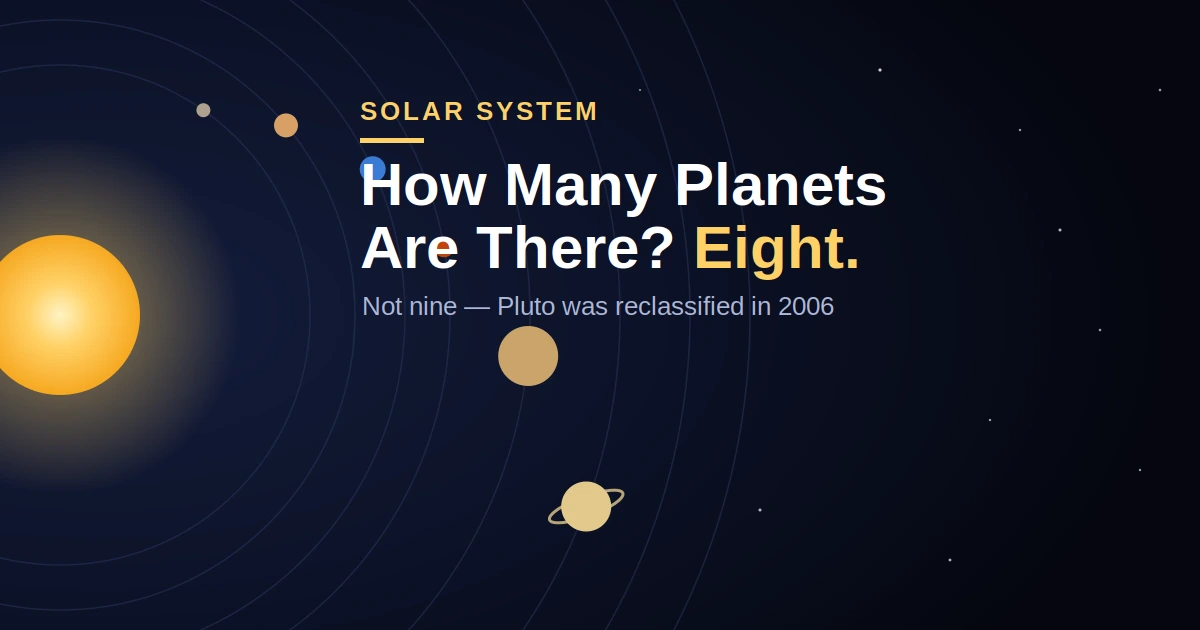
The solar system has eight planets: Mercury, Venus, Earth, Mars, Jupiter, Saturn, Uranus, and Neptune. This has been the official count since 2006, when the International Astronomical Union (IAU) reclassified Pluto as a dwarf planet. If you were taught nine, you were counting Pluto which held the title from 1930 to 2006.
NASA states it plainly: <cite index=”32-1″>our solar system has eight planets, and five dwarf planets all located in an outer spiral arm of the Milky Way galaxy called the Orion Arm.</cite>
The eight planets in order from the Sun
The eight planets split into two families: four small, rocky inner planets, and four large, gas- or ice-rich outer planets. In order of distance from the Sun, they are Mercury, Venus, Earth, Mars, Jupiter, Saturn, Uranus, and Neptune.
Here’s each at a glance:
| # | Planet | Type | Key trait |
|---|---|---|---|
| 1 | Mercury | Terrestrial (rocky) | Closest to the Sun and the smallest planet |
| 2 | Venus | Terrestrial (rocky) | Hottest planet; thick, toxic atmosphere |
| 3 | Earth | Terrestrial (rocky) | The only known planet with life |
| 4 | Mars | Terrestrial (rocky) | The “red planet,” with the tallest volcano |
| 5 | Jupiter | Gas giant | Largest planet; the Great Red Spot storm |
| 6 | Saturn | Gas giant | Famous for its bright ring system |
| 7 | Uranus | Ice giant | Rotates on its side |
| 8 | Neptune | Ice giant | Farthest planet; strongest winds |
The inner (terrestrial) planets
Mercury, Venus, Earth, and Mars are the four inner planets. They’re called terrestrial because they have solid, rocky surfaces. As NASA describes it, <cite index=”32-1″>the first four planets from the Sun Mercury, Venus, Earth, and Mars are known as terrestrial planets because they have solid surfaces.</cite> They’re comparatively small and dense, and sit closer together than the outer worlds.
The outer (giant) planets
Jupiter, Saturn, Uranus, and Neptune are the giants. Jupiter and Saturn are gas giants, made mostly of hydrogen and helium. Uranus and Neptune are ice giants, with more water, ammonia, and methane in the mix. All four are vastly larger than Earth and orbit far from the Sun, separated from the inner planets by the asteroid belt.
Why isn’t Pluto a planet anymore?
Pluto lost its planet status in 2006 because the IAU wrote a formal definition of “planet” for the first time — and Pluto didn’t meet all of it. The sticking point: a planet must have “cleared its neighbourhood” of other objects. Pluto shares its region, the Kuiper Belt, with countless icy bodies, so it was reclassified as a dwarf planet.
Under the IAU’s 2006 definition, an object must do three things to count as a planet:
- Orbit the Sun (not another planet).
- Be massive enough for its own gravity to pull it into a nearly round shape.
- Have “cleared the neighbourhood” around its orbit of other comparable objects.
Pluto passes the first two but fails the third. It was actually the discovery of similar-sized objects out in the Kuiper Belt most notably Eris, roughly Pluto’s size that forced the issue. Astronomers faced a choice: call all of them planets and let the count balloon, or draw a clearer line. They drew the line, and Pluto ended up on the dwarf-planet side of it.
This remains one of the most debated decisions in modern astronomy. Some planetary scientists still argue the “cleared the neighbourhood” rule is flawed, and there’s an ongoing minority push to revise the definition. So while eight is the official answer, it isn’t universally loved.
What about dwarf planets?
Dwarf planets are round objects that orbit the Sun but haven’t cleared their orbital neighbourhood. The IAU currently recognises five: Pluto, Eris, Ceres, Haumea, and Makemake. That number could grow, since several other objects are strong candidates awaiting formal classification.
The recognised five:
- Ceres — the largest object in the asteroid belt, and the only dwarf planet in the inner solar system
- Pluto — the best known, out in the Kuiper Belt
- Eris — roughly Pluto’s size; its discovery triggered the 2006 reclassification
- Haumea — an odd, elongated, fast-spinning body with its own ring
- Makemake — another sizeable Kuiper Belt object
Astronomers estimate there could eventually be dozens or even hundreds more dwarf planets as surveys of the outer solar system improve. So if your real question is “how many round worlds orbit the Sun,” the honest answer is: at least 13 that we’ve named, and likely many more to come.
Is there a ninth planet? The Planet Nine search
Maybe but it hasn’t been found, so it doesn’t count yet. “Planet Nine” is a hypothesised world in the far outer solar system, proposed in 2016 to explain the strangely clustered orbits of distant icy objects. It’s a genuine, active area of research in 2026, not science fiction, but until it’s directly observed it remains unconfirmed.
The idea started when astronomers noticed a group of Kuiper Belt objects moving in oddly similar orbits, as if shepherded by something massive and unseen. In 2016, Caltech’s Michael Brown and Konstantin Batygin proposed that <cite index=”28-1″>the similarity in orbits could be caused by the presence of a planet with a mass more than 10 times that of Earth.</cite>
Where things stand now:
- Still not found. As of recent searches, <cite index=”28-1″>Planet Nine has not been found, despite both large-scale sky surveys and targeted searches.</cite>
- A powerful new tool is looking. The Vera C. Rubin Observatory, which achieved first light in 2025, is now running its Legacy Survey of Space and Time. One estimate gives it a <cite index=”27-1″>roughly 70–80% chance of detecting Planet Nine if it exists.</cite>
- New candidates and complications. In 2025, researchers reported a possible candidate in archival infrared data, <cite index=”27-1″>consistent with a planet of 7 to 17 Earth masses at 500–700 AU.</cite> Meanwhile, fresh discoveries in the Kuiper Belt keep testing the theory.
It’s worth being clear-eyed: not everyone is convinced. Some astronomers argue there simply isn’t enough long-term orbital data yet. As one summary of the debate notes, <cite index=”29-1″>the biggest issue is that the outer solar system hasn’t been observed for long enough</cite> some of these distant objects take tens of thousands of years to complete a single orbit, so subtle gravitational nudges are hard to pin down. New finds like the object 2023 KQ14 have actually complicated the picture rather than confirmed it.
The takeaway: if Planet Nine is confirmed, the textbook answer becomes nine again. Until then, eight stands.
How the count has changed over time
The number of planets isn’t fixed by nature it depends on how we define “planet,” and that definition has shifted. Here’s the short history:
- Ancient times: Five planets were known (Mercury, Venus, Mars, Jupiter, Saturn), visible to the naked eye.
- 1781: Uranus discovered, bringing the count to six (plus Earth).
- 1846: Neptune discovered — eight.
- 1930: Pluto discovered and counted as the ninth planet.
- 2006: The IAU defines “planet,” reclassifies Pluto, and the count returns to eight.
- Today: Eight planets, five recognised dwarf planets, and an open question about a possible ninth.
The lesson is that “how many planets” is partly a science question and partly a naming question. The objects don’t change; our categories do.
Pros and cons of the eight-planet definition
The 2006 definition is useful but genuinely contested. Here’s the balanced view:
Arguments for it:
- Gives a clear, testable rule instead of an ever-growing list
- Prevents the count ballooning as we find more Pluto-sized bodies
- Reflects a real physical difference (planets dominate their orbits; dwarf planets don’t)
Arguments against it:
- “Cleared the neighbourhood” is fuzzy and hard to apply at the edges
- It would arguably disqualify some planets if they orbited farther out
- Many planetary scientists prefer a definition based on the object itself, not its orbit
- It sidelined Pluto in a way the public never fully accepted
FAQs
How many planets are in the solar system right now?
Eight: Mercury, Venus, Earth, Mars, Jupiter, Saturn, Uranus, and Neptune. This has been the official count since 2006. A possible ninth planet is being searched for, but it hasn’t been confirmed.
Why is Pluto not a planet?
Pluto was reclassified as a dwarf planet in 2006 because it hasn’t “cleared its neighbourhood” it shares the Kuiper Belt with many other icy objects. It still meets the other criteria (orbiting the Sun, being round), but not that one.
Is Pluto a planet again?
No. Pluto remains a dwarf planet under the current IAU definition. There’s an ongoing debate about revising the definition, but as of now the official status hasn’t changed.
How many dwarf planets are there?
Five are officially recognised: Ceres, Pluto, Eris, Haumea, and Makemake. More candidates exist, and the number is expected to grow as surveys of the outer solar system improve.
What is Planet Nine?
Planet Nine is a hypothesised planet in the far outer solar system, proposed to explain the clustered orbits of distant icy bodies. It’s estimated to be several times Earth’s mass but has not been directly observed, so it isn’t counted yet.
What are the eight planets in order?
From the Sun outward: Mercury, Venus, Earth, Mars, Jupiter, Saturn, Uranus, and Neptune. The first four are rocky (terrestrial) planets; the last four are giant planets.
Could the number of planets change again?
Yes. If Planet Nine is confirmed, the count would rise to nine. The definition of “planet” could also be revised, which would change how objects like Pluto are classified.
A note on our “solar system”
The eight planets all share one thing: they orbit a single, ordinary star pouring out energy that makes life and everything else possible. That same sunlight reaching Earth is what home solar systems capture and turn into usable power. If reading about the Sun’s planets has you curious about harnessing its energy at home, you can learn about solar options for New Zealand at Cybotix Energy.