You looked at your last summer power bill, worked out that the AC ran for about $300 of that, and made the small quiet decision to just be hot next January. If that sounds familiar, you’re the reader this article is for.
A Wall Mounted Solar AC NZ: specifically, a hybrid AC/DC split system promises to fix that number by running the compressor directly off solar panels instead of paying retail rates for the same kilowatt-hours you’re already generating on the roof. It’s a real technology, it’s now widely available in NZ, and the maths on it has shifted meaningfully in the last two years. But it’s not automatically the right answer for every home. This is an honest look at where it works.
What a wall Mounted solar AC NZ actually is (and how “hybrid AC/DC” works)
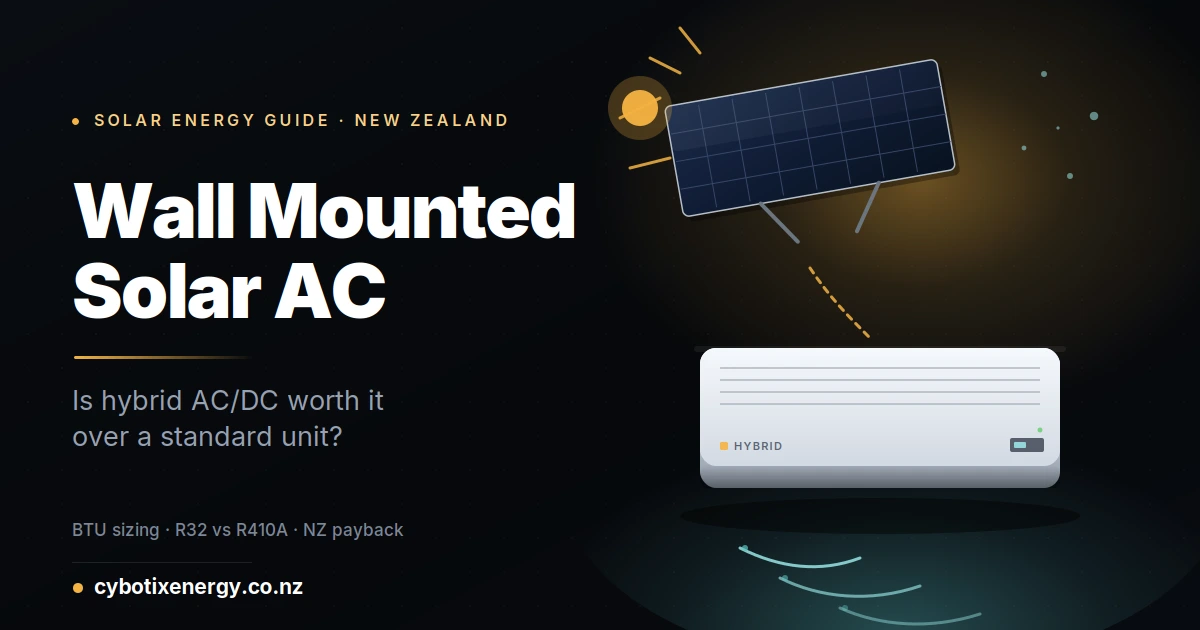
A wall mounted solar AC is a standard split-system air conditioner with a modified inverter that accepts direct DC input from solar panels alongside the usual AC mains connection. The two feeds run in parallel: sun powers the compressor first, mains fills the gap. No grid-tie inverter sits in between.
That distinction matters more than it sounds. On a normal rooftop solar setup, DC from the panels gets converted to AC by an inverter, sent out to the grid or into your appliances, and for an air conditioner converted back to DC inside the AC’s own inverter to drive the variable-speed compressor. Every conversion loses a few percent. A hybrid solar AC removes two of those steps entirely.
The three input modes solar-only, hybrid, and mains-only
The unit switches between these automatically:
- Solar-only — bright day, panels producing more than the AC needs. Draws zero from the grid.
- Hybrid — partial cloud or high load. Uses whatever the panels supply and tops up from mains.
- Mains-only — night, or heavily overcast. Behaves as a normal AC.
No user intervention required. The transitions happen inside the inverter in milliseconds.
Why NZ homeowners are looking at this in 2026
Two numbers moved sharply against each other over the last three years: retail electricity rose from around 33c/kWh to a national average close to 39c/kWh, while solar export rates stayed anchored at 8–17c/kWh for most retailers. That gap you sell cheap, buy back expensive is why “use it yourself” has quietly become the highest-value thing you can do with rooftop solar.
Air conditioning is the largest same-time daytime load most homes could add. If you can run it directly off panels during peak sun, you’re avoiding 39c/kWh imports instead of earning 12c/kWh exports on the same power a roughly 3× improvement in the value of that solar generation.
The buyback rate problem
Most NZ retailers currently pay 8–17c/kWh for exported solar and charge 28–48c/kWh (depending on region) for the same power back at night. A few time-of-use plans pay more in peak windows, but flat rates dominate. Anything you can consume the moment you generate it is effectively worth the full retail rate you’d otherwise pay which is why matching load to generation, rather than exporting and buying back, is the single biggest lever on rooftop solar economics.
How wall-mounted solar AC compares to a standard AC with grid-tied solar
Direct answer: a hybrid solar AC is more expensive upfront than a standard AC, but avoids the 20-30% round-trip losses of exporting and buying back the same energy. For a household that runs AC heavily during daylight hours, payback improves meaningfully. For a household that mostly cools in the evening, it doesn’t.
| Setup | Upfront cost (NZD) | Runs during outage | Daytime kWh cost | Evening kWh cost | Best for |
|---|---|---|---|---|---|
| Standard AC on mains | $1,500–$3,000 | No | 35–42c | 35–42c | Renters, low AC use |
| Standard AC + existing grid-tied solar | Solar $10,000+, AC $1,500–$3,000 | No (unless battery) | ~10–15c (self-consumed) | 35–42c | Homes with existing solar |
| Wall-mounted hybrid solar AC + dedicated panels | AC $2,500–$5,000, panels $1,500–$3,500 | Yes (solar-only mode) | ~0c fuel | 35–42c | Rural, off-grid backup, daytime users |
The third option isn’t universally better it’s better for the specific use case of running an AC during the hours the sun is on the roof, without needing to size and fund a full home solar system to do it.
Sizing a wall-mounted solar AC matching BTU to your room
NZ homes typically need roughly 9,000 BTU per 15–20 m² of floor area, adjusted up for high ceilings, north-facing glazing, poor insulation, or a kitchen; adjusted down for well-insulated, single-storey, south-facing spaces. Under-sizing means the unit runs flat out and never quite cools; over-sizing means short-cycling and worse humidity control.
Rough sizing guide for NZ conditions:
| Room size | Typical use | Recommended size |
|---|---|---|
| 12–20 m² | Bedroom, small office | 9,000 BTU |
| 20–35 m² | Living room, master bedroom | 12,000 BTU |
| 35–55 m² | Open-plan lounge, small shop | 18,000 BTU |
| 55–80 m² | Large open-plan area, workshop, café | 24,000 BTU |
When to size up (and when not to)
Size up if the room has poor insulation, west-facing afternoon sun, a lot of glazing, or gets heavy use during 30°C+ days. Don’t size up “just to be safe” an oversized AC reaches temperature too quickly, cycles off, then back on, and never runs long enough to properly dehumidify. You end up with a cold, damp room and higher power draw.
The R410A vs R32 refrigerant choice
R32 is the newer refrigerant with roughly a third the global warming potential of R410A and marginally better thermodynamic efficiency. R410A is still legal, widely available, and serviceable in NZ, but it’s on the phase-down list under the Kigali Amendment meaning long-term parts and refrigerant costs will drift upward as supply tightens.
For a unit you’re planning to run for 10+ years, R32 is the safer forward-looking choice. That said, R410A units still work fine, remain fully supported, and are often slightly cheaper upfront. If your installer offers both, choose based on total lifecycle cost, not on assumptions about imminent bans.
What panels you need and whether existing rooftop solar will work
Direct answer: hybrid solar AC units typically accept 300–500V DC from a dedicated string of panels, wired directly to the outdoor unit. You generally cannot tap an existing grid-tied inverter’s output, because that output is 230V AC, not the DC voltage the AC’s internal inverter is designed to accept.
Rough panel count for each size:
- 9,000 BTU — 2–4 panels (~800–1,600W)
- 12,000 BTU — 3–5 panels (~1,200–2,000W)
- 18,000 BTU — 4–6 panels (~1,600–2,400W)
- 24,000 BTU — 6–8 panels (~2,400–3,200W)
That’s per unit, not per home. If you’re running AC in three rooms, you are either sharing a larger array across multiple hybrid units or adding a dedicated string per unit.
Off-grid, hybrid, and grid-parallel wiring configurations
Three legitimate setups:
- Hybrid parallel (most common): dedicated solar string to the AC, AC also plugged into the mains circuit. Sun runs it first, mains fills gaps. No grid-tie inverter needed.
- Off-grid: solar plus battery, no mains connection. Works for cabins, sleepouts, remote workshops.
- Grid-tie parallel: combines the hybrid AC’s dedicated solar string with a house’s existing grid-tied array. Requires careful design to avoid backfeeding conflicts; get a licensed electrician involved from the start.
Real-world NZ economics a worked example
For an Auckland home running an 18,000 BTU AC around 1,200 hours a year at an average draw of 1.6 kW, that’s roughly 1,920 kWh/year. At 39c/kWh retail, mains-only running costs about $750/year. Shifting even 60% of that consumption to direct solar during daylight hours drops the running cost to roughly $300/year an annual saving in the range of $400–$500.
Against a hybrid solar AC premium of roughly $1,500–$2,500 over a standard unit (including the dedicated panels), payback lands somewhere between three and six years well inside the equipment’s operational lifespan. Cooler regions running less AC will see longer paybacks; hotter regions and commercial daytime users see shorter ones.
Installation, consents, and warranty in New Zealand
Direct answer: refrigerant work must be done by a licensed refrigeration technician, and DC solar wiring above certain voltages needs a registered electrician. Residential retrofit generally doesn’t require council consent, though localised rules apply to heritage buildings and body corporates. Warranty terms typically run 3–5 years on the unit, longer on the compressor.
What a licensed installer actually does
A proper install includes:
- Sizing survey floor area, insulation, glazing, orientation
- Roof survey for the dedicated solar string orientation, pitch, shading
- Refrigerant line set installation, evacuation, and charging
- DC wiring from panels to outdoor unit, with appropriate isolators and surge protection
- AC connection and RCD/breaker sizing on the mains side
- Commissioning check solar input, hybrid switchover, cooling output
Any quote missing steps 4 or 5 isn’t a real hybrid solar install it’s a normal AC with a solar system sold as an add-on.
Who should buy a wall-mounted solar AC and who shouldn’t
Good fit:
- Rural or lifestyle-block homes without existing grid-tied solar
- Small businesses running AC heavily during business hours (cafés, salons, small offices)
- Off-grid cabins, sleepouts, and workshops
- Homes with south-facing roofs unsuitable for a full solar system but with a spot for 3–6 panels
- Buyers wanting AC that keeps working during grid outages
Poor fit:
- Households that mostly run AC in the evening after work
- Apartments with no roof or panel-mounting rights
- Homes with existing large grid-tied solar arrays and low daytime consumption (a standard AC on your existing solar may be cheaper)
- Buyers unwilling to add dedicated panels (retrofitting to an existing string usually isn’t feasible)
FAQs
Does a solar AC work at night?
Yes. When solar output drops to zero, the unit switches to mains power automatically and runs exactly like a standard AC. You don’t lose functionality after sunset you just stop generating fuel savings.
Can I run it on solar panels I already have?
Usually not directly. Most existing rooftop solar is grid-tied through an inverter that outputs 230V AC, but a hybrid solar AC expects DC input at 300–500V from a dedicated panel string. You can run the AC from your existing solar through the mains connection (as any AC would), but you won’t get the direct-DC efficiency benefit.
How many solar panels do I need?
Between 2 and 8 panels depending on unit size roughly 800W for a 9,000 BTU unit up to 3,200W for a 24,000 BTU unit. Your installer will size the array to match the outdoor unit’s DC input range.
Is R32 or R410A better?
R32 has lower environmental impact and marginally better efficiency, and it’s the direction the industry is moving. R410A is still fully supported and slightly cheaper. For a 10-year investment, R32 is the safer future-proof choice, but either works well today.
Do I need council consent to install one in NZ?
Generally not for residential retrofit. Refrigerant work must be done by a licensed technician, DC wiring by a registered electrician, and body corporates or heritage properties may have their own rules. Check with your local council if you’re unsure.
How much can I actually save on power bills?
For an average NZ household running AC 1,000–1,500 hours a year, savings typically fall in the $300–$600 range annually enough to pay back the hybrid premium in three to six years for a well-matched install, longer for lighter users. Cooling more, in a warmer region, shortens payback.
What happens on a cloudy day?
The unit blends solar and mains automatically whatever the panels produce, the AC uses first, and mains fills the rest. You don’t lose comfort; you just save less on that specific day. Over a full year, cloud cover is already baked into the average generation figures used for sizing.