You have built a solar array and battery bank for the bach, the sleepout, or the tiny home you actually live in. Then you priced an air conditioner and hit the wall: every unit on the shelf needs 240 V mains power, which is exactly what your off-grid property doesn’t have.
That’s the specific problem a wall mounted solar AC off-grid DC 48V system solves. It’s not the same as a hybrid AC/DC unit designed to reduce power bills on a grid-tied house it’s a fundamentally different product built to run directly from your solar panels and battery bank at 48 V DC, with no mains connection required. If you’re building off-grid in New Zealand and want cooling in summer plus heating in winter, this is the class of AC that actually fits your setup.
What a DC 48V wall-mounted solar AC actually is
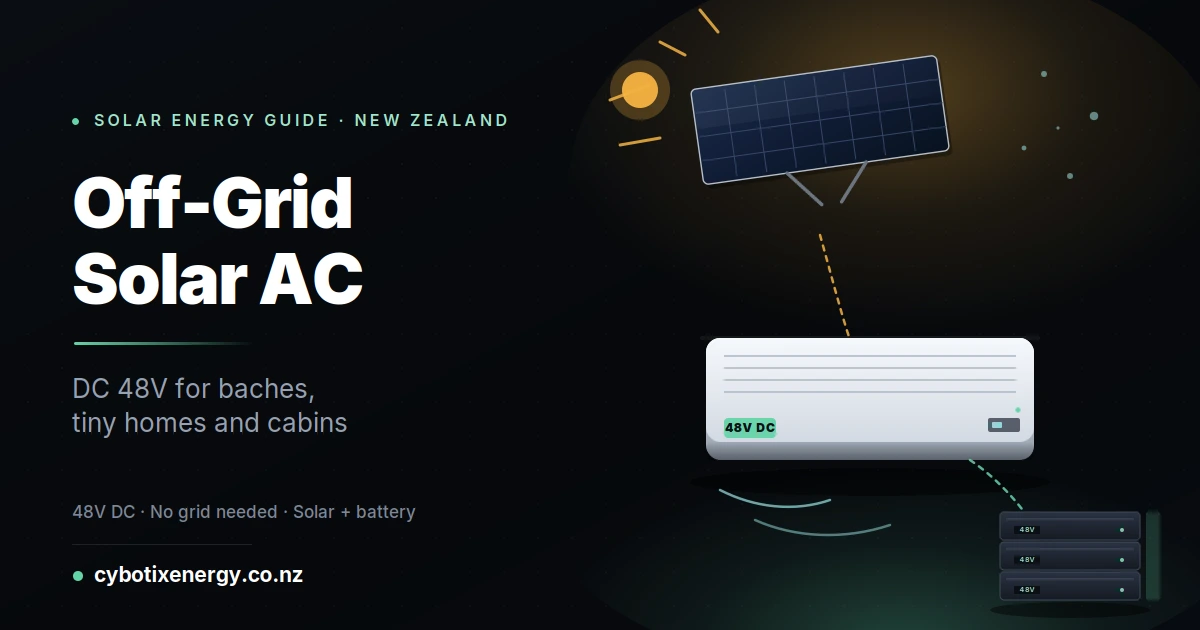
A DC 48 V wall-mounted solar AC is a split-system air conditioner engineered to run directly on 48 volts of direct current, sourced from solar panels and a battery bank. No inverter conversion, no mains connection, no grid dependency. Same physical installation as a normal split system outdoor compressor unit, indoor wall-mounted head but with a compressor and control board designed for DC input at battery-bank voltage.
The result: you get the same cooling and heating experience as a mains-powered split system, but powered entirely from your off-grid electrical system. The unit accepts DC power directly and converts it internally to whatever the compressor motor needs.
Off-grid DC vs hybrid AC/DC vs standard AC three different products
These three categories look similar in marketing but do fundamentally different jobs:
- Standard AC — runs on 230 V mains only. Useless without grid or an inverter.
- Hybrid AC/DC — runs on 230 V mains and accepts a DC solar input in parallel. Best for grid-tied homes wanting to reduce daytime power bills.
- Off-grid DC 48 V (this product) — runs on 48 V DC only. No mains input. Purpose-built for off-grid installations without any grid connection.
Picking the wrong category means either paying for capability you can’t use, or buying a unit that literally cannot function on your setup.
Why 48V DC is the right voltage for off-grid cooling
48 V matches the standard voltage of most modern off-grid battery banks in New Zealand. Skipping the inverter conversion loss (typically 8–15%), allowing thinner wiring at safer voltages than lower systems, and connecting directly to your existing infrastructure makes 48 V the practical sweet spot for off-grid AC installations.
Most serious off-grid battery systems built in the last few years LiFePO₄ banks from Pylontech, BYD, Victron, or similar run at 48 V nominal. Wiring your AC to match that voltage means:
- No inverter losses — a typical grid-tie inverter loses 8–15% of the DC power passing through it as heat. Over a summer of daytime cooling, that’s real money.
- Safer wiring — 48 V is below the threshold where the electrical code requires the strictest safety measures, unlike 230 V AC or higher DC voltages.
- Direct battery integration — you’re not going battery → inverter → AC (three conversions). You’re going battery → AC (one conversion inside the unit itself).
The inverter efficiency problem in real numbers
Say your 12,000 BTU air conditioner draws 1.2 kW while running. Through a typical off-grid inverter at 88% efficiency, that pulls 1,365 W from your battery instead. Over 8 hours of running: wasted energy = 1.3 kWh per day, or roughly one hour of extra AC runtime lost to conversion. Over a full summer, that’s the difference between the battery lasting the whole evening and running out at 10 pm.
BTU sizing for off-grid installations
The same sizing rules apply as any other AC roughly 9,000 BTU per 15–20 m² of floor area, adjusted for insulation, orientation, ceiling height, and window area. For off-grid installations specifically, sizing conservatively pays off because bigger AC = more panels and battery = significantly more cost.
Under-sizing means the unit runs longer to reach temperature. Over-sizing means short-cycling, poor humidity control, and an oversized solar system to feed it.
Room-size to BTU mapping for typical off-grid spaces
| Room / Space | Typical use | Recommended size |
|---|---|---|
| 12–20 m² | Bach bedroom, sleepout, tiny home living/sleeping combo | 9,000 BTU |
| 20–35 m² | Open-plan tiny home, bach lounge, small cabin | 12,000 BTU |
| 35–55 m² | Full-size bach, off-grid cabin, small commercial | 18,000 BTU |
| 55–80 m² | Large open-plan off-grid home, workshop with living quarters | 24,000 BTU |
Most NZ bach and tiny-home installs land in the 9,000–12,000 BTU range. Full off-grid homes typically need 18,000 or 24,000 BTU depending on layout and insulation.
Sizing the solar array and battery bank behind it
A DC 48 V AC only performs well if the system feeding it is sized correctly. Rough guide for continuous daytime cooling plus overnight runtime: 2–8 solar panels (400 W each) per unit for daytime generation, plus 5–20 kWh of battery capacity for evening and overnight use. Both scale with BTU size.
Panels for daytime cooling
Assuming NZ’s average of about 4.5 sun-hours per day in summer, and rounding for real-world conditions:
- 9,000 BTU unit — 3–4 × 400 W panels for daytime-only cooling
- 12,000 BTU — 4–5 × 400 W panels
- 18,000 BTU — 6–8 × 400 W panels
- 24,000 BTU — 8–10 × 400 W panels
Panels don’t need to be new many off-grid installers combine new panels with reclaimed grid-tie panels from residential retrofits. What matters is total wattage and proper string voltage into the AC unit’s DC input.
Battery bank for evening and overnight cooling
Battery sizing follows the same logic total kWh needed, plus 30–50% headroom for LiFePO₄ depth-of-discharge margins:
- 9,000 BTU for a 4-hour evening = ~5 kWh battery bank
- 12,000 BTU for 4 hours = ~7 kWh
- 18,000 BTU for 4 hours = ~10 kWh
- 24,000 BTU for 4 hours = ~13 kWh
Running an AC through the night doubles these figures. Most off-grid bach owners run cooling only during peak heat (afternoon and early evening), which keeps battery requirements manageable.
What happens on multiple cloudy days
This is where honest expectations matter. During a stretch of grey, wet weather realistic for parts of NZ in shoulder seasons solar generation drops to 20–30% of sunny-day output. Without a backup generator, you either accept reduced AC use during those days, or over-size your battery bank for multi-day autonomy (which gets expensive fast).
Most practical off-grid installs balance moderate battery capacity (2–3 days autonomy) with a small backup generator for extended overcast periods.
NZ-specific factors that affect off-grid AC performance
Three environmental factors matter more in New Zealand than in temperate US or European markets: coastal humidity and salt corrosion, winter sun-hour scarcity, and cold-weather battery derating.
Coastal installs
Within 5 km of the coast (which covers most NZ off-grid baches), the outdoor compressor unit’s aluminium fins and steel cabinet corrode faster than inland installs. Marine-grade coatings and stainless-steel mounting brackets add 3–5 years to outdoor unit lifespan. Factor a replacement cycle at 8–10 years rather than 12–15 for coastal exposure.
Winter sun hours by region
NZ solar generation varies significantly by latitude and season:
- Northland (Kaitaia): ~3.5 kWh/kW installed in June, ~5.5 kWh in December
- Auckland: ~3.0 kWh/kW in June, ~5.0 kWh in December
- Christchurch: ~2.5 kWh/kW in June, ~5.5 kWh in December
- Invercargill: ~1.8 kWh/kW in June, ~5.5 kWh in December
Winter heating from a solar-fed AC is possible in most of NZ, but Southland and Otago installs need larger arrays (and often a wood burner as primary heat) to be practical.
Cold-weather battery derating
LiFePO₄ batteries deliver less capacity in cold weather a 10 kWh battery might behave like an 8 kWh battery at 5 °C. For year-round off-grid installs in cooler regions, the battery bank should be sized for winter conditions and installed in a temperature-buffered space (garage, insulated battery cabinet) rather than exposed outdoors.
Where DC 48V off-grid ACs make sense and where they don’t
Good fit:
- Rural baches and cribs
- Tiny homes on wheels or foundations
- Sleepouts and granny flats without grid connection
- Off-grid cabins and remote homes
- Glamping and eco-tourism accommodation
- Marine and boat installations (with appropriate 48 V systems)
- Emergency preparedness backup
Not the right fit:
- Grid-connected homes wanting to reduce power bills use a hybrid AC/DC unit instead
- Spaces so small the install complexity isn’t worth it (under 12 m²)
- Buyers without an existing or planned solar-plus-battery system
- Anyone expecting to run the AC 24/7 in winter without extensive solar oversizing
DC 48V off-grid AC vs hybrid solar AC which do you need?
These are two fundamentally different products for two different setups. Getting the choice right at purchase time saves significant re-work later.
| DC 48V Off-Grid AC | Hybrid AC/DC AC | |
|---|---|---|
| Grid connection needed | No — off-grid only | Yes — 230V mains |
| Solar required | Yes (dedicated 48V system) | Optional (works without) |
| Battery required | Yes (48V bank) | No |
| Runs during grid outage | Yes, as long as solar/battery hold | No unless paired with UPS/battery |
| Best for | Rural baches, tiny homes, off-grid properties | Grid-tied homes reducing daytime bills |
| Typical NZ price bracket | Similar to hybrid units, plus solar/battery cost | Similar equipment cost, no battery needed |
Rule of thumb: if your property has no grid connection, buy off-grid DC. If your property is grid-connected but you want lower bills, buy hybrid.
Refrigerant, consent, and licensed installer requirements
R410A is legal in New Zealand but sits on the HFC phase-down list under the Kigali Amendment long-term availability and refrigerant cost will drift upward as global supply tightens. Refrigerant work must be done by a licensed refrigeration technician regardless of whether the unit runs on DC or AC, and off-grid installations may need building consent depending on location and structure type.
R410A vs R32
R32 has roughly a third of R410A’s global warming potential and marginally better efficiency. For a 10-year purchase, R32 is the safer forward-looking choice but R410A is still legal, fully supported, and often slightly cheaper. Confirm with your installer what refrigerant your chosen unit uses before committing.
When you actually need consent for an off-grid install
For a wall-mounted AC on an existing bach, sleepout, or dwelling: typically no consent needed for the AC itself, though the refrigerant work still requires a licensed technician. For a new off-grid dwelling being built with the AC included: consent is likely required as part of the wider building consent. Check with your local council early some allow off-grid tiny homes as “vehicles” under specific conditions, others require full building consent.
Real-world NZ off-grid install a worked example
For a Coromandel weekend bach (30 m² open-plan living space, summer-weighted use):
- AC unit: 12,000 BTU DC 48 V wall-mounted — approximately $2,500–$3,500 NZD
- Solar array: 4 × 400 W panels (1.6 kW total) — approximately $1,200–$2,000
- Battery bank: 10 kWh LiFePO₄ at 48 V — approximately $4,000–$7,000
- DC wiring, MPPT charge controller, breakers — approximately $800–$1,500
- Licensed refrigeration installer — approximately $600–$1,200
- Total system cost: roughly $9,000–$15,000 NZD
For a bach used 40–60 nights per year (typical NZ pattern), that works out to genuine cooling comfort in summer, plus a battery system that also powers lights, water pump, and appliances the rest of the year.
FAQs
Can I run a 48V DC AC directly from solar panels only, without a battery?
Only during peak daylight hours when the panels are producing more than the AC draws. For any consistent cooling including short cloudy periods, evenings, or overnight you need a battery bank between the panels and the AC.
How many solar panels does a 12,000 BTU DC AC need?
For daytime-only cooling in NZ conditions, roughly 4–5 × 400 W panels (about 1.6–2.0 kW total). For overnight runtime, you also need approximately 7 kWh of battery capacity per 4 hours of after-dark cooling.
Is R410A refrigerant still legal in NZ?
Yes. R410A is fully legal and widely supported in NZ. It’s on the long-term HFC phase-down under the Kigali Amendment, meaning supply will tighten and prices rise over time but existing units and their servicing continue to be supported.
Can I use a DC 48V AC in a grid-connected home?
Technically yes, if you have a 48 V battery bank feeding it. But it’s usually overkill a grid-tied home is better served by a hybrid AC/DC unit that uses mains as backup and doesn’t require a dedicated battery bank.
How is DC off-grid AC different from hybrid AC/DC?
Off-grid DC runs only on 48 V DC from solar and battery no mains input at all. Hybrid runs on 230 V mains plus an optional DC solar input, keeping the grid as backup. Different products for different problems.
Do I need council consent to install one on a bach?
For the AC itself on an existing structure: usually not. For a new off-grid dwelling that includes an AC install as part of the build: yes, likely, as part of the broader building consent. Refrigerant work needs a licensed technician regardless.
Can it heat as well as cool?
Yes, most DC 48 V wall-mounted units are reverse-cycle heat pumps that both cool in summer and heat in winter. Efficiency is best in mild conditions; below 0 °C outdoor temperatures, heating output drops significantly.