You have installed solar. You are generating power. Some of it goes to your home; the rest flows back to the grid. And you’ve discovered a frustrating truth: your electricity retailer is paying you a fraction of what they charge to sell the same power back to you at night.
Solar Feed-in Tariffs by NZ Retailer
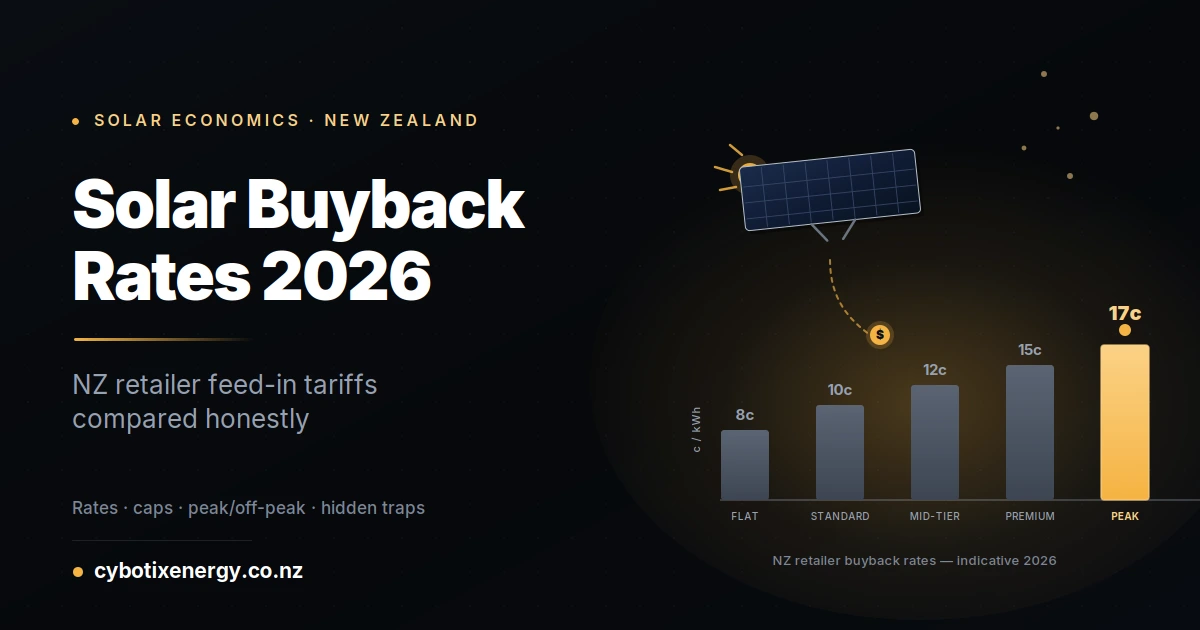
That gap is your solar feed-in tariff (FiT) the per-kWh rate your retailer pays for surplus solar exported to the grid. In New Zealand there’s no government-mandated minimum, so 2026 rates range from 0c to over 17c/kWh depending on retailer, plan, time of day, and cap. This solar feed-in tariffs by NZ retailer 2026 comparison guide breaks down what each major retailer actually pays, what tricks to watch for, and why the highest headline rate isn’t always the best deal.
Important: FiT rates change frequently (some retailers update quarterly). All figures below reflect published rates as of early 2026. Verify current rates on each retailer’s own website before committing to any plan.
What a solar feed-in tariff actually is
A feed-in tariff (or “buyback rate”) is the per-kWh price your electricity retailer pays for surplus solar you export to the grid. Unlike some countries, New Zealand has no regulated minimum each retailer sets its own rates, plan structures, and export caps. This creates significant variation from ~0c on some plans to 17c+ on premium plans.
How it’s different from net metering
Net metering (used in Australia and parts of the US) credits your export at the same rate you buy at a 1:1 swap. Feed-in tariffs (used in NZ) pay you a separate, usually lower, rate for exports than the retail rate you pay for imports. In NZ, you might export at 10c and buy at 33c a 3x gap that fundamentally shapes solar economics here.
The 2026 NZ retailer FiT comparison table
The table below reflects published rates as of early 2026. Verify current rates directly with each retailer before switching — they change more often than most homeowners realise.
| Retailer | Standard Rate (c/kWh incl. GST) | Peak/Off-peak split | Cap | Plan Requirement | Best For |
|---|---|---|---|---|---|
| Meridian (Solar Buyback) | 12.5–17c | Yes (higher at peak) | Varies | Existing customer | Peak-shifted exports (with battery) |
| Genesis (EcoTracker) | 8–12c | Time-of-use | 5 kWh/day cap on some plans | Bundled plan | Steady daytime exports |
| Contact Energy | 8–12c | Flat rate on most plans | Uncapped | Contact plan bundle | Simple, no-fuss exports |
| Mercury (Solar Buyback) | 8–10c | Flat | Uncapped standard | Mercury bundle | Straightforward reliable payments |
| Nova Energy | 8–12c | Flat/some ToU | Varies | Bundle | Regional NZ areas Nova serves |
| Frank Energy | 8–10c | Flat | Uncapped | Bundle | Value/simplicity |
| Ecotricity | ~10c | Flat | Uncapped | 100% renewables ethos | Green-focused customers |
| Electric Kiwi | Limited / no FiT on some plans | — | — | Various | Not currently strong for solar exporters |
| Powershop | 8–10c | Flat | Uncapped | Bundle | Prepay-style flexibility |
| Octopus Energy NZ | 12–15c (some plans) | Time-of-use | Uncapped | Bundle | Aggressive competitive rate |
The 17c/kWh figure you may have seen in ads typically applies to Meridian’s peak-time rates on specific plans not their all-day standard rate. Reading the fine print is essential.
What makes one FiT better than another beyond the headline rate
Five variables actually matter not just the headline rate. A “17c/kWh” plan can pay less annually than a “10c/kWh” plan if the cap is low, the peak window doesn’t match your export profile, or the plan bundle inflates your fixed daily charge. The best plan on paper isn’t always the best in practice.
The daily/monthly export cap trap
Some retailers advertise high rates that only apply up to a specific daily export cap say, the first 5 kWh/day, dropping to near-zero above that. A 5 kW solar system on a sunny day exports 25+ kWh, meaning 80% of your daily export earns almost nothing. Always check the cap alongside the headline rate.
Peak vs off-peak splits
Some retailers pay their highest rate only during “peak” windows (typically 7–9am and 5–9pm). Solar generation peaks midday when you’re not in a peak window. Without a battery to time-shift exports, you’ll never earn the peak rate on most of your generation.
Fixed rate vs floating
Some plans lock the FiT rate for a period (12 months, sometimes longer). Others adjust monthly with wholesale market movements. Fixed rates protect against future declines but can lock you in if better rates emerge. Floating gives flexibility but adds uncertainty.
Plan bundling
The FiT rate matters, but so does the rest of the plan. A 12c/kWh FiT bundled with a 30% higher fixed daily charge or a 20% higher unit rate erodes your net gain. Compare total annual cost not just the buyback rate.
Retailer stability and payment terms
Smaller retailers sometimes offer higher rates but pay less reliably or have shorter operating history. Confirm payment frequency (monthly credit vs quarterly), whether they credit against your bill or pay cash, and how they handle account changes.
How your battery changes the FiT calculation
A home battery fundamentally changes your export profile. You self-consume first, charge the battery next, then export the surplus which usually means exporting less overall, but at times you choose. That means you can time exports to your retailer’s peak-payment windows for materially higher returns.
No battery you are stuck with midday exports
Without storage, solar generates when the sun’s up (roughly 9am–4pm), you use what you need in real-time, and everything else exports immediately. This lands you in the off-peak window for most retailers meaning you get the low end of any variable rate.
With a battery you control when exports happen
A battery lets you charge up during off-peak hours and export during peak-payment windows (typically evening). On a Meridian-style plan that pays 17c at peak and 8c off-peak, this alone can double your FiT earnings on the same generation.
Real-world calculation what a NZ home actually earns
A typical 5 kW NZ solar system generates 6,500–7,500 kWh/year. Self-consumption captures 30–50% (2,000–3,750 kWh); the rest exports. At 10c/kWh average FiT, exports of 3,500 kWh earn roughly $350/year in feed-in payments meaningful but not transformative on its own.
Worked example Auckland home, 5 kW system, no battery
- Annual generation: ~7,000 kWh
- Self-consumption: ~35% (2,450 kWh)
- Exports: ~4,550 kWh
- Average FiT (mixed peak/off-peak): 9c/kWh
- Annual FiT earnings: ~$410
- Plus self-consumption savings at 33c/kWh × 2,450 kWh = ~$810
- Total solar benefit: ~$1,220/year
Same example, with a 10 kWh battery
- Annual generation: ~7,000 kWh
- Self-consumption (day + battery): ~65% (4,550 kWh)
- Exports: ~2,450 kWh, timed to peak windows
- Average FiT: 14c/kWh (peak-shifted)
- Annual FiT earnings: ~$343
- Plus self-consumption savings: 33c × 4,550 kWh = ~$1,500
- Total solar benefit: ~$1,843/year
The battery reduces FiT payments but increases total return by ~$620/year because self-consumption at 33c beats export at 10c. This is the calculation retailers hope you don’t do.
The FiT vs self-consumption question
For most NZ homes in 2026, self-consumption beats export payment. A kWh you use at home saves 33c+ off your bill. A kWh you export earns 8–15c. Every kWh you shift from export to self-consumption gains you 18–25c net. Chasing the highest FiT is only worthwhile if you can’t practically self-consume more.
Load-shifting strategies
Simple habit changes materially increase self-consumption:
- Run the dishwasher, washing machine, and dryer during midday (11am–3pm)
- Set your EV charger for daytime scheduling if you’re home
- Time hot water cylinder heating to coincide with peak solar generation
- Charge phones, laptops, and battery-powered tools during daylight
Combined, these can shift 500–1,500 kWh/year from export (at 10c) to self-consumption (saving 33c) — worth $115–$345/year without any hardware change.
When exporting is genuinely the right choice
Exporting still makes sense when:
- Your system is significantly oversized vs your usage (rare for standard 5 kW installs)
- You’re away from home during daylight hours consistently
- You lack storage capacity to time-shift usage
- Your retailer offers a genuinely competitive peak-time rate you can capture
Common retailer tricks to watch for
Retailers know FiT is a marketing headline, so they optimise the number that appears in ads sometimes at the cost of what you actually receive. Four common patterns to watch:
- Introductory rate that drops after 6–12 months: headline “12c/kWh” for the first year, quietly moving to 8c afterward
- High cap only at the first tier:15c for first 5 kWh/day, 5c above that; heavy solar generators lose out
- Rate quoted excluding GST: the “13c” on the ad becomes 11.3c after tax
- Unusually high fixed daily charge: the FiT looks good but your monthly bill is inflated $10–$20 elsewhere
Reading the plan terms in full before signing is genuinely worth the 10 minutes.
Switching retailers is it worth the hassle?
Yes, if the annual net difference exceeds ~$200/year after transfer fees. Switch fees, contract exit costs, and setup charges can eat half your first-year gains. Use Powerswitch (Consumer NZ’s comparison tool) to run the numbers against your specific export profile before committing.
The 30-day cooling-off period
New Zealand consumer law gives you a 30-day cooling-off period on most electricity contracts you can back out if you change your mind or discover a better plan. Use this window to compare actual first-month bills against expectations before locking in.
Multi-year lock-ins vs monthly flexibility
Some retailers offer fixed FiT rates in exchange for a 2- or 3-year contract. In a market where rates are trending down, locking a good rate now is defensible. Just factor early-exit fees into your calculation.
The battery-plus-solar future is FiT still relevant?
With battery costs falling, the future of NZ solar economics is more self-consumption and less export. FiT rates will likely continue declining as more households install solar and retailers hit their solar-uptake caps. If you’re installing new solar today, the sensible play is sizing for self-consumption plus battery not maximising export volume.
FAQs
Which NZ retailer pays the best solar feed-in tariff in 2026?
On paper, Meridian’s peak-time rate (up to 17c) is the highest, but only for customers who can time their exports to peak windows meaning battery owners. For flat-rate no-effort payments, Contact Energy and Genesis are competitive. Octopus Energy NZ has been aggressive on rates for new customers. Verify current rates directly before switching.
Can I export unlimited solar power to the grid?
Most retailers offer uncapped exports on standard plans, but some cap at 5–10 kWh/day for the higher-tier FiT rate anything above the cap earns significantly less or zero. Your Distribution Network Operator (DNO) may also cap total export capacity for your connection.
Do NZ feed-in tariffs include GST?
This varies by retailer some quote inclusive of GST, others exclusive. The 13% difference is significant. Always confirm which is displayed on the plan page before comparing rates.
How much can I earn from a 5 kW solar system in NZ?
Without a battery, roughly $400/year in FiT payments plus $800/year in self-consumption savings (~$1,200 total). With a 10 kWh battery, FiT earnings drop but total benefit rises to roughly $1,800/year due to significantly higher self-consumption. Exact figures vary with your usage patterns and location.
Is there a minimum FiT in New Zealand?
No. Unlike Australia or parts of the US, NZ has no legally-mandated minimum solar buyback rate. Each retailer sets its own, and some plans effectively pay nothing for exports.
Do I need a battery to get a good buyback rate?
Not strictly some retailers offer competitive flat rates without requiring storage. But a battery lets you capture peak-time premium rates (12–17c) that you can’t practically catch without time-shifting your exports. If the FiT differential matters to your economics, a battery pays back partly through this.
What happens if my retailer’s FiT drops after I sign up?
On fixed-rate plans, it stays locked for the contract period. On floating-rate plans, it changes with the retailer’s terms. Retailers must give notice (usually 30 days) of any rate change; you can typically exit fee-free within a specified window after a rate change.