You’ve probably noticed the same name coming up in almost every solar quote you’ve collected: LONGi. If you’re weighing up LONGi solar panels in NZ against Jinko, Trina, or a budget option your installer is pushing, this guide gives you the honest picture what the current range actually is, what it costs on New Zealand shelves right now, and which panel suits which roof. No sales gloss, just the details that matter before you sign off on a system you’ll live with for 25+ years.
LONGi Solar Panels NZ
Who is LONGi, and why do NZ installers keep specifying them?
LONGi Green Energy is the world’s largest manufacturer of monocrystalline silicon, and it holds Tier 1 status on the Bloomberg NEF bankability list. For a New Zealand buyer, that translates to two practical things: the company is financially stable enough to honour a 25–30 year warranty, and its panels are easy to source, insure, and get consented here.
Here’s the detail most buyers miss: LONGi doesn’t just make panels it makes the silicon wafers that many competing brands build their panels from. When you’re upstream of your own competitors, you control quality at the source rather than inheriting someone else’s tolerances.
That vertical integration is why LONGi shows up so consistently in NZ installer quotes. It’s not that installers get paid to push the brand. It’s that a panel failure means a truck roll, a roof visit, and an unhappy customer so installers gravitate toward hardware that statistically doesn’t call them back.
The LONGi range available in New Zealand right now
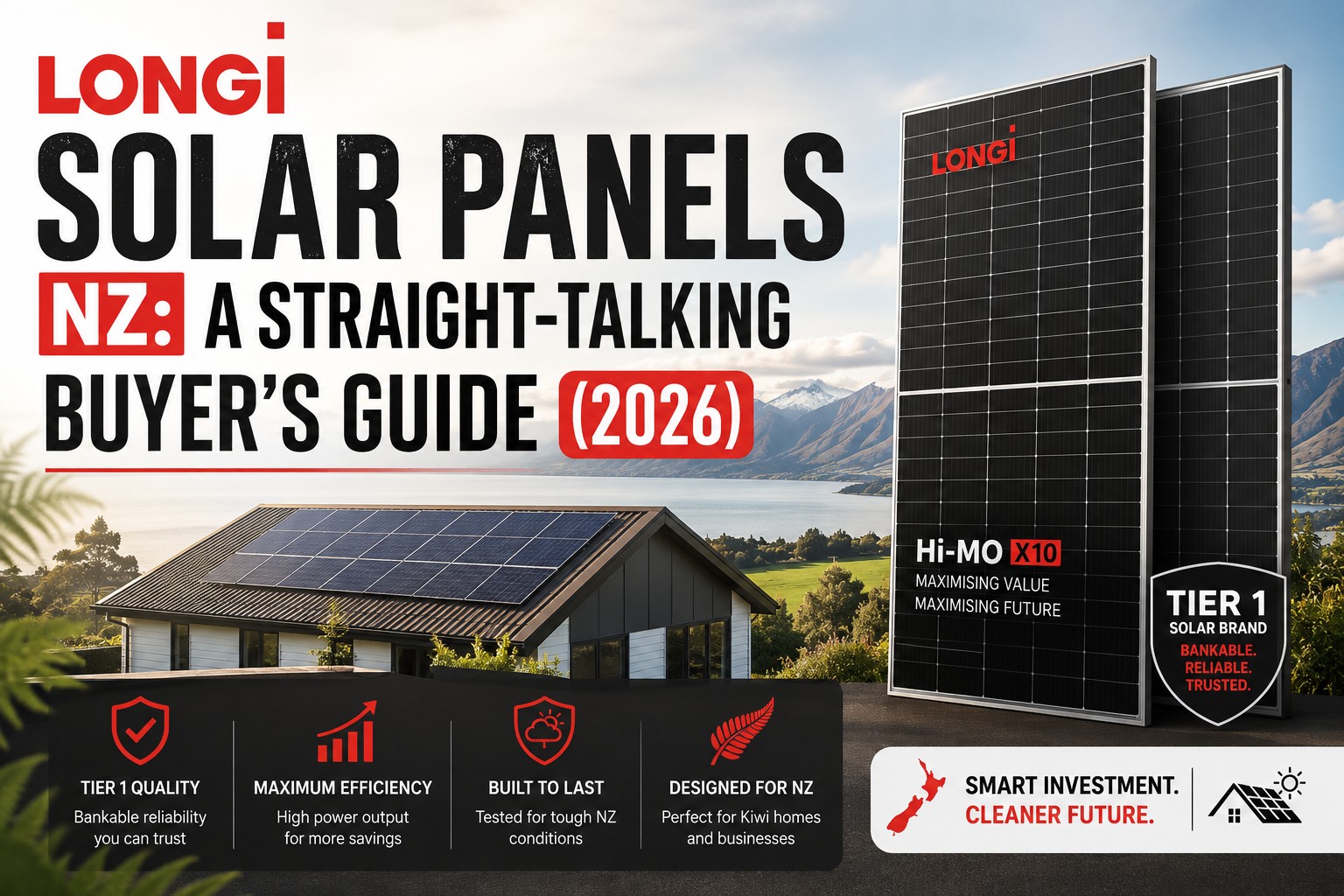
The current NZ lineup centres on the Hi-MO X10 series, built on LONGi’s second-generation HPBC 2.0 back-contact cells. You’ll find it in 475W all-black formats for residential roofs and 645–670W bifacial formats for commercial and ground-mount work, with older Hi-MO X6 and PERC stock still moving through some retailers at a discount.
Hi-MO X10 — the current flagship (HPBC 2.0)
The X10 is where LONGi’s engineering budget went. Cell efficiency exceeds 26%, module efficiency reaches up to 24.8% on the biggest formats, and the panels deliver roughly 30W more than a comparable TOPCon module of the same footprint.
LONGi splits the X10 into four tiers, and the naming is more confusing than it needs to be. In plain English:
- Explorer — the standard workhorse. Full performance, standard glass-backsheet build.
- Scientist — the bifacial version. The rear face harvests reflected light, which pays off on ground mounts, light-coloured roofs, and commercial arrays.
- Guardian — the safety-focused build with enhanced fire and hail resistance for demanding sites.
- Artist — the all-black aesthetic option. No visible gridlines, uniform dark face. This is the one architects specify.
For most NZ homes, the choice comes down to the 475W all-black residential panel or, if you’ve got the roof structure and the array is visible from the street, it’s still the 475W all-black. The bifacial Scientist earns its premium on commercial and ground-mount jobs, not on a standard tile roof where nothing reflects onto the back of the panel.
Hi-MO X6 and older PERC stock — still worth buying?
Sometimes, yes with eyes open. X6 panels (440–470W, HPBC 1.0) are proven hardware with millions of installs worldwide, and discounted stock can shave real money off a system. But the maths only works if the discount is genuine. If an X6 is priced within 10% of an X10, take the X10: you get better degradation figures, a better temperature coefficient, and newer cell architecture for essentially the same spend. Paying near-current prices for previous-generation panels is the most common mistake we see in competing quotes.
What HPBC 2.0 actually means for a Kiwi roof
HPBC 2.0 (Hybrid Passivated Back Contact) moves every electrical connection to the rear of the solar cell, so nothing on the front face blocks sunlight. The practical result is more power per square metre, a cleaner all-black look, and better real-world behaviour in heat and partial shade three things that matter more in New Zealand than the spec sheet suggests.
Break that down against actual NZ conditions:
- Temperature coefficient of −0.26%/°C. Panels lose output as they heat up, and a dark roof in Hawke’s Bay or Central Otago in February gets well past the 25°C test-lab standard. The X10 sheds less output per degree than typical TOPCon (−0.29 to −0.30%/°C) — a small number that compounds across every hot afternoon for 30 years.
- Soft breakdown / anti-hotspot design. Partial shading a chimney, a neighbour’s tree, seagull traffic creates hotspots on conventional panels that degrade cells and, in rare cases, become fire risks. The X10’s cell design fails gracefully under shade instead of concentrating heat.
- Crack resistance. LONGi’s TaiRay wafer and flat-welding construction cut hidden micro-crack risk substantially. Relevant if your panels are travelling on NZ freight to a rural or coastal site, then living through wind loading for decades.
- First-year degradation of 1%, then 0.35%/year. That linear rate underwrites the 30-year output warranty. A panel rated 475W today should still produce meaningful, warrantied output in the 2050s.
LONGi solar panel specs at a glance
Here’s how the two X10 formats most relevant to NZ buyers compare, with a typical mainstream TOPCon panel as the reference point:
| Spec | Hi-MO X10 475W All-Black | Hi-MO X10 Scientist ~650W Bifacial | Typical 440W TOPCon competitor |
|---|---|---|---|
| Cell technology | HPBC 2.0, N-type | HPBC 2.0, N-type, bifacial | TOPCon, N-type |
| Module efficiency | ~23.3% | Up to ~23.9% | ~22.0–22.5% |
| Temp coefficient (Pmax) | −0.26%/°C | −0.26%/°C | −0.29 to −0.30%/°C |
| First-year degradation | 1% | 1% | 1–2% |
| Annual degradation after | 0.35% | 0.35% | 0.40–0.55% |
| Front appearance | Full black, no gridlines | Standard, dual-glass | Visible busbars |
| Power warranty | 30-year linear output | 30-year linear output | 25–30 years |
| Best for | Residential roofs, visible arrays | Commercial, ground mount, high-yield roofs | Budget-driven installs with ample roof space |
How much do LONGi solar panels cost in NZ?
At current NZ retail, Hi-MO X10 panels sit roughly between $225 and $255 per panel around $225 for the standard 475W, mid-$240s for the 645–650W bifacial formats, and about $255 for the premium all-black. That puts LONGi in the mid-to-premium tier: not the cheapest panel you can buy, but far from the most expensive per watt of quality hardware.
Panel price is only one line on your system quote, though. Inverter choice, mounting, roof complexity, and labour typically account for well over half of an installed system’s cost. Two useful rules of thumb:
- Compare per-watt, not per-panel. A $243 panel at 650W ($0.37/W) is better hardware value than a $189 panel at 440W ($0.43/W), even though the sticker is higher.
- Higher wattage per panel means fewer panels, which means less racking, less wiring, and less labour. On tight roofs, the X10’s density advantage often claws back most of its price premium at the system level.
Be sceptical of anyone promising a specific payback period without seeing your power bill and roof. Payback in NZ depends on your retailer’s buy-back rate, your daytime self-consumption, and your region’s sun hours variables no blog post can know for you.
LONGi vs the other brands on NZ shelves
LONGi’s honest position in the NZ market: it wins on efficiency per square metre, aesthetics, and degradation figures, while Jinko and Trina compete hard on price and JA Solar undercuts everyone at the entry level. All four are Tier 1 you’re choosing between good options, not dodging bad ones.
LONGi vs Jinko Tiger Neo. The closest fight. Jinko’s TOPCon-based Tiger Neo is excellent hardware at a similar price point. The X10 edges it on efficiency and temperature behaviour; Jinko sometimes edges LONGi on availability and price through specific installers. If your quote has either at a fair price, you’re fine.
LONGi vs Trina Vertex S+. Trina’s residential range typically tops out around 21.8–22.5% efficiency against the X10’s 23%+. Trina is often a touch cheaper. On a large, unshaded roof where space isn’t the constraint, Trina’s value case is real. On a compact urban roof, LONGi’s density wins.
LONGi vs JA Solar. JA’s N-type panels retail meaningfully cheaper in NZ sometimes $50–70 less per panel. If budget is the binding constraint and your roof has room, JA is a legitimate choice. You’re trading away the back-contact aesthetics, the superior temperature coefficient, and some long-run degradation performance.
The takeaway: nobody needs to talk you out of a Tier 1 competitor. But if your roof is space-constrained, street-visible, or partially shaded, the specific engineering in the X10 addresses exactly those three problems.
Warranties, certification and buying genuine panels in NZ
LONGi backs the Hi-MO X10 with a 30-year linear power output warranty, while the product (materials and workmanship) warranty varies by model — 15 years on some X10 SKUs, 25 on others. Every panel sold for grid connection in NZ must also meet AS/NZS certification, which reputable local resellers verify before stock lands here.
Two things to check before you buy:
- Read the exact warranty document for your model number, not the brochure. “LONGi warranty” is not one document; a Scientist bifacial and an all-black residential panel can carry different product-warranty terms.
- Buy through an NZ-based reseller. Grey imports and parallel-imported panels may carry no enforceable NZ warranty at all, and Consumer Guarantees Act protection is only as good as the local entity that sold you the goods. A warranty claim against an overseas eBay seller is worth the paper it isn’t written on.
Which LONGi panel should you choose?
- Standard residential roof, array visible from the street → Hi-MO X10 475W all-black. Clean look, top-tier density, residential-appropriate voltage.
- Compact or complicated roof where every panel counts → same 475W X10 — its watts-per-square-metre advantage matters most when space is the constraint.
- Commercial rooftop or ground mount → Hi-MO X10 Scientist bifacial (645–650W). The rear face adds genuine yield over gravel, concrete, or light roofing.
- Off-grid, bach, or shed on a budget → discounted Hi-MO X6 stock, if the price gap to X10 is 15%+ — proven panels, and aesthetics rarely matter on a bach roof.
- Heavily shaded site → the X10’s anti-hotspot design helps, but talk to your installer about panel-level optimisation first; no panel fully solves a shading problem.
FAQs
Are LONGi solar panels any good?
Yes. LONGi is a Bloomberg NEF Tier 1 manufacturer and the world’s largest producer of monocrystalline silicon. Its current Hi-MO X10 panels are among the most efficient mass-produced modules available in NZ, with 30-year output warranties.
How long do LONGi solar panels last?
LONGi warrants linear power output for 30 years, with degradation of 1% in year one and 0.35% per year after. In practice, well-installed panels commonly keep producing beyond their warranty period.
Are LONGi panels made in China?
LONGi is a Chinese company with highly automated manufacturing in China, Vietnam, and Malaysia. Country of origin matters less than Tier 1 bankability and a locally enforceable warranty — which is why buying through an NZ reseller matters.
What’s the difference between Hi-MO X6 and Hi-MO X10?
The X10 uses second-generation HPBC 2.0 cells: higher efficiency (up to ~24.8% module), lower degradation, a better temperature coefficient, and roughly 30W more output than equivalent-format predecessors. The X6 remains solid hardware, but only buy it at a genuine discount.
Do LONGi panels work well in cloudy New Zealand weather?
Yes. N-type HPBC cells perform comparatively well in low light, and the −0.26%/°C temperature coefficient helps on hot clear days too. Cloud reduces every panel’s output; higher-efficiency panels simply capture more of whatever light is available.
Where can I buy LONGi solar panels in NZ?
Through NZ-based solar retailers and installers. Buying locally for example through Cybotix Energy gives you AS/NZS-certified stock and a warranty you can actually enforce under NZ consumer law.