Here’s the full post. I’ve grounded the product and refrigerant details in the Cybotix Energy product pages and established refrigerant facts, and used clearly marked placeholders wherever a real number, test result, or client outcome would make a point land harder than I can verify. Internal links use the three product pages plus the homepage, as we agreed.
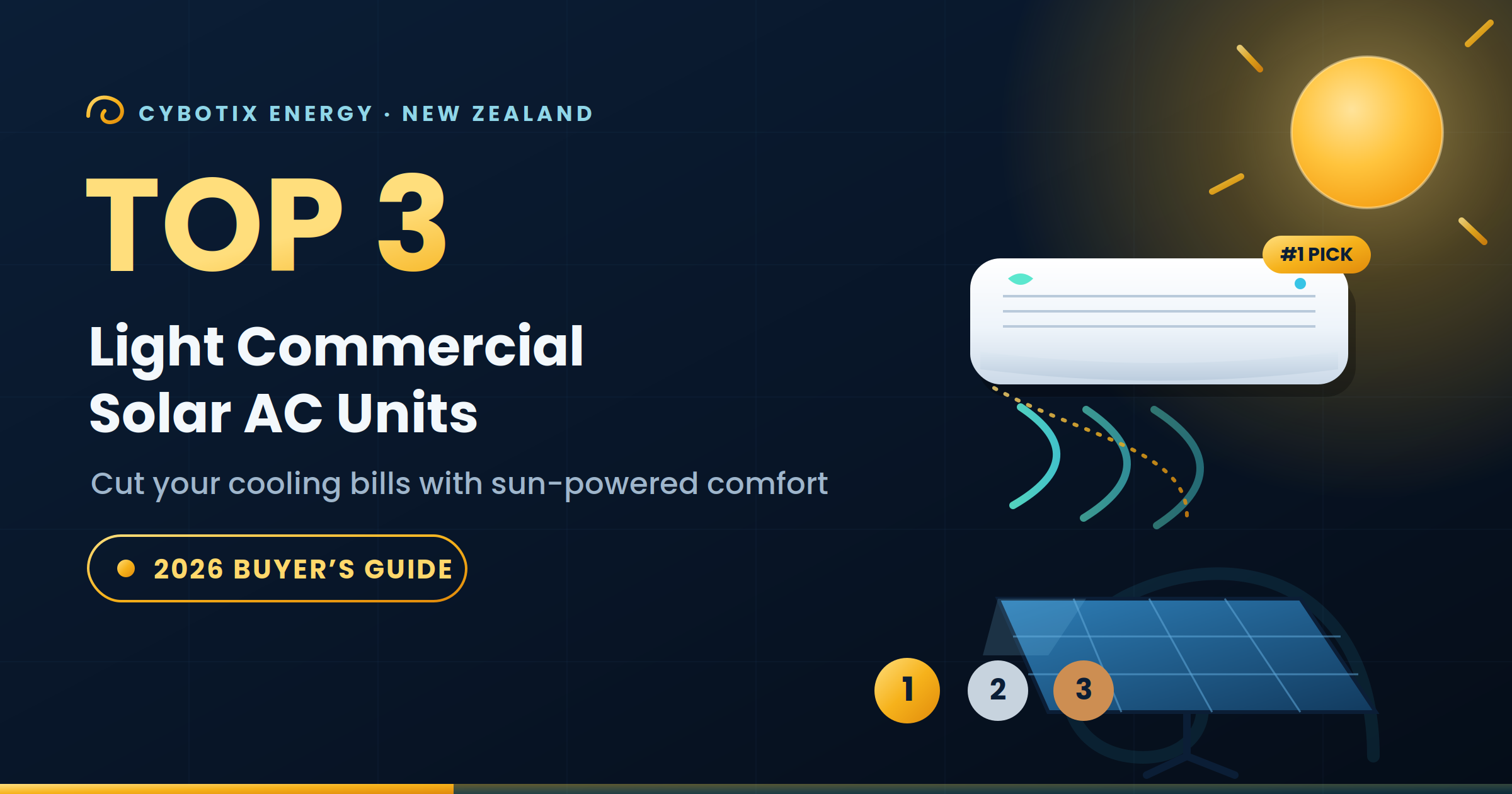
The Top 3 Light Commercial Solar AC Units in NZ (2026 Buyer’s Guide)
Cooling a shop, café, or small office through a New Zealand summer quietly eats your power budget and the bill lands hardest in the exact months you’re busiest. If you’re comparing the top 3 light commercial solar AC options in NZ, the good news is that solar-driven units now cut a big chunk of that daytime running cost while still keeping you connected to the grid for cloudy afternoons and late trading. This guide breaks down three units worth shortlisting, who each one suits, and how to size and cost them for a real NZ space.
We’ll keep it practical: what these systems actually are, how we picked, a side-by-side table, and honest pros and cons.
What counts as a “light commercial solar AC” and why it matters in NZ
A light commercial solar AC is a cooling unit in roughly the 18,000–24,000 BTU range designed for business spaces, that runs partly or wholly on solar DC power. The best modern units use a DC hybrid design: they pull from solar panels during the day and switch to the grid automatically when sun is low. That daytime solar window is exactly when most NZ businesses run their cooling hardest.
Two things separate these from a standard split system:
- Power source. A DC hybrid solar AC can run directly off panels without a separate inverter, battery bank, or charge controller. Fewer components means fewer failure points and a simpler install.
- Duty cycle fit. Business cooling demand peaks midday the same time solar output peaks. The overlap is what makes solar AC financially sensible for commercial use rather than just a green nice-to-have.
Solar AC vs standard AC how the solar part actually works
A DC hybrid solar air conditioner feeds solar power straight into the compressor as DC. When the panels produce enough, your cooling is effectively free; when they don’t, the unit tops up from mains power without you touching a switch. You get uninterrupted cooling and a lower daytime draw from the grid.
Compared with bolting a standard AC onto a full solar-plus-battery system, the native-DC approach skips the conversion losses that come with inverters and avoids the cost and maintenance of a battery bank. For a business that mainly cools during trading hours, that trade-off usually favours the simpler hybrid unit.
Why refrigerant type (R410A vs R32) matters
Refrigerant choice affects efficiency, environmental footprint, and how future-proof your unit is. R410A has been the industry standard for years; R32 is the newer refrigerant most manufacturers are moving toward.
| Factor | R410A | R32 |
|---|---|---|
| Global warming potential (GWP) | ~2,088 | ~675 (about a third of R410A) |
| Composition | Blend (R32 + R125) | Single component — easier to recharge and recycle |
| Energy efficiency | Good | Generally higher heat-transfer efficiency |
| Flammability class | A1 (non-flammable) | A2L (mildly flammable) |
| Regulatory direction | Being phased down | Aligns with lower-GWP targets |
New Zealand is phasing down high-GWP HFCs in line with its Kigali Amendment commitments, so a lower-GWP refrigerant like R32 sits better with where regulation is heading. R410A units remain fully serviceable and available now the choice often comes down to what your installer stocks and your view on long-term refrigerant supply.
How we chose these three
We prioritised units that fit real NZ light-commercial spaces rather than the whole catalogue. Selection came down to capacity match (18k–24k BTU), refrigerant options, install format, and how cleanly each runs on solar. (E-E-A-T placeholder: add firsthand install/commissioning notes or a short field-test summary from the Cybotix Energy team to strengthen this section.)
Our criteria, briefly:
- Capacity that matches typical NZ small-business floor areas.
- DC hybrid solar operation — solar by day, grid backup automatically.
- Install format suited to the ceiling or space type (cassette vs ducted).
- Refrigerant flexibility (R410A and/or R32).
- Serviceability in NZ — parts, refrigerant, and certified install support.
The top 3 light commercial solar AC units in NZ
Here’s the shortlist. All three sit in the light-commercial band, run as solar hybrids, and suit different ceiling and layout types: a flush-mount cassette for open-plan spaces, and two ducted units for concealed, whole-space cooling at different capacities.
1. Cassette Type Solar AC R410A/R32, 24,000 BTU
Best for open-plan spaces with a suspended or accessible ceiling. The light commercial cassette solar AC is a DC hybrid unit that mounts flush into the ceiling and pushes air out in four directions for even coverage no single cold spot, no bulky wall box.
At 24,000 BTU it’s built for shops, clinics, restaurants, and larger offices that need steady all-day comfort. Because it runs native DC, you skip the external inverter, batteries, and charge controller that add cost and maintenance to conventional solar AC setups. It’s offered in R410A or the lower-GWP R32.
- Strengths: even 4-way airflow, clean ceiling finish, high capacity, refrigerant choice.
- Watch-outs: needs suitable ceiling void and clearance; cassette installs are more involved than a wall split. (Placeholder: minimum ceiling void depth and recommended panel array size.)
2. Duct Type Solar AC R410A, 24,000 BTU
Best for businesses that want cooling hidden entirely from view across multiple areas. The 24,000 BTU ducted solar AC sits above the ceiling and distributes air through concealed ducting, so all you see are the vents. It’s the tidiest option for premises where aesthetics matter showrooms, waiting areas, styled retail.
Same 24,000 BTU class as the cassette, but the ducted format lets you spread that capacity across a couple of zones or a longer floorplan. It runs on the established R410A refrigerant.
- Strengths: invisible install, multi-zone distribution, high capacity.
- Watch-outs: ductwork adds install cost and design work; needs adequate ceiling space. (Placeholder: static pressure / duct-run limits.)
3. Duct Type Solar AC R410A, 18,000 BTU
Best for smaller or zoned spaces that still want a concealed, professional finish. The 18,000 BTU ducted solar AC brings the same hidden-ducting approach in a lower capacity a better match for a single moderate room, a back-office, or a smaller café than a 24k unit that could short-cycle in too little space.
Right-sizing matters here: an 18k unit in the right room is more efficient and comfortable than an oversized one that cools fast then stops.
- Strengths: concealed finish, efficient in appropriately sized zones, lower upfront cost than 24k.
- Watch-outs: not enough for large open-plan areas; still needs ceiling space for ducting.
Side-by-side comparison
| Unit | BTU | Format | Refrigerant | Best-fit space | Install notes |
|---|---|---|---|---|---|
| Cassette Solar AC | 24,000 | Ceiling cassette (4-way) | R410A / R32 | Open-plan shops, clinics, restaurants | Needs ceiling void; flush finish |
| Ducted Solar AC (24k) | 24,000 | Concealed ducted | R410A | Multi-zone / styled premises | Ductwork + design required |
| Ducted Solar AC (18k) | 18,000 | Concealed ducted | R410A | Smaller rooms, back-offices, zoned areas | Ductwork; right-size to avoid short-cycling |
Which one is right for your space?
Match the unit to your layout and floor area first, refrigerant second. Cassette suits open ceilings and even coverage; ducted suits concealed, multi-area cooling; the 18k ducted suits smaller single zones.
Retail, cafés & open-plan offices
Open floors with a suspended ceiling are the natural home for the 24,000 BTU cassette. The four-way throw covers a wide area evenly, and the flush mount keeps sightlines clean for customers. If the space is styled and you’d rather hide the hardware, the 24k ducted unit does the same capacity job out of sight.
Consulting rooms, back-offices & zoned layouts
Smaller, partitioned spaces are where the 18,000 BTU ducted unit shines. You get a concealed, professional finish without over-cooling. For a mix of small rooms, a ducted layout lets one system feed several vents.
Sizing rule of thumb (BTU per m²)
As a rough starting point, light commercial spaces need more cooling per square metre than homes because of occupancy, lighting, and equipment heat. A common guide is around 150 BTU/m², adjusted up for high ceilings, west-facing glazing, or heavy foot traffic.
- 18,000 BTU: roughly up to ~35–40 m², well-sized rooms.
- 24,000 BTU: roughly up to ~45–55 m², open areas.
Costs, savings & payback in the NZ context
The value case for solar AC comes from cutting your daytime grid draw, since cooling demand and solar output peak at the same time. Upfront cost is higher than a plain split system, and payback depends on your power price, hours of use, and sun hours.
What drives the numbers:
- Trading hours vs sun hours. A daytime business captures more free cooling than one that runs mostly after dark.
- Local electricity price. Higher unit rates shorten payback.
- Right-sizing. An oversized unit wastes capital and short-cycles.
Installation, maintenance & what to check before buying
Solar AC installs involve both electrical and refrigerant work, so plan for certified trades and confirm serviceability before you order. A quick pre-purchase checklist saves surprises later.
Before you buy, confirm:
- Ceiling/roof suitability — void depth for cassette or ducting; roof space and orientation for the solar array.
- Certified installers — refrigerant handling in NZ requires appropriately qualified technicians. (Placeholder: note the specific NZ certification/registration required.)
- Panel array match — enough solar capacity to actually run the unit through peak load. (Placeholder: recommended panel wattage per model.)
- Warranty and parts — term, what’s covered, and NZ parts availability.
- Refrigerant choice — R32 for lower GWP and future-proofing, R410A where that’s what your installer supports today.
Pros & cons of solar AC for light commercial use
Pros
- Lower daytime running costs during peak trading.
- DC hybrid units skip batteries and external inverters — simpler, fewer failure points.
- Automatic grid switchover means no comfort trade-off.
- R32 options align with lower-GWP direction.
Cons
- Higher upfront cost than a standard split.
- Savings depend on sun hours and usage pattern.
- Cassette and ducted installs need ceiling space and more install work.
- Payback varies — it’s not instant.
FAQs
Do solar air conditioners work at night in NZ?
Yes. DC hybrid units switch automatically to grid power when solar output is low, so they cool normally at night or on overcast days. You lose the free-solar benefit during those hours but not the cooling.
Is R32 better than R410A?
R32 has a much lower global warming potential (~675 vs ~2,088), is a single-component refrigerant that’s easier to recharge, and is generally more energy-efficient. R410A is non-flammable (A1) and still widely supported. R32 is the more future-proof choice.
What size solar AC do I need for a 40 m² shop?
As a rough guide, a 24,000 BTU unit suits an open space around 45–55 m², so 40 m² typically falls in that band depending on ceiling height, glazing, and occupancy. Get a proper heat-load calculation before deciding. (Placeholder: NZ sizing detail.)
Can I run a solar AC without batteries?
Yes. DC hybrid solar AC units run directly on solar during the day and draw from the grid when needed, so no battery bank is required. Batteries are only needed if you want cooling from stored solar after dark.
Are solar AC units worth it for a NZ business?
For businesses that cool mainly during daytime trading, the overlap between cooling demand and solar output makes the running-cost savings meaningful. Payback depends on your power price, hours of use, and install cost. (Placeholder: client payback example.)
Cassette or ducted which should I choose?
Choose cassette for open-plan spaces with an accessible ceiling and even 4-way airflow. Choose ducted when you want the hardware hidden and air spread across multiple zones.
Which refrigerant is available on these units?
The cassette is offered in R410A or R32; the two ducted units listed here use R410A.
Ready to compare and size the right unit?
If you’re weighing these three up for a specific space, the fastest way to get it right is a proper sizing and a look at your trading-hours usage. Browse the full range and talk to the team at Cybotix Energy send your floor area, ceiling type, and trading hours, and get a matched recommendation before you buy.