Your power bill went up 8% again this year. The grid feels less reliable every storm season. And you keep reading about “the energy transition” without anyone explaining what any of it actually means for your specific NZ house.
Innovative Energy Solutions
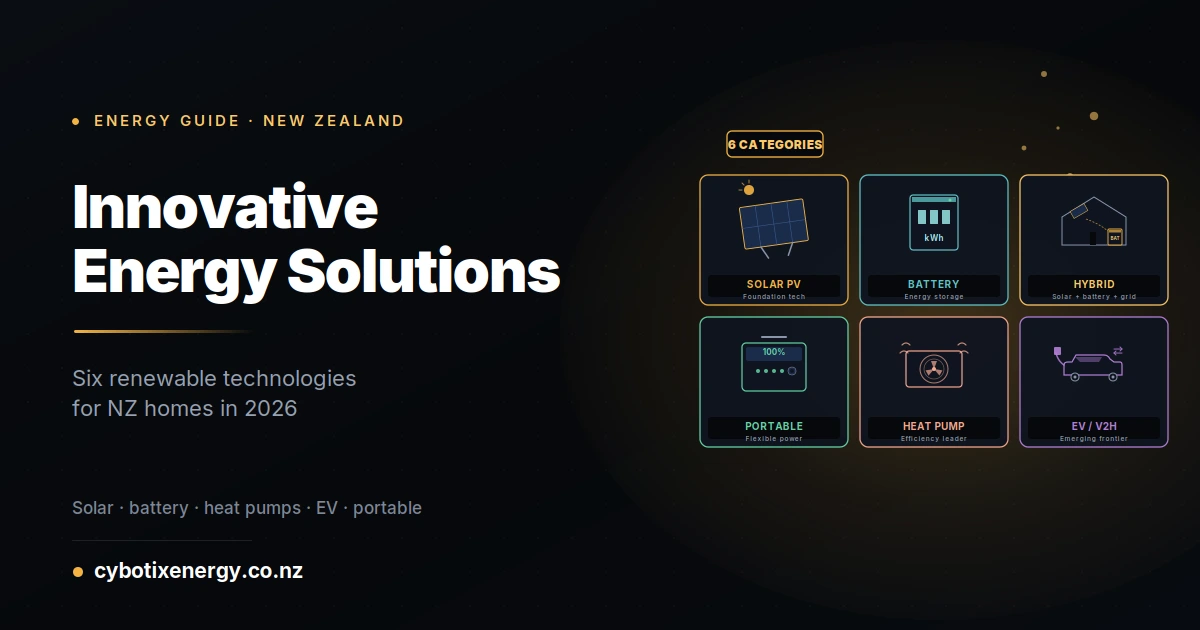
This guide covers the innovative energy solutions for a sustainable future that NZ homeowners can genuinely deploy today the practical technology mix that exists in 2026, not corporate messaging about aspirational 2050 goals. Six technology categories are ready for real residential deployment right now. Understanding which fits your situation matters more than following any single trend.
The 30-second answer what NZ actually has available in 2026
Six categories of renewable/sustainable home energy technology are practically deployable in NZ right now:
- Rooftop solar PV — the foundational technology
- Battery energy storage — the recent game-changer
- Hybrid solar + battery + grid systems — the popular combination
- Portable power stations — the underrated first step
- Heat pump water heating and space heating — the biggest efficiency win
- EV integration and V2H (vehicle-to-home) — the emerging frontier
Everything else hydrogen fuel cells, distributed nuclear, tidal is still 5-10 years from practical residential deployment in NZ.
Why NZ’s energy transition is genuinely different from most countries
New Zealand’s grid is already approximately 84% renewable (mostly hydro, geothermal, and growing wind and solar). That fundamental fact reshapes every home renewable energy decision here. It’s not the same conversation as it is in Australia, the US, or the UK countries with coal-dependent grids where “adding solar reduces carbon” is the primary argument.
In NZ, adding rooftop solar doesn’t primarily reduce carbon emissions (they’re already low). It primarily reduces your grid dependency, insulates you from ongoing power price rises, and provides outage protection during increasingly frequent storm events like Cyclone Gabrielle (2023). Those are the honest, practical reasons NZ homes go solar in 2026.
If you’re being sold home solar in NZ primarily as a “climate action” the pitch is weaker here than elsewhere. The stronger arguments are financial and resilience-based. Frame your decision accordingly.
Category 1: Rooftop solar PV (the foundation)
Solar photovoltaic panels convert sunlight to electricity. Still the foundational renewable technology for NZ homes, with panel efficiency continuing to improve and pricing dropping roughly 10% annually. A typical 5-7 kW rooftop system generates 4-7 MWh per year in NZ conditions enough to offset 50-80% of a typical family home’s annual electricity usage.
What’s actually changed in 2026: panels are now 22-24% efficient (up from 18-20% five years ago), inverter technology has stabilised around hybrid string designs, and mounting hardware handles Category 4 wind loads reliably. Installation typically takes 3-5 days on-site.
When solar makes sense in NZ: north-facing roof with minimal shading, home ownership (renters have limited options), electricity usage above 12 kWh/day, and 8-12 year expected occupancy of the property. Payback periods on typical NZ installations run 8-12 years, with panels rated for 25+ years of production. For a detailed pre-purchase framework, see our What to Know Before Buying Solar Panels NZ guide.
Category 2: Battery energy storage (the game-changer)
Home batteries store solar-generated power for evening use or grid outage backup. This is where NZ home energy technology has advanced most dramatically in the past three years. LiFePO4 (lithium iron phosphate) batteries — used by Tesla Powerwall, BLUETTI, Enphase, and other current-generation systems offer 10+ year lifespans, 4,000+ cycle counts, and pricing that finally justifies residential deployment for many NZ households.
Battery sizing for typical NZ homes: most residential deployments land at 10-15 kWh usable capacity. Enough to cover a full evening of household loads (fridge, lighting, TV, phone charging) plus meaningful portion of morning peak use. Undersizing (less than 8 kWh) leaves you drawing grid power for peak evening loads. Oversizing (more than 20 kWh) rarely justifies the cost for typical homes.
The outage backup benefit has become increasingly important since Cyclone Gabrielle (2023) exposed grid vulnerabilities across the North Island. For coastal Auckland, Coromandel, Northland, and East Coast homes, battery backup during multi-day outages is now a genuine reason for battery investment — separate from the pure economic case.
Category 3: Hybrid solar + battery + grid systems
The most popular NZ home renewable configuration in 2026: solar panels + home battery + grid connection running together. Solar generates during the day, battery stores excess for evening use, grid provides backup when both are insufficient. Cybotix Energy NZ deploys this configuration for the majority of customers because it balances cost, reliability, and outage protection genuinely well.
A typical NZ hybrid system: 5-7 kW rooftop solar + 10-15 kWh battery + grid connection with net metering. Total installed cost usually $18,000-$32,000 NZD depending on specific equipment, roof complexity, and battery capacity. Payback timeline 10-14 years typical, faster with rising electricity prices.
Why hybrid dominates over pure grid-tied or pure off-grid: grid-tied only delivers zero backup during outages (surprisingly common oversight); pure off-grid requires oversized capacity and creates single-point-of-failure risk; hybrid genuinely delivers most benefits of both approaches with acceptable trade-offs.
Category 4: Portable power stations (the underrated solution)
Portable power stations from brands like BLUETTI, EcoFlow, and Anker offer a genuinely different sustainable-energy path no permanent installation, no roof work, no JPS/network operator interconnection paperwork. Just plug and use.
For renters (who legally can’t install rooftop solar on properties they don’t own), holiday-home owners (avoiding cost of permanent solar on infrequently-used properties), and anyone wanting to “try before committing” to permanent solar installation, portable power stations are the underrated first step into home renewables. A capable unit (BLUETTI AC300, EcoFlow Delta Pro, or similar) delivers 2-3 kWh of usable storage and can power essential loads (fridge, lighting, medical devices, work-from-home setup) for 12-24 hours during outages.
Combined with portable solar panels, these systems become genuinely off-grid capable powering weekend camping trips, remote workstations, or emergency backup at rural properties. The category has matured dramatically since 2020; 2026 units offer LiFePO4 batteries, app-controlled monitoring, and safety systems previously found only in permanent installations.
Category 5: Heat pump technology (the biggest carbon reduction lever)
For NZ homes, replacing gas or electric-resistance heating with heat pumps delivers larger practical energy savings than most solar installations. Modern heat pumps operate at 300-400% efficiency (COP of 3-4) meaning 1 kWh of electricity input produces 3-4 kWh of heat output. Compare this to resistance electric heating (1:1 efficiency) or gas heating (85-95%, with imported gas dependency).
Heat pump hot water specifically is the highest-ROI home energy upgrade available to most NZ households. Replacing a standard electric hot water cylinder with a heat pump hot water system typically cuts water heating electricity by 60-70%. Payback: 4-7 years, faster than most solar installations.
Integration with solar and battery: heat pumps use significant electricity, but time-shifting their operation to daylight hours (when solar generates surplus) essentially converts solar directly to hot water a genuinely elegant efficiency. If you’re prioritising true energy efficiency and carbon reduction, the order should be: heat pumps first, then solar, then battery. Not the other way around.
Category 6: EV integration and V2H (the emerging frontier)
Electric vehicle integration is the fastest-emerging renewable energy category for NZ homes. Bidirectional EV chargers (V2H, V2G) turn your EV battery into home backup power an EV like a Nissan Leaf or Ford F-150 Lightning has 40-130 kWh of battery storage, dwarfing typical home battery installations.
What V2H means practically: during a grid outage, your EV powers your home for days rather than hours. When the grid is up, your EV charges from your solar during the day, then discharges to power your home in the evening. Two-way flow between EV, home battery, solar, and grid genuine energy independence at scale.
Current NZ status: limited compatible vehicles (Nissan Leaf CHAdeMO, some Ford models, growing set of others), limited bidirectional charger availability, ongoing standards evolution. 2026 is genuinely the early-adopter year for NZ V2H deployment. If you’re buying an EV in the next 2-3 years, factor V2H compatibility into your vehicle choice. If you’re an early adopter comfortable with emerging tech, deploy now. If you prefer proven technology, wait 2-3 years for the market to stabilise.
Comparing the six categories which fits your situation
Match your priorities to the right starting technology:
| Your Priority | Best Starting Point | Why |
|---|---|---|
| Reduce electricity bills | Solar PV, then add battery later | Fastest financial payback |
| Backup during storms/outages | Battery backup or portable power station | Direct outage protection |
| Carbon reduction | Heat pumps first, then solar | Larger efficiency gains |
| Energy independence | Hybrid solar + battery + backup | Redundancy across sources |
| Renter-compatible | Portable power stations | No installation required |
| Future-proofing | Solar + battery + EV charger + heat pump | Full system integration |
Most NZ households benefit from a staged approach: start with the highest-ROI upgrade (usually heat pump hot water or solar PV), add battery storage 2-3 years later when the case strengthens, and add V2H or additional technologies as they mature. Trying to do everything at once often results in oversized, over-budget installations that don’t perform to expectations.
What NZ homeowners are actually installing in 2026
The most common Cybotix Energy NZ deployment in 2026 is a 5-7 kW solar + 10-15 kWh hybrid battery system. This configuration hits the balance point between cost ($18,000-$28,000 NZD typical), capability (covers 60-80% of typical 3-4 bedroom home electricity needs plus outage backup), and payback period (10-14 years typical).
Second most common: portable power stations paired with portable solar panels for renters, secondary properties, or as a first step before permanent installation. Third: heat pump hot water upgrades deployed independently of solar, delivering fast payback for households with high hot water usage.
FAQs
What’s the most cost-effective renewable energy investment for NZ homes?
Heat pump hot water typically delivers the fastest payback (4-7 years) and highest efficiency return. Solar PV comes second (8-12 year payback). Hybrid solar + battery systems have longer paybacks (10-14 years) but add outage protection value that pure financial analysis misses. Start with heat pump hot water, then solar, then battery in that order for maximum ROI.
Do I need solar panels AND a battery, or just one?
Depends on your goals. Solar only delivers bill reduction with no outage protection. Battery only delivers outage protection with no bill reduction. Both together deliver both benefits and are increasingly the standard NZ configuration. For pure financial optimisation without outage concerns, solar-only remains valid; for anyone in storm-prone regions or with medical devices, hybrid solar-plus-battery is genuinely worth the additional investment.
Is off-grid living actually practical in NZ?
Yes for rural properties, generally not for urban NZ homes. Off-grid requires oversized battery capacity (30+ kWh), backup generation (typically diesel), and acceptance of occasional constrained-usage days. For remote properties without reasonable grid connection cost, off-grid makes sense. For grid-connected urban homes, hybrid (solar + battery + grid) delivers most benefits at significantly lower cost and complexity.
How much does a whole-home renewable energy system cost in NZ 2026?
Ranges widely by scope. Solar-only (5-7 kW): $10,000-$16,000 NZD. Hybrid solar + battery (5-7 kW + 10-15 kWh): $18,000-$32,000 NZD. Whole-home upgrade (solar + battery + heat pump hot water + heat pump heating + EV charger): $35,000-$65,000+ NZD. Most NZ homes deploy in stages over 3-5 years rather than all at once.
Will renewable energy tech get much better if I wait 2-3 years?
Marginal improvements yes, revolutionary changes no. Panel efficiency drops 5-10% per year, battery pricing drops similarly, but the technology has matured to the point where waiting for “the next big thing” typically doesn’t pay off. The one exception: if you’re buying an EV in the next 2-3 years, V2H integration is genuinely evolving and worth watching.
What’s the environmental impact of solar panels and batteries at end-of-life?
Genuinely lower than most people assume. Solar panels are recyclable (glass, aluminium, silicon all recoverable); NZ has emerging panel recycling infrastructure. LiFePO4 batteries are recyclable and don’t contain the same hazardous materials as older lithium-ion chemistries. End-of-life waste is a real consideration but shouldn’t be a deciding factor against installation.
Are there any NZ government incentives for home renewable energy in 2026?
Currently minimal at national level. Some local councils offer solar or heat pump grants (varies by region); EECA (Energy Efficiency and Conservation Authority) runs occasional programmes; some banks offer green loan discounts for renewable installations. Check current status before installing programme availability shifts periodically.