You’ve decided hybrid solar is right for your NZ home solar panels + home battery + grid connection working together for daily savings AND outage protection. Now Google shows you 15 brand options, 4 inverter architectures, and installation quotes ranging from $18,000 to $45,000. Which one’s actually best for your situation?
Best Hybrid Solar System in NZ
This guide walks through how to choose the best hybrid solar system in NZ 2026 as a decision framework inverter architecture, battery sizing, brand comparison, installer selection, and honest 2026 pricing bands. No marketing pitch, no vendor bias. Just what NZ homeowners genuinely need to know to make an informed 15-year investment decision.
Note: this is educational content, not personalised financial or engineering advice. Your specific installation requires site-specific consultation with a qualified NZ solar specialist.
The 30-second answer “best” depends on what you’re optimising for
“Best” isn’t universal. Match the system to your priority:
- Lowest cost: Deye or Growatt hybrid inverter + entry-tier LiFePO4 battery ($15,000-$18,000)
- Premium quality: Tesla Powerwall 3 or Enphase IQ ($22,000-$30,000)
- Maximum flexibility: BLUETTI modular systems ($15,000-$25,000)
- Best local support: Fronius with established NZ installer network ($20,000-$28,000)
Most NZ homes end up with mid-tier hybrid (Deye or Sungrow inverter + 10-15 kWh LiFePO4 battery + reputable local installer) at $18,000-$25,000. It’s the mainstream sweet spot for good reason.
What makes a solar system “hybrid” vs alternatives
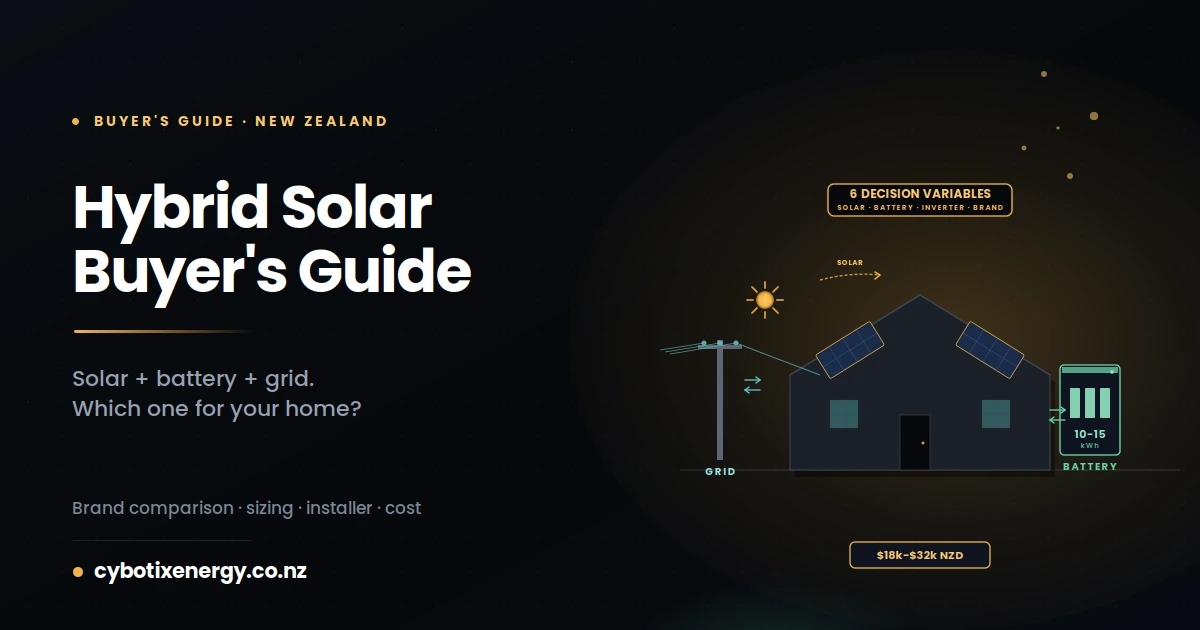
A hybrid solar system combines rooftop solar panels + home battery storage + grid connection, controlled by a hybrid inverter that manages all three sources intelligently. This is distinct from grid-tied-only (no battery, no outage backup), off-grid (no grid connection, requires oversized battery), and battery-only systems (no solar generation).
The hybrid architecture solves the biggest limitation of grid-tied-only solar: what happens when the grid fails. Grid-tied systems shut down entirely during outages (safety requirement to prevent back-feeding to line workers). Hybrid systems keep working solar continues generating, battery continues supplying power, only the grid connection pauses.
For NZ homeowners who experienced Cyclone Gabrielle (2023) or any of the significant storm outages since, hybrid solar’s outage resilience is often the deciding factor over pure grid-tied installations. Adding roughly 30-40% to the total cost buys genuine multi-day outage protection.
The 6 decision variables that determine your hybrid system
Six variables determine your best-fit hybrid solar system: solar array size, battery capacity, inverter type and brand, battery chemistry, backup capability tier, and installer quality. Get any of these wrong and the system underperforms. Get all six right and you have 10-15 years of reliable service.
1. Solar array size
Mainstream NZ homes: 5-7 kW rooftop array. Smaller if roof space is limited or usage is low; larger if EV charging is planned. Panel count typically 12-18 panels at 400W each. See our BLUETTI Solar Panel Sizing Guide for detailed sizing methodology.
2. Battery capacity
Mainstream: 10-15 kWh usable capacity. Undersizing means the battery fills up mid-day, wasting excess solar; oversizing wastes capital. Family homes with 20-30 kWh/day usage typically settle at 10-15 kWh enough to cover full evening loads plus meaningful morning peak.
3. Inverter type
Two architectures: all-in-one hybrid inverters (single unit handles solar + battery + grid; simpler, cheaper) and separate inverter + battery inverter (more flexibility, better for complex installations). Most NZ mainstream installations use all-in-one simpler for installers, better warranty support.
4. Battery chemistry
LiFePO4 (lithium iron phosphate) is now the mainstream choice 3,000-5,000+ cycles to 80% capacity, superior thermal stability, safer for indoor installation. Avoid older NMC lithium (shorter life, higher fire risk) and definitely avoid lead-acid (obsolete for residential hybrid).
5. Backup capability tier
Three levels: essential circuits only (fridge, lighting, WiFi cheapest wiring), partial-home backup (most household circuits except heavy loads), and whole-home backup including heat pumps (most expensive, requires larger inverter). Match to your outage-protection priority.
6. Installer quality
Arguably the single biggest determinant of long-term satisfaction. A great installer with mid-tier equipment outperforms a poor installer with premium equipment every time. Detailed installer selection guidance below.
NZ hybrid solar brand comparison honest 2026 landscape
The NZ hybrid solar market has clear tiers. Here’s how the main brands compare:
| Brand | Positioning | Typical NZ Price Range | Best For |
|---|---|---|---|
| Tesla Powerwall 3 | Premium integrated | $18k-$25k battery + solar | Homeowners wanting premium brand + integrated ecosystem |
| Enphase IQ + battery | Premium microinverter | $22k-$30k full system | Complex roofs with shading issues |
| Fronius Gen24 + battery | European quality | $20k-$28k full system | Buyers prioritising strong local installer network |
| Deye + LiFePO4 battery | Mid-tier value | $15k-$22k full system | Value-focused mainstream buyers |
| Sungrow + battery | Mid-tier established | $16k-$23k full system | Established brand at competitive price |
| BLUETTI EP / AC500 | Modular scalable | $12k-$25k full system | Flexibility, expandability, portable + fixed use |
| Growatt + battery | Entry-tier budget | $12k-$18k full system | Budget-conscious buyers accepting entry-tier support |
When premium brands justify their price
Tesla Powerwall 3 delivers integrated ecosystem simplicity and strong brand recognition (relevant for property resale value). Enphase genuinely excels for complex roofs with shading, where microinverter architecture outperforms string inverters significantly. Both cost 20-40% more than mid-tier alternatives justified when their specific advantages match your specific situation, not otherwise.
The mid-tier sweet spot
Deye, Sungrow, and Fronius cover the mainstream NZ market. Similar technical capability to premium brands, similar warranty terms, established NZ installer networks. For 80% of NZ homes, mid-tier delivers everything you actually need without paying for premium brand marketing.
Modular flexibility angle
BLUETTI occupies a unique position modular systems that scale from portable (AC200MAX, AC300) through fixed home installations (AC500 + B300S, EP500Pro, Apex 300 with SolarX 4K). Genuine advantage for buyers who want flexibility to expand over time, use components in van/mobile settings, or integrate with existing portable BLUETTI investments.
Entry-tier considerations
Growatt and similar budget brands can save $3,000-$6,000 on initial install but come with trade-offs: limited NZ installer network, smaller warranty support presence, sometimes shorter equipment warranties. Legitimate for budget-constrained buyers who accept these trade-offs consciously; problematic when chosen on price alone without understanding the support implications.
Sizing your hybrid system for typical NZ homes
For typical NZ family homes (3-4 bedroom, family of 4, 20-30 kWh/day usage): 5-7 kW solar + 10-15 kWh battery is the mainstream sweet spot. Smaller homes (2 bedroom, family of 2) work with 4-5 kW + 8-10 kWh. Larger homes with EV charging typically need 7-10 kW solar + 15-20 kWh battery.
The mainstream 5-7 kW + 10-15 kWh sizing
This configuration delivers:
- 60-80% of typical family home annual electricity offset via solar generation
- Full evening + partial morning peak coverage from battery storage
- Meaningful outage backup — full essential circuits for 12-24 hours, longer with careful load management
- Room for future EV addition without immediate resizing
Total installed cost typically $18,000-$28,000 NZD for a complete system with quality mid-tier equipment.
Larger homes and EV charging
Homes planning EV integration should size up: 7-10 kW solar + 15-20 kWh battery provides enough daily generation to charge an EV from solar most days plus meaningful backup capacity. EV owners without this sizing typically end up charging from grid overnight, defeating much of the solar investment logic.
The oversized-solar temptation
Sales-focused installers sometimes push oversized arrays (10-12 kW on homes that don’t need it) because larger systems mean bigger commissions. Match your solar generation to your actual usage excess export to grid earns feed-in tariff (currently 8-17c/kWh depending on retailer) but costs significantly more than the additional generation is worth. See our Solar Feed-in Tariffs by NZ Retailer 2026 guide for detailed FiT analysis.
Choosing your installer the single biggest decision
The installer matters more than the brand. A great installer with mid-tier equipment outperforms a poor installer with premium equipment 100% of the time. Look for 10+ years NZ installation experience, specific manufacturer certifications for your chosen brand, local reference sites you can actually visit, transparent warranty support process, and membership in industry bodies (SEANZ Sustainable Energy Association NZ).
Red flags installers to avoid
- Cannot name specific manufacturer certifications
- Won’t provide reference sites in your region
- Quote significantly below competing quotes (usually means missing something)
- Pressure tactics for immediate decision
- No clear post-installation support process
- Won’t discuss what happens if equipment fails
Green flags what a good NZ installer looks like
- Long NZ track record (verifiable with references)
- Named installer team (not “we’ll assign someone”)
- Clear written scope of work
- Transparent about component brands and models
- Explains trade-offs honestly rather than pushing single option
- SEANZ membership or equivalent industry standing
Getting comparable quotes
Get at least 3 quotes from established NZ installers. Request identical specifications from each: same solar array size, same battery capacity, same backup capability tier. Compare on total cost, equipment specifications, and warranty terms not just headline price. The cheapest quote is rarely the best value.
NZ pricing reality what hybrid solar actually costs in 2026
Complete NZ hybrid solar installations in 2026 typically cost $18,000-$32,000 NZD for standard family homes (5-7 kW solar + 10-15 kWh battery + hybrid inverter + installation). Budget builds land at $15,000-$18,000; premium builds hit $32,000-$45,000. Anything below $12,000 or above $50,000 for typical residential warrants extra scrutiny.
What these prices typically include
- Solar panels (12-18 x 400W)
- Hybrid inverter (5-10 kW)
- LiFePO4 battery bank (10-15 kWh)
- Mounting hardware and DC wiring
- AC wiring and grid connection work
- Network operator interconnection paperwork
- Basic monitoring setup
What’s often NOT included
- Backup wiring for critical circuits (adds $1,000-$3,000)
- Consumer unit upgrade if required (adds $500-$2,000)
- Roof reinforcement for older homes (adds $500-$3,000)
- EV charger integration (adds $1,500-$3,500)
- Extended monitoring or smart-home integration
- Extended warranty upgrades
Get itemised quotes to prevent surprise additions. A $22,000 headline quote can become $28,000 with these commonly-omitted items.
Payback reality
Typical NZ hybrid solar payback: 10-14 years at current electricity prices, faster as prices rise. Payback assumes proper sizing, quality installation, and reasonable use of solar during daylight hours. Systems typically warranted 10-25 years, meaning 5-15 years of pure benefit after payback.
Common mistakes NZ hybrid solar buyers make
Five mistakes appear repeatedly in NZ hybrid installations:
- Undersizing battery capacity: battery fills mid-day, wasting excess solar generation
- Choosing based on lowest quote: poor installer quality costs more long-term than any equipment savings
- Ignoring backup circuit planning: battery works but critical loads aren’t wired to backup circuits
- Skipping firmware and monitoring setup: system runs but you can’t optimise usage patterns
- Neglecting expansion planning: locked into current capacity when needs grow (EV, additional loads)
All five are preventable with proper pre-installation consultation and quality installer selection. None are complicated to avoid once you know they exist.
FAQs
What size hybrid solar system do I need for my NZ home?
For typical 3-4 bedroom NZ family homes with 20-30 kWh/day usage: 5-7 kW solar + 10-15 kWh battery. Smaller households (2 bedroom, family of 2): 4-5 kW + 8-10 kWh. Larger homes with EV charging: 7-10 kW + 15-20 kWh. Your specific usage pattern matters check your last 12 months of power bills for actual daily kWh usage.
How much does a hybrid solar system cost in NZ 2026?
Standard family homes typically pay $18,000-$32,000 NZD complete installed. Budget builds $15,000-$18,000; premium (Tesla, Enphase) $22,000-$32,000; luxury/large-home installations $32,000-$45,000+. Anything below $12,000 or above $50,000 for typical residential warrants extra scrutiny.
Which is the best hybrid solar battery brand in NZ?
No universal “best.” Premium: Tesla Powerwall 3 or Enphase. Mid-tier mainstream: Fronius, Deye, Sungrow. Modular/flexible: BLUETTI. Budget: Growatt. Choose based on your priority (integrated ecosystem vs local support vs flexibility vs price). Most NZ homes end up with mid-tier brands paired with LiFePO4 batteries.
Can I add a battery to my existing solar system later?
Yes, but usually requires inverter replacement. Grid-tied-only solar systems typically don’t have hybrid inverters and can’t directly integrate batteries. Adding battery capability means replacing the inverter (adds $3,000-$5,000 above battery cost). If you’re planning a battery within 3-5 years of solar installation, buying hybrid-ready inverter initially saves significant cost.
Do I need three-phase power for hybrid solar in NZ?
No, single-phase hybrid systems work for the majority of NZ homes. Most NZ residential properties have single-phase power connection, and single-phase hybrid inverters up to 10 kW cover typical household needs. Three-phase homes (larger rural or older commercial-converted properties) need three-phase hybrid inverters which cost more but scale to higher capacity.
How long does a hybrid solar installation take in NZ?
Installation itself: 2-4 days on-site. The full timeline from signing contract to system energisation typically 8-16 weeks including network operator interconnection approval, equipment delivery, and installer scheduling. Post-storm rebuild periods extend timelines to 16-24 weeks due to installer demand.
What happens to my hybrid system during a power outage?
System keeps working this is the hybrid architecture’s main advantage over grid-tied only. Solar continues generating (weather permitting), battery continues supplying power to backup-wired circuits, only the grid connection pauses (safety requirement). Typical hybrid setups provide 12-24 hours of essential circuit operation with 10-15 kWh battery, longer with load management or continued solar generation.