The wind picks up, a tree comes down on a rural feeder line, and you’re out for two days. Somewhere in the middle of that second night, you start pricing batteries. And that’s when the confusion starts: half the product pages say LiFePO4, half say lithium-ion, and none of them explain the difference. Here’s the thing most comparisons of LiFePO4 vs lithium-ion for home battery backup get wrong they’re not two competing technologies. One is a subtype of the other. Once you see that, the decision gets a lot clearer.
Lithium-Ion Home Battery Backup NZ
LiFePO4 is lithium-ion here’s what you’re actually comparing
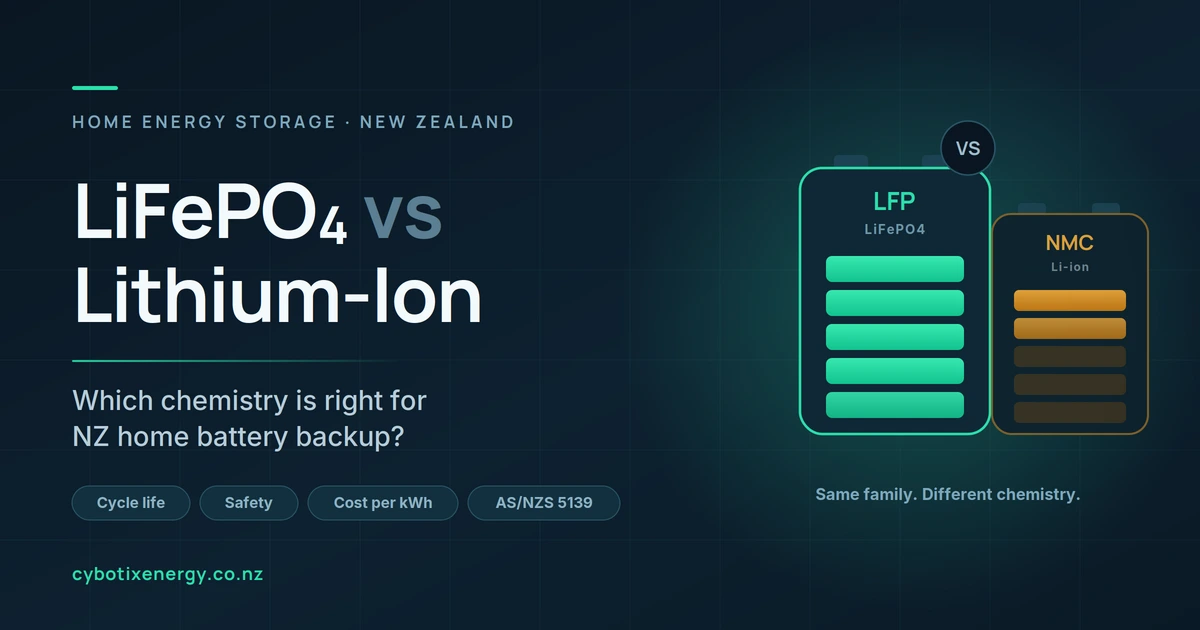
LiFePO4 (lithium iron phosphate, usually shortened to LFP) is one chemistry inside the lithium-ion family. So the real comparison isn’t LFP versus lithium-ion. It’s LFP versus the nickel-based lithium-ion chemistries NMC and NCA which is what most sellers mean when they write “lithium-ion” without qualifying it.
The three chemistries you’ll see on NZ spec sheets
- LFP (LiFePO4) — iron and phosphate cathode, 3.2V nominal per cell. Dominant in home storage, portable power stations, marine and campervan setups.
- NMC (nickel manganese cobalt) — 3.6–3.7V nominal. Common in EVs and in a handful of older wall-mounted home batteries.
- NCA (nickel cobalt aluminium) — the highest energy density of the three, used mostly in EVs and power tools. Rare in residential storage.
Why the two terms get muddled
“Lithium-ion” describes the whole family, which makes it a convenient word for marketers who don’t want to talk about cathode chemistry. If a datasheet only says “lithium-ion,” look for the nominal cell or module voltage. Modules built in multiples of 3.2V are LFP. Multiples of 3.6–3.7V point to a nickel-based chemistry. If neither is stated, ask the supplier directly a reputable one will tell you without hesitating.
LiFePO4 vs lithium-ion (NMC): head-to-head comparison
Across the metrics that matter for home backup, LFP wins on cycle life, thermal stability and cost per usable kilowatt-hour. NMC wins on energy density and weight. For a battery bolted to a garage wall, that trade lands firmly in LFP’s favour.
| Factor | LiFePO4 (LFP) | Lithium-ion (NMC) |
|---|---|---|
| Cycle life to 80% capacity | ~3,000–6,000+ | ~1,000–3,000 |
| Usable depth of discharge | 90–100% | 80–90% |
| Energy density (cell level) | ~90–160 Wh/kg | ~150–250 Wh/kg |
| Thermal runaway onset | Roughly 250–270°C | Roughly 150–210°C |
| Cathode oxygen release | Minimal | Releases oxygen, feeding a fire |
| Weight per usable kWh | Higher | Lower |
| Cost per usable kWh over life | Lower | Higher |
| Typical warranty | 10 years / defined throughput | 10 years, often lower cycle count |
| Best suited to | Daily cycling, fixed installs, backup | Weight- or space-constrained builds |
Cycle life, translated into NZ years
Cycle counts only mean something once you know your duty pattern. A battery used purely for outages might see 20 real cycles a year the rating will never be the limiting factor, and the electronics will age out before the cells do. A battery that charges from solar every day and discharges every evening sees around 365. At that rate, a 6,000-cycle LFP pack has headroom past the warranty period, while a 2,000-cycle NMC pack is looking at replacement inside seven years.
Most NZ households who install a battery end up cycling it daily, because sitting idle earns nothing. That single behavioural fact is what settles the chemistry question for the majority of installs.
Energy density versus footprint
LFP’s lower energy density means more kilograms and more litres for the same storage. That penalty is real, but it only bites in specific situations: a retrofit into a tight hallway cupboard, a boat where displacement matters, or a campervan with a payload limit. Bolted to a garage wall, an extra 20kg is a non-issue.
Safety, siting, and what AS/NZS 5139 means for your install
LFP’s higher thermal-runaway threshold is the main reason it dominates residential storage. Its cathode is chemically stable at temperatures where nickel-based cathodes begin breaking down and releasing oxygen — and oxygen is what turns a cell failure into a sustained fire. NZ installation rules then interact with that choice through siting, barriers and separation from living spaces.
Thermal runaway in plain English
Every lithium-ion cell stores a lot of energy in a small space. If a cell is damaged, overcharged or badly overheated, it can enter a self-sustaining reaction. In a nickel-based cathode, the breakdown liberates oxygen, which feeds the reaction from inside the cell. LFP’s iron-phosphate structure holds its oxygen far more tightly, so failures tend to vent and smoulder rather than propagate hard. The battery management system is the second line of defence it monitors cell voltage, current and temperature, and disconnects before conditions get dangerous. Chemistry sets the ceiling on how bad a failure can get. The BMS decides how often you get near it.
Consent, siting and installer obligations
In New Zealand, AS/NZS 5139:2019 amended in December 2025 applies to battery energy storage installations via the citation of AS/NZS 3000 in the Electricity (Safety) Regulations. Practically, that means:
- Systems above roughly 2kWh generally require building consent and electrical inspection. Your installer should handle the consenting.
- The standard sets separation distances between the battery and habitable spaces or ignition sources, plus ventilation and enclosure requirements.
- A garage or general storage room does not count as a dedicated battery room under the amended definitions — a point that catches out a lot of DIY plans.
- Compliant labelling and signage are required so emergency services know what they’re walking into.
This is a summary, not compliance advice. Confirm the specifics for your property with a registered electrical worker before you commit to a location.
How NZ conditions change the answer
New Zealand’s particular mix of storm-driven outages, low solar export rates and cool overnight temperatures pushes most households toward LFP. The reasoning has less to do with the chemistry’s headline specs than with how the battery actually gets used here.
Our outage profile is long, not frequent
In Northland, the Coromandel, Hawke’s Bay and the Canterbury foothills, outages tend to be weather-driven and measured in hours to days, not the brief flickers you’d size a UPS for. That favours capacity and cycle depth over fast-discharge power. It also means sizing for a handful of essential circuits fridge, lighting, water pump, internet will usually serve you better than trying to run the whole house.
Export rates reward cycling
Buyback rates for exported solar sit well below what you pay to import. Storing your midday surplus and using it at 7pm is worth more than selling it. That turns daily cycling into the default operating pattern, which is exactly the scenario where LFP’s cycle life pays for itself.
Cold mornings matter more than you’d think
No lithium-ion chemistry should be charged below 0°C without help doing it plates metallic lithium onto the anode and permanently damages capacity. A frosty Central Otago or Waikato morning is genuinely below that line. What separates a good pack from a cheap one is whether the BMS inhibits charging when it’s too cold, and whether the pack has an integrated heater. Check for both. Nameplate capacity tells you nothing about whether the battery will accept charge in July.
Salt air and humidity
Coastal Northland and Wellington are hard on hardware. For any outdoor or garage-adjacent install, look at the enclosure IP rating and the corrosion protection on terminals and cabinet fixings, not just the cells inside.
Portable power station or installed battery?
This is the question most buyers skip, and it often matters more than chemistry. A plug-in LFP power station covers your fridge, router and lighting for a few hundred to a few thousand dollars, with no consent and no electrician. A wired hybrid system backs up whole circuits automatically, but needs consent, an installer and a considerably bigger budget.
What a portable unit realistically runs
Rough daily numbers for a two-day outage:
- Modern 400L fridge-freezer: 1.0–1.5 kWh
- Wi-Fi router and modem: 0.25 kWh
- Four LED lights for five hours: 0.16 kWh
- Phones and a laptop: 0.3 kWh
That’s roughly 2 kWh a day. A 2kWh station covers one day of essentials; recharge it from a solar panel and you can stretch it indefinitely through a settled-weather outage. Through a storm with no sun, plan on capacity alone.
Where portable stops being enough
- Heat pumps and electric hot water high continuous draw, and usually hardwired
- Rural bore and tank pumps big startup surge, often 240V hardwired
- Induction cooking brief but very high power
- Medical equipment where an automatic changeover is non-negotiable
Portable — pros: no consent, no installer, portable to the bach, cheap entry, expandable. Cons: manual plug-in, limited capacity, won’t run hardwired circuits.
Installed — pros: automatic changeover, whole-circuit backup, works with solar and time-of-use tariffs, larger capacity. Cons: consent and inspection, higher cost, fixed to one property.
Plenty of households start portable and add an installed system later. That’s a sensible order, not a compromise.
Total cost of ownership over ten years
LFP usually costs more upfront per kilowatt-hour of nameplate capacity, and less per kilowatt-hour actually delivered. Divide by lifetime throughput and the ranking flips.
Take two 10kWh packs cycled daily for ten years illustrative figures, not quotes:
- LFP: 9.5 kWh usable, 6,000-cycle rating. Ten years of daily cycling is ~3,650 cycles, comfortably inside spec. Throughput ≈ 34,700 kWh. At $9,000, that’s about $0.26 per kWh delivered.
- NMC: 9.0 kWh usable, 2,500-cycle rating. It reaches end of rated life around year seven, so ten years needs roughly one and a half packs. Throughput ≈ 32,900 kWh at ~$12,000 total, or about $0.36 per kWh delivered.
Worth knowing on the financial side: as of 2026 New Zealand has no national residential battery rebate. Businesses and farms can generally claim GST input credits on solar and battery installation, and retailers are required to accept solar export and pay a feed-in tariff under Electricity Authority rules.
Our recommendation and when we’d say otherwise
For NZ home battery backup, LiFePO4 is the default, and it isn’t a close call. It handles daily cycling for longer, tolerates deeper discharge, fails less dangerously, and costs less per kilowatt-hour delivered. Nickel-based lithium-ion only wins in narrow cases.
We’d point you to NMC in three situations: a genuinely severe space or weight constraint where LFP physically won’t fit; an existing NMC system you’re expanding and want to keep matched; or a mobile application where every kilogram counts against a payload limit. Outside those, choose LFP.
Before you buy, confirm:
- The cell chemistry is stated explicitly, not implied
- Cycle life is quoted at a defined depth of discharge, not as a bare number
- The BMS includes low-temperature charge inhibit, and ideally a heater
- IP rating suits the install location
- The warranty is measured in throughput as well as years
- Warranty support is available in New Zealand, not just from an overseas factory
- Your installer is a registered electrical worker familiar with AS/NZS 5139
If you’d like a hand matching capacity to your actual load, the team at Cybotix Energy works through NZ home backup sizing every week.
FAQs
Is LiFePO4 the same as lithium-ion?
LiFePO4 is a type of lithium-ion battery, not an alternative to one. When a product page compares “LiFePO4 vs lithium-ion,” it almost always means LFP versus a nickel-based chemistry like NMC.
Is LiFePO4 safer than other lithium-ion batteries?
It has a higher thermal-runaway threshold and its cathode doesn’t readily release oxygen, so failures are less likely to escalate. That makes it the safer chemistry class, though a certified battery management system and a compliant install still matter.
How long does a LiFePO4 home battery last in NZ?
With daily cycling, a 6,000-cycle LFP pack has enough rated cycles to run past a standard ten-year warranty. Backup-only use puts far fewer cycles on the cells, and the electronics typically age out before the battery does.
Do I need building consent for a home battery in New Zealand?
Generally yes for systems above about 2kWh, along with electrical inspection. AS/NZS 5139 also governs where the battery can sit relative to habitable rooms. Your installer should manage consenting confirm that before you sign.
Can a LiFePO4 battery charge in cold weather?
Not below 0°C without heating. Charging a cold lithium cell causes permanent damage, so quality packs inhibit charge below a threshold and better ones include a heater. Worth checking if you’re in a frost-prone region.
Is a portable power station enough to get through a power cut?
For a fridge, lights, internet and devices, roughly 2kWh a day covers it so a mid-sized unit handles a day or two, longer with a solar panel. Hardwired loads like heat pumps and bore pumps need an installed system.
Which chemistry is cheaper over ten years?
LFP, in most cases. It usually costs more upfront per nameplate kilowatt-hour but delivers far more total energy before replacement, which brings the cost per kilowatt-hour delivered down.