Your battery was installed two years ago. Nobody has touched it since. It sits in the garage doing its job, and at some point you started wondering whether you were supposed to have been doing something.
Do Solar Batteries Need Maintenance
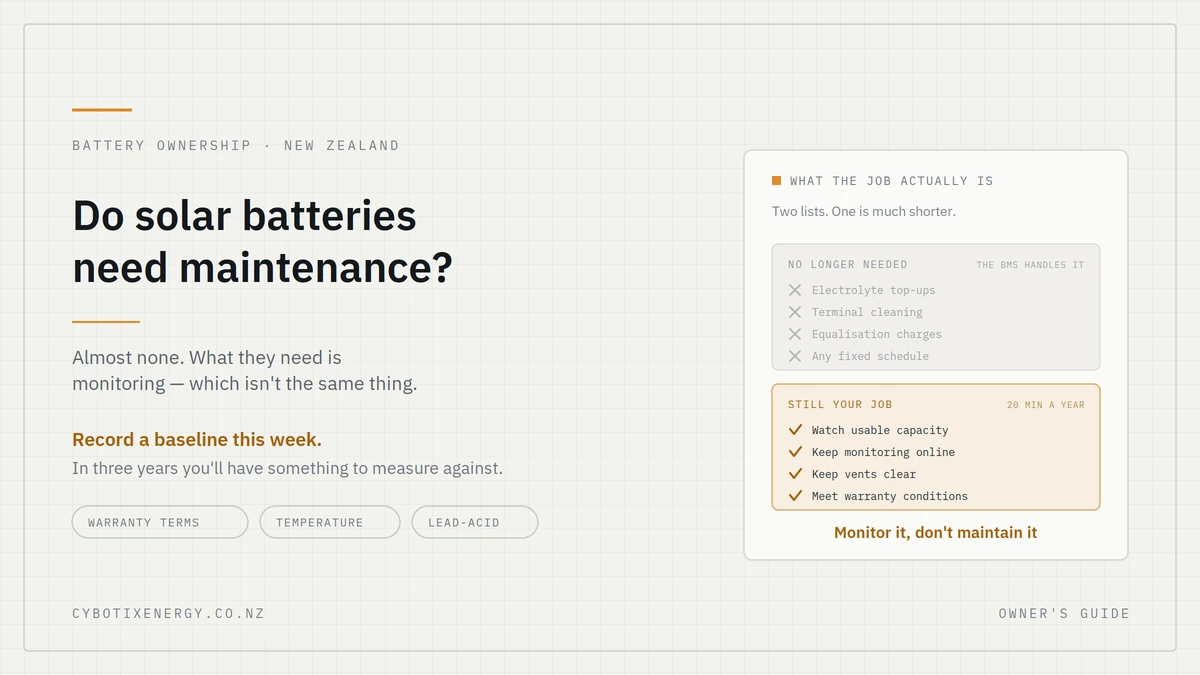
The honest answer: almost nothing. Solar batteries need very little maintenance a modern lithium unit has no fluids to check, no terminals to clean and no cycles to run manually. What it does need is monitoring, and it needs you to keep your warranty conditions satisfied. Those two things are the whole job.
The short answer
A modern LiFePO₄ home battery requires no scheduled physical maintenance. No electrolyte top-ups, no equalising charges, no terminal cleaning.
What it needs is someone noticing if its behaviour changes, and keeping the conditions attached to its warranty intact. That’s monitoring rather than maintenance, and it takes about twenty minutes a year.
Why modern batteries need so little
Worth understanding, because it explains why the advice you’ll find from a decade ago doesn’t apply.
The BMS does the work that used to be manual
Every modern battery has a battery management system firmware that handles cell balancing, temperature protection, charge and discharge limits, and cutting off before the cells reach a damaging state.
Those were once manual tasks. Now they run continuously without you knowing. That’s the single biggest reason a modern battery asks so little of its owner.
Sealed chemistry
LiFePO₄ cells are sealed. There’s no liquid electrolyte to evaporate, nothing to top up, and no hydrogen venting to manage the way a flooded lead-acid bank requires.
What that means practically
There is no maintenance schedule to follow. If you’ve been doing nothing for two years, you haven’t been neglecting it you have been using it as designed.
The risk isn’t that you skipped a task. It’s that nobody has looked at the numbers.
Monitoring, not maintenance
The reframe worth holding onto: your job is noticing change, not performing tasks.
A battery rarely fails suddenly. It drifts a bit less capacity, slightly longer to charge, the occasional shutdown and the drift is easy to miss if you’ve nothing to compare against.
What to watch
- Usable capacity how much you actually get out of it, in kWh
- Charge and discharge times noticeably slower than they were?
- Unexpected shutdowns or the system dropping to grid when it shouldn’t
- Error codes in the app or on the inverter
- State of health, if your system reports it
How often
A glance at the app monthly. A proper look twice a year say March and September. Ten minutes each time.
Record a baseline, because nobody does
This is the most useful habit on the page and almost nobody has it.
In the first month after installation, write down what the system does. Usable capacity, typical charge time, how long it runs your evening load. A screenshot of the app is enough.
Two years later, when you’re wondering whether capacity has dropped, you’ll have something to compare against instead of a vague sense that it used to last longer. Without that, a warranty conversation becomes an argument about impressions.
If your system’s already installed and you don’t have a baseline take one this week. It’s more useful than no baseline, and it’s better than the one you’ll wish you had in 2028.
The things that actually shorten battery life
Four factors matter, and three of them were decided at installation.
| Factor | Effect | Can you change it? | What to do |
|---|---|---|---|
| Temperature | The dominant ageing factor | Rarely — set at install | Keep vents clear, improve airflow if possible |
| Sitting at 100% | Accelerates ageing | Sometimes, via settings | Ask your installer about charge limits |
| Deep daily cycling | Consumes cycle life faster | Partly, by sizing | Size for shallower cycles where possible |
| Long idle at wrong charge | Matters for baches | Yes | Follow the recommended idle state |
Temperature is the one that matters most
Heat ages lithium cells, and it does so whether or not you’re using the battery. An unventilated garage cupboard in a Hawke’s Bay February is a harder environment than the specification assumes.
Cold matters too many batteries limit or refuse charging below a certain temperature, which in an uninsulated South Island garage can mean reduced winter performance.
The frustrating part: placement was decided at installation and usually can’t be changed afterwards. What you can do is keep vents clear, avoid stacking boxes against it, and mention it to your installer if the space runs hot.
Sitting at full charge
Holding a lithium battery at 100% for long periods is harder on it than sitting at a partial charge. Some systems let you cap the charge level for exactly this reason.
Worth asking your installer whether yours does, and whether it’s configured sensibly for how you use it.
Depth of discharge
How deeply you cycle affects how many cycles you get. A battery sized so that a normal evening uses 40% of its capacity will outlast an identical one being run to 90% every night.
That’s a sizing decision rather than a maintenance one our guide to sizing home battery backup covers it.
The one real obligation: your warranty conditions
Here’s the part nobody writes about, and it’s the closest thing to genuine maintenance you have.
Most battery warranties carry conditions. Fail them and you may have cover you can’t actually claim on which you’d discover at the exact moment you need it.
Conditions that commonly appear
- Monitoring must remain connected and reporting to the manufacturer
- Firmware kept current
- Operation within the stated temperature range
- Installed and commissioned by an approved installer
- Cycle count or energy throughput limits over the warranty term
- Capacity retention measured against a stated curve, not against your expectations
Why this is the actual task
That first one catches people. A battery whose monitoring has been offline for a year router changed, password lost, app uninstalled may have a gap in exactly the data a warranty claim depends on.
Keeping the internet connection alive and the firmware current is more consequential than anything physical you could do to the unit. It’s also easy to let slip, because nothing appears to be wrong.
If you have lead-acid, this is a different article
Some New Zealand off-grid setups and older installs still run flooded lead-acid, and it genuinely does require scheduled maintenance.
| Task | LiFePO₄ | Flooded lead-acid |
|---|---|---|
| Check electrolyte levels | Never | Regularly |
| Top up with distilled water | Never | As needed |
| Clean terminals | No | Periodically |
| Equalisation charge | No | Periodically |
| Ventilation requirements | Minimal | Significant — hydrogen venting |
| Specific gravity testing | No | Optional but useful |
If that’s what you have, follow your manufacturer’s schedule it’s real work with real consequences for skipping it. And when replacement time comes, lithium removes almost all of it.
What you can and can’t do yourself
Scoped carefully, because the line matters.
Yours to do
- Keep vents and airflow clear. No boxes, no bikes, no stored gear against the unit.
- Look for dust, cobwebs and pests. Rodents and wiring are a genuinely bad combination.
- Keep the area dry and accessible.
- Watch the app and note anything that’s changed.
- Keep monitoring connected after any router or Wi-Fi change.
Not yours to do
- Opening enclosures or covers
- Touching terminals or DC wiring
- Anything involving the inverter’s internals
- Firmware updates on some systems check whether yours is owner-serviceable
- Investigating a fault beyond reading the code
Those are prescribed electrical work for a licensed electrical worker. Not a grey area.
And to be direct: a battery that’s swollen, unusually hot, smells odd or is smoking is an emergency. Leave the area, don’t attempt anything, and call your installer or emergency services depending on severity. That is not a project.
A simple seasonal routine
Not a maintenance schedule a short calendar.
Twice a year (March and September):
- Check vents and airflow
- Read state of health in the app
- Check the error log
- Walk around it and look
- Confirm monitoring is still connected
Before winter:
- Confirm settings suit lower generation. Our guide to appliances and solar timing covers what changes seasonally.
After a storm or extended outage:
- Confirm it recovered properly and returned to normal operation
If you’re away for months:
- Check the manufacturer’s recommended idle state of charge, particularly for baches
When to call someone
- Capacity dropping faster than the warranty curve allows
- Repeated error codes, even if it keeps working
- Unusual heat during normal operation
- Any swelling, deformation or smell
- An inverter that keeps faulting or dropping to grid unexpectedly
Bring your monitoring history to that conversation. A documented record of behaviour over time is what turns a warranty claim from a debate into a process.
FAQs
Do solar batteries need maintenance?
Modern lithium batteries need no scheduled physical maintenance no fluids, no terminal cleaning, no equalising. What they need is monitoring and for your warranty conditions to stay satisfied.
How long do solar batteries last in New Zealand?
Warranties commonly run ten years with a stated capacity retention figure, and real life depends heavily on temperature and cycling depth. A battery in a cool, ventilated space cycled moderately will outlast an identical one in a hot cupboard run flat nightly.
How do I check my battery’s health?
Through your system’s app or portal usable capacity, state of health if reported, charge and discharge times, and the error log. Compare against a baseline from the first month if you have one.
Does a hot garage damage a solar battery?
Heat is the main ageing factor for an installed battery, so a consistently hot, unventilated space shortens its life. Keep airflow clear, and raise it with your installer if the space runs hot placement is hard to change later.
Can I do battery maintenance myself?
Visual checks, keeping vents clear and watching the app, yes. Anything involving terminals, enclosures, DC wiring or the inverter’s internals is prescribed electrical work and needs a licensed electrical worker.
Will neglecting it void my warranty?
Possibly many warranties require monitoring to stay connected, firmware to be current, and operation within a temperature range. Keeping the connection alive is the most commonly missed condition.