You’re paying a daily connection charge for a building that’s empty forty-six weeks of the year. Or you’re not connected at all, and every arrival starts with wrestling a generator into life.
Either way, solar looks like the answer. Which kind depends on something most guides skip entirely: how the place actually gets used. A bach isn’t a small house, and sizing it like one produces the wrong system.
Solar for Baches and Holiday Homes NZ
The short answer
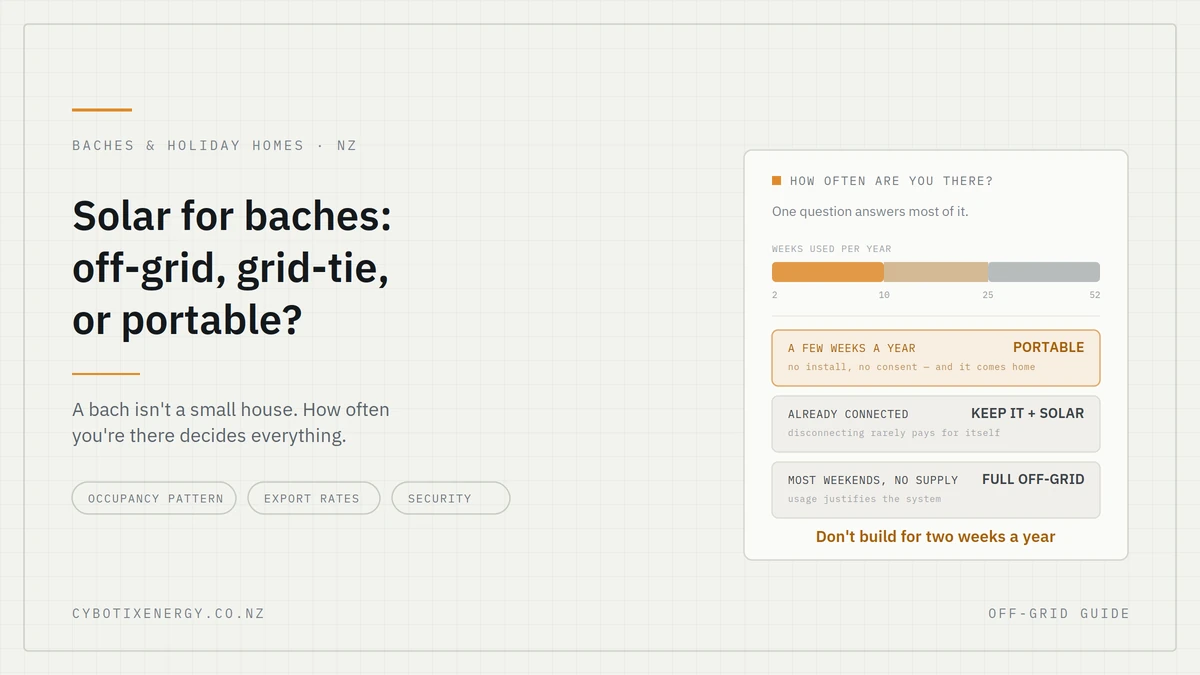
Already connected? Keep the connection and add solar. Disconnecting to save a fixed daily charge rarely pays for itself.
Not connected? The choice is between a full off-grid system and portable power and for a place used a few weeks a year, portable is right more often than people expect.
A bach is not a small house
This is the framing that changes everything downstream.
Empty for months, then intensive
Your bach sits unused for long stretches. Then six people arrive with a chest freezer’s worth of food, everyone showers, the water pump runs constantly, and there are phones and devices charging on every surface.
That’s not a daily average. It’s a rare peak with long idle periods around it.
Why that inverts the sizing question
A home system is sized for steady daily consumption through the worst season. A bach system is sized for a load that happens a handful of times a year.
Building a system big enough for peak Christmas occupancy means it spends the other eleven months doing almost nothing. That’s a poor use of money, and it’s why the usual sizing method leads people astray here.
Summer-weighted use is a genuine advantage
Most baches see their heaviest use in the highest-generation months. That’s the opposite of a home’s problem, where demand peaks exactly when generation is lowest.
Our off-grid design guide covers sizing for the worst week of winter the method that matters for a permanently occupied place. For a summer bach, much of that constraint disappears, which makes the system considerably cheaper.
If you already have a grid connection
Keep it. That’s the honest answer, and it costs us the bigger sale.
The maths on disconnecting
Disconnecting saves you the fixed daily charge. To replace that connection you’d need enough generation and storage to cover a full Christmas occupancy in any weather, with no fallback if you get it wrong.
That’s a substantial system bought to save a modest annual charge and it removes the safety net that makes the place usable when the weather doesn’t cooperate.
Work out your actual annual fixed charge before considering it. Most people find the number is smaller than the system it would take to replace.
What to add instead
- Solar to offset what you use while you’re there
- Storage only if outages are frequent enough to bother you
- A hybrid inverter if you want the place to keep working during a cut
Our guides to sizing a solar system and home battery backup cover both sides of that.
The export question nobody mentions
Here’s the part specific to holiday homes.
An empty bach with solar exports almost everything it generates for most of the year. And under most retailer buy-back rates, exported energy earns considerably less than imported energy costs.
So a large array at a mostly-empty bach spends eleven months selling power cheaply and two weeks offsetting power at full value. That changes the sizing calculation substantially a smaller array sized closer to your actual occupancy usually returns better than filling the roof.
Ask your installer to model it on your real usage pattern, not on a standard household profile.
If you don’t have a connection
Two real paths, and a line extension quote usually settles which.
What a connection would cost
Getting supply to an unserviced rural section can be expensive, and the figure depends entirely on distance, terrain and what’s already nearby.
Get a written quote from your lines company before deciding anything. It’s often the number that makes the decision for you.
Full off-grid
Panels, battery, inverter, consenting and a licensed installer. A genuine system, sized for how you use the place.
Worth it when usage justifies it regular weekends year-round, or a bach that functions as a second home rather than a summer place.
Portable power
No install, no consent, no electrician. This is the option most bach owners haven’t seriously considered, and for intermittent use it’s frequently the right one.
The case for portable at a bach
Nobody writes this, because it’s the cheaper answer.
No install, no consent, no electrician
You arrive, you plug things in, you use them. No design phase, no waiting on a booking, no consent question.
It comes home with you
Two things follow from that.
Theft stops being a concern. An unoccupied building with visible, valuable equipment is a target, and a portable unit that travels in your boot isn’t there to steal.
The asset gets used year-round. Instead of sitting idle for eleven months, it’s your home backup during outages, your camping power, your worksite supply. That completely changes the value calculation against a fixed system.
What it realistically runs
A fridge, lights, a water pump, phones, laptops, a fan. Our guides to running a refrigerator overnight and what appliances solar can run cover the arithmetic.
Pair it with a folding panel and it refills during the day, which turns a weekend’s capacity into a week’s.
Where it falls short
- Hard-wired loads a water pump on a wall switch, hard-wired lighting
- Larger groups for longer stays
- Electric hot water or heating, which no portable unit covers meaningfully
- A bach used most weekends, where a fixed system starts making sense
The options side by side
| Grid + solar | Full off-grid | Portable | Generator | |
|---|---|---|---|---|
| Upfront cost | Moderate | Highest | Lowest | Low |
| Ongoing cost | Fixed charges | Maintenance | None | Fuel |
| Install required | Yes | Yes | No | No |
| Consent | Possibly | Likely | None | None |
| Suits intermittent use | Yes | Poorly | Best | Yes |
| Theft risk when empty | Moderate | High | None — it leaves | Moderate |
| Runs hard-wired loads | Yes | Yes | No | Yes |
| Noise | None | None | None | Significant |
| Useful elsewhere | No | No | Yes | Somewhat |
The problem nobody plans for: long idle periods
Equipment left unattended for months is a different maintenance situation from a home system, and it’s where bach installations quietly go wrong.
Batteries over winter
A battery bank left at the wrong state of charge for eight months, with nobody there to notice, can drift somewhere you don’t want it to be.
Our guide to solar battery maintenance covers what matters. The bach-specific problem is simply that nobody’s walking past to check which is an argument for remote monitoring, or for portable gear that comes home with you.
Remote monitoring earns its place here
On a home system, monitoring is useful. At a bach it’s close to essential, because it’s the only way you’ll know something has gone wrong before you arrive to find out.
Vermin, damp and dust
Unoccupied buildings attract rodents, and rodents and wiring are a bad combination. Coastal damp and dust accumulate with nobody to notice. Worth a proper look at the equipment each time you arrive.
Theft and security
An unoccupied rural building with visible equipment is a target, and it deserves more thought than it usually gets.
Things that matter:
- Panel placement visible from a road versus not
- Where the inverter and batteries live inside a locked space rather than an external enclosure
- Whether portable gear travels with you, which removes the problem entirely
- What your insurer expects for an unoccupied dwelling
That last one is worth checking before you install anything. Cover for equipment at a property that’s empty most of the year may carry conditions.
Consents, briefly
Grid-connected systems need lines company approval regardless of how often the place is occupied. Building or resource consent depends on placement, structure and your council.
Baches attract some specific complications: cross-lease and unit title arrangements, coastal environment provisions in some districts, and older buildings that predate current rules.
Our guide to solar consent requirements covers the general position.
Three worked scenarios
Connected bach, Coromandel, six weekends a year. Keep the connection. A modest array offsets what you use while there, and the fixed charge is cheaper than the system it would take to replace. No battery outages during six weekends a year are an inconvenience, not a problem worth solving.
Unconnected bach, Northland, family stays two weeks each summer. Portable power and a folding panel. It runs the fridge, lights and pump, refills during the day, costs a fraction of a fixed system, comes home in the car, and works as home backup for the rest of the year. Don’t build a system for two weeks of use.
Unconnected bach, Central Otago, most weekends year-round. Full off-grid. Usage justifies the investment, winter sizing genuinely matters at that latitude, and the place functions as a second home rather than a summer bach.
FAQs
Should I disconnect my bach from the grid?
Usually not. Work out your actual annual fixed charge first most people find it’s smaller than the system needed to replace the connection reliably. Adding solar while keeping the connection is generally the better value.
Can I run a bach entirely on solar?
Yes, with enough generation and storage. Whether it’s worth it depends on usage. For a place used a few weeks a year, portable power usually makes more sense than a full off-grid build.
Do I need consent for solar at a bach?
Grid-connected systems need lines company approval. Building or resource consent depends on placement and your council, and baches sometimes carry extra complications like cross-lease arrangements. Check locally before designing.
What size system does a holiday home need?
Size it to your occupancy pattern, not to a standard household profile. A system built for peak Christmas use sits idle most of the year, and an empty bach exports most of what it generates at below what you pay to import.
Is portable power enough for a bach?
For a fridge, lights, water pump and devices during intermittent stays, often yes particularly paired with a folding panel. It won’t cover hot water, heating or hard-wired loads.
What happens to the batteries while nobody’s there?
That’s the main risk with a fixed system at an intermittently used property. Batteries left at the wrong charge for months can drift, and nobody’s there to notice. Remote monitoring helps; portable gear that comes home with you sidesteps it.
Will solar panels at an empty bach get stolen?
It’s a real consideration for an unoccupied rural building. Placement, locked internal spaces for inverters and batteries, and your insurer’s conditions all matter and it’s one reason portable equipment that travels with you appeals.