Your panels went on four years ago. You’ve been glancing at the app, and the numbers look lower than you remember. Now you’re wondering whether something is wearing out.
Solar panel degradation is real, and in New Zealand’s UV conditions it’s worth understanding properly. But here’s the thing worth knowing before you read any further: if your output has dropped noticeably in four years, degradation almost certainly isn’t the cause. It’s too slow to explain a change you’d actually notice.
Something else is going on, and it’s usually fixable.
Solar Panel Degradation in NZ
The short answer
Panels lose a small percentage of output in their first year, then a much smaller amount each year after that. Most performance warranties guarantee a stated output at 25 years.
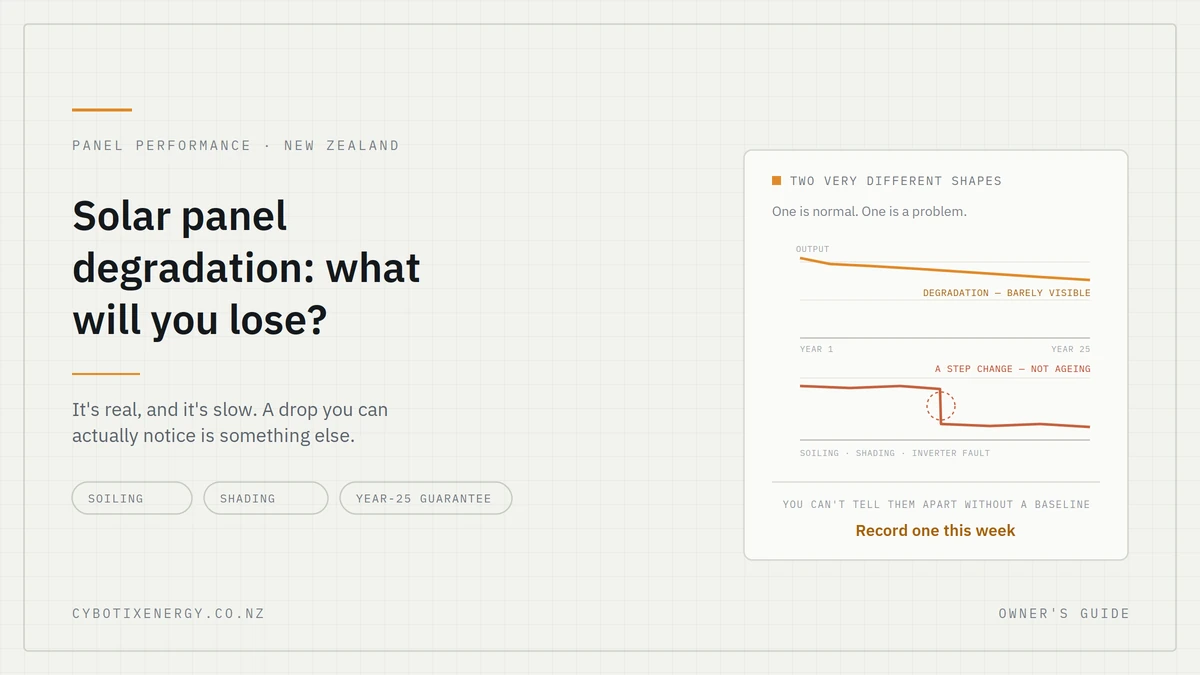
A gradual, barely perceptible decline across decades is degradation. Anything you can see happening within a few years is something else.
What degradation actually is
Panels are outdoors for decades, exposed to UV, heat and daily thermal cycling. Over that time the cell material and the encapsulant surrounding it change slightly, and the cell converts a fraction less light than it did when new.
It’s gradual, permanent and entirely expected. It’s built into the warranty.
The first year is different
There’s a larger drop in the first year than in any year afterwards light-induced degradation, which happens as the cells stabilise after their first real exposure to sunlight.
That’s why panels have two degradation figures rather than one, and why comparing panels on a single number is comparing the wrong thing.
What it isn’t
- Not a fault. A panel degrading at its stated rate is working as designed.
- Not reversible. No cleaning, servicing or setting recovers it.
- Not a defect claim. That’s a separate warranty, covered below.
The two numbers that matter
| Metric | What it means | Why it matters |
|---|---|---|
| First-year degradation | The initial drop as cells stabilise | Larger than any subsequent year varies by cell technology |
| Annual degradation | Yearly loss from year two onward | Much smaller, and where most of the 25-year total accumulates |
| Year-25 guarantee | Output the manufacturer commits to at end of term | The number to actually compare |
Compare the year-25 figure, not the annual rate
Both numbers roll up into one: the percentage of original rated output the manufacturer guarantees at year 25.
That’s the honest comparison point for two reasons. It’s the figure the manufacturer will actually be held to, and it captures the whole curve rather than one slice of it.
Put two quotes side by side and compare that number. A panel guaranteeing a higher percentage at year 25 is making a stronger claim about its own longevity, and manufacturers don’t offer those figures casually. Our guide to choosing the right solar panel covers the full comparison method.
Before you blame degradation: five things more likely
If you’ve noticed a drop, work through these first. In order of likelihood.
1. Soiling
By far the most common cause, and entirely reversible.
Dust, pollen, salt film, bird mess, and in some areas a grimy residue that builds up over a dry spell. Rain handles a lot of it, but not all and a panel that hasn’t seen proper rain for six weeks can lose a meaningful chunk of output.
How to check: look at them. If they’re visibly dirty, that’s your answer.
2. New shading
Shading changes over years and nobody notices it happening.
A tree that’s grown, a neighbour’s new extension, a satellite dish, a chimney flue that got extended. Even partial shading on one panel can drag down a whole string depending on your setup.
How to check: look at the array mid-morning and mid-afternoon, not at noon. Shadows at the edges of the day are the ones that catch people.
3. Inverter issues
The inverter is the component most likely to actually fail, and a fault can present as reduced output rather than an obvious error.
A failed MPPT input, thermal derating in a hot location, or a fault the app reports quietly.
How to check: the error log and event history in your monitoring app.
4. You’re comparing different seasons
The most common error of all.
July generation against January generation isn’t a comparison it’s two completely different conditions. Output in midwinter can be a fraction of midsummer for reasons that have nothing to do with your panels.
How to check: compare the same month year on year, nothing else.
5. One panel or string underperforming
If your monitoring is at inverter level rather than panel level, a single failing panel can pull a string down without showing up as an obvious fault.
How to check: ask your installer to test string by string.
None of these five are degradation. All of them are more likely, and four of the five are fixable.
New Zealand conditions and what they mean
Our environment is genuinely harder on panels than the latitude suggests, and it’s worth understanding.
UV intensity
New Zealand experiences notably high peak UV a combination of thinner ozone, clean air with low particulates, and the Earth being closest to the sun during our summer.
Over decades, UV is what stresses encapsulants, backsheets and frame coatings. It’s a real argument for build quality over headline efficiency, and it’s why the year-25 guarantee is worth more attention here than in a temperate northern climate.
Salt air and coastal sites
A large share of NZ housing sits within a few kilometres of the coast. Salt accelerates corrosion of frames, fasteners and junction boxes and the mounting hardware usually shows it before the panels do.
Salt mist resistance certification is worth confirming if you’re coastal. Our guide to solar on metal roofs covers the galvanic corrosion side of that.
Operating temperature
Panels that run hotter age faster. That’s partly climate and partly mounting a tight-mounted array on a dark roof with no airflow behind it runs hotter than the same panels on rails with a proper standoff.
It’s one of the few degradation factors you can influence, and it’s decided at installation.
What matters less than people expect
Hail, snow and wind rarely cause degradation at typical NZ sites. Wind matters for mounting a safety and structural question rather than a performance one.
How to tell degradation from a problem
You need a baseline. Almost nobody has one, and it’s the single most useful thing you can create.
Record a baseline in year one
Three things, once, in your first year:
- Peak output on a clear sunny day, in kW
- Daily generation on a typical good day in a named month
- Monthly totals for a full twelve months
A screenshot of the app is enough. Save it somewhere you’ll find it.
Five years later, when you’re wondering whether output has dropped, you’ll have something to compare against rather than an impression. Without it, a warranty conversation becomes an argument about memory.
If your system is already installed and you have no baseline take one now. It’s better than the one you’ll wish you had in 2031.
Compare like with like
Same month, similar weather, similar time of day. Seasonal comparisons are meaningless and they’re the reason most people think their panels are failing when they aren’t.
What normal looks like
On a monitoring app, genuine degradation is nearly invisible year to year. It’s a slight trend you’d only see across a decade of monthly totals.
Anything sudden is not degradation. A step change means a fault, shading or soiling.
What the warranty actually covers
Two separate warranties, routinely conflated.
Product versus performance
Product warranty covers the panel itself defects in materials and workmanship.
Performance warranty guarantees a minimum output over time. It’s the one relevant to degradation, and it’s usually the longer of the two.
When an installer says “25-year warranty,” they almost always mean the performance one. Our panel selection guide covers why the product warranty length is the better quality signal.
How a performance claim works
Measured against the manufacturer’s stated curve, not against what you hoped for. You’d generally need to demonstrate output below the guaranteed figure, which means evidence over time.
Which brings it back to the baseline. A claim supported by records is a process; a claim supported by a feeling is a conversation that goes nowhere.
Who honours it here
The question almost nobody asks. Ask your installer:
- Is there a New Zealand importer or distributor for this brand?
- Who processes a claim?
- What happens if the installer’s business closes?
- Has this manufacturer been in the NZ market long enough to have a record here?
A 25-year warranty is worth exactly as much as the entity standing behind it.
What you can actually do
You can’t reverse degradation. You can avoid accelerating it, and you can stop losing output to fixable causes:
- Clean at a sensible interval more often if you’re coastal, rural or under trees
- Manage shading as vegetation grows
- Ensure airflow behind the array, which is a mounting decision
- Monitor, so you notice a change rather than discovering it
- Keep your baseline and compare like with like
Planning for it when you buy
If you’re sizing a system to meet a specific need, size it on year-25 output rather than day-one output.
A system that exactly covers your usage today will fall slightly short in twenty years. Building that in from the start costs a little more now and avoids a shortfall later our guide to sizing a solar system covers the calculation.
FAQs
How much output do solar panels lose per year?
A larger drop in the first year as cells stabilise, then a much smaller amount annually. The figure that matters is the guaranteed output at year 25, which captures the whole curve check the datasheet for your specific panels.
Do solar panels stop working after 25 years?
No. The warranty term ends; the panels keep generating at a reduced output. Many continue producing usefully well beyond it.
Why has my solar output dropped?
Most likely soiling, new shading, an inverter issue, or comparing different seasons. Degradation is too slow to explain a change you’d notice over a few years work through the fixable causes first.
Does New Zealand’s UV damage solar panels faster?
Our peak UV is high for the latitude, and UV stresses encapsulants and frames over decades. It’s an argument for build quality and a strong year-25 guarantee rather than a reason to expect early failure.
How do I know if my panels are degrading or just dirty?
Look at them. If they’re visibly soiled, clean them and re-measure. Genuine degradation is barely visible year to year, so anything you can see in the data is almost certainly something else.
Is panel degradation covered by warranty?
Degradation at the stated rate isn’t a fault, so no. Output below the guaranteed curve is a performance warranty claim which is why records and a baseline matter.
Should I factor degradation into my system size?
If you’re sizing to a specific requirement, yes size on year-25 output. A system that just covers your needs today will fall slightly short in two decades.