Your panels have been on the roof since March. Then the June bill arrives and it looks almost the same as the one from before you installed them. Nothing is broken. This is just what winter does.
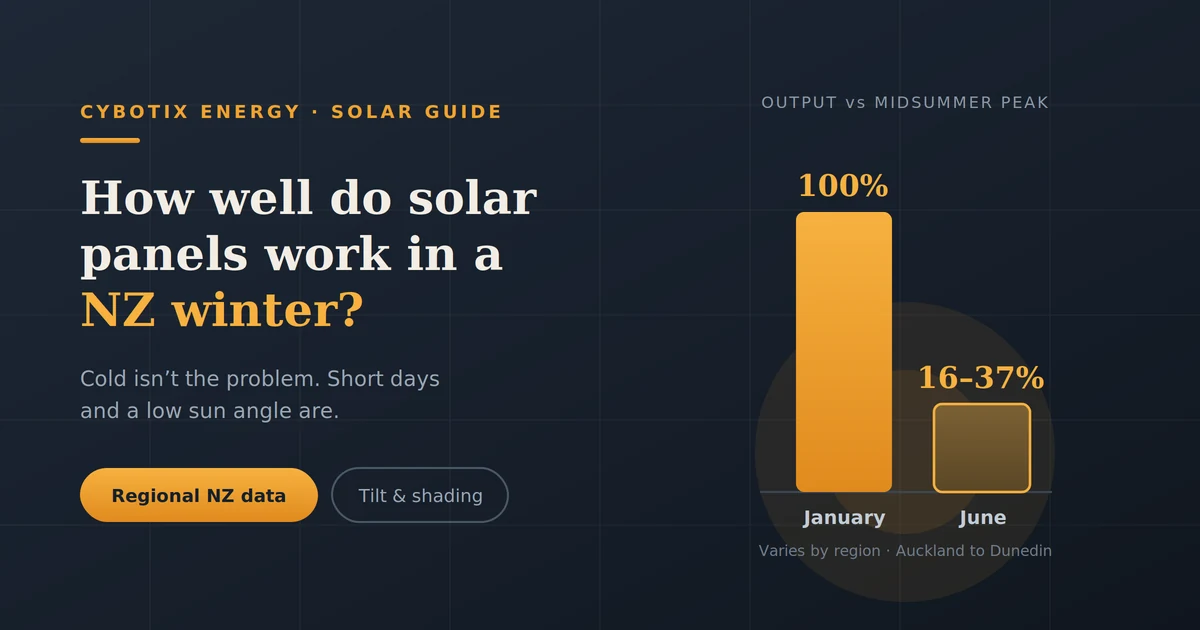
The honest answer to how well solar panels work during winter in New Zealand: you’ll generate roughly a fifth to a third of your midsummer output, depending heavily on where you live. Auckland holds up far better than Dunedin. But the reason isn’t what most people assume cold weather isn’t the culprit. It’s daylight, sun angle, and the awkward fact that winter is when your house wants the most power.
Do Solar Panels Work in Winter in New Zealand
Expect winter generation somewhere between 16% and 37% of your summer peak, with the gap widening the further south you go. PVGIS satellite data puts Auckland’s winter-to-summer ratio at 28%, Christchurch at 18%, and Dunedin at just 16% the further south, the bigger the seasonal swing. Solar Scout
An EECA study modelling a north-facing Auckland array at 15° tilt found June generation came to 37% of January’s once the number of days per month was accounted for. Eeca
Those two Auckland figures 28% and 37% don’t contradict each other. They measure slightly different things (seasonal averages versus a specific month-to-month comparison at a defined tilt). Treat the range as the useful answer rather than picking one number and calling it fact.
Concrete version: Christchurch systems generate around 6.61 kWh per day per kilowatt installed in summer, dropping to 2.06 kWh per day in winter, with spring and autumn sitting at 5.55 and 3.47 respectively. For a 7kW system, that’s roughly 46 kWh a day in January and about 14 kWh in July. Zenenergy
Cold weather doesn’t reduce solar output it slightly improves it
This is the part that surprises people. Solar panels are rated at 25°C and become less efficient as they heat up. Panels lose roughly 0.3–0.5% of efficiency for every degree above 25°C, and on a still summer day they can reach 65°C and shed 12–20% of their rated output. Solar Scout
A crisp 8°C Canterbury morning with clear sky is excellent panel weather. The cells run near their rated temperature and convert light efficiently.
There’s a neat illustration of this in the national data. Wellington produces 1,431 kWh/kWp annually second only to New Plymouth despite having fewer sunshine hours than Blenheim or Nelson, partly because constant wind keeps panels at 40–50°C rather than baking. Solar Scout
So when someone tells you solar “doesn’t work in the cold,” they’ve got it backwards.
So what actually causes the winter drop?
Four things, and none of them is temperature. Shorter days cut your generating window, a lower sun angle weakens the light reaching each panel, winter cloud cover blocks more of what’s left, and low-angle sun turns objects that never shaded you in summer into genuine obstructions.
Shorter days
Auckland gets around 15 hours of daylight at the summer solstice and about 9.5 in late June. That’s a third of your generating window gone before any other factor applies.
Lower sun angle
At midwinter the sun tracks low across the northern sky. Light passes through more atmosphere and strikes your panels obliquely rather than square-on, so each hour of sunshine delivers less energy.
Latitude drives this, which is why sunshine hours alone mislead. Blenheim records the most sunshine hours in the country at 2,521, yet ranks only third for actual yield, because its lower sun angle means each sunshine hour delivers less irradiance than one in Auckland. New Zealand spans latitudes 34 to 47 degrees a 13-degree spread that shows up clearly in winter numbers. Solar ScoutNiwa
Cloud and rain
Panels still generate under cloud, just less. Winter weather patterns differ sharply between the Waikato and the West Coast, which is why two systems of identical size can report very different Julys.
Low-angle shading
The shading audit done in February is close to worthless for June. A fence, a hedge or a neighbour’s roofline that sits well below the summer sun path can cut directly across a winter array. This is the single most common cause of a system underperforming its winter estimate and the most fixable.
Winter solar output by New Zealand region
Annual yield figures below are modelled from PVGIS satellite data:
| Location | Annual yield (kWh/kWp) | Winter-to-summer ratio | Practical read |
|---|---|---|---|
| New Plymouth | Highest in NZ | Strong all-round performer | |
| Wellington | 1,431 | Wind-cooled panels offset fewer sunshine hours | |
| Auckland | 1,391 | 28% | Mildest seasonal swing of the main centres |
| Christchurch | 1,340 | 18% | Clear winter days, but short ones |
| Dunedin | 1,226 | 16% | Largest swing; size for winter deliberately |
| Invercargill | 1,137 | Lowest in NZ, still comparable to London (1,154) |
Invercargill sits at the bottom of the national table yet remains close to London’s output and every New Zealand region receives more annual solar irradiance than Germany, which runs one of the world’s largest solar markets. Solar ScoutSolar Scout
For your specific roof, national averages are the wrong tool. NIWA’s free SolarView tool estimates available solar energy at a given address, accounting for panel direction, roof slope and local obstructions like buildings and terrain an address-level estimate that includes your local horizon, which coarse satellite models can’t capture. NIWANicegear
The winter squeeze why the bill jumps more than the output falls
Here’s what most articles miss. Your generation bottoms out in exactly the months your consumption peaks: heat pumps, longer hot-water cycles, lights on at 5pm, the dryer running because nothing dries outside. Output down 70%, demand up 30%.
It gets tighter. Winter also brings lower hydro generation nationally, meaning less energy available and higher prices. So the kilowatt-hours you’re buying from the grid in July are often the most expensive ones of the year. Eeca
The practical consequence: a system sized purely on annual averages can still disappoint you in July, even when it performs exactly as modelled. If winter self-sufficiency matters to you, that needs to be a stated design goal from the start not something you discover afterwards.
Does panel tilt change your winter result?
Yes, meaningfully. Steeper tilts catch low winter sun more squarely, while shallow tilts favour the high summer sun. PVGIS puts the best year-round tilt across New Zealand at 35–42° steeper than a lot of NZ roofs. Nicegear
NIWA SolarView modelling for an Auckland site compared 27° and 52° tilts and found the higher angle collects more sun over winter while giving up summer output. GridFree®
Steeper tilt (winter-optimised)
- Better June–August generation, when power costs most
- Sheds rain, dust and debris more readily
- Gives up meaningful summer output
- Needs tilt frames on a low-pitch roof more cost, more wind load, sometimes consent
Standard roof pitch (20–25°)
- No extra hardware, lower cost, cleaner look
- Better annual total for most homes
- Weakest exactly when you need it most
One detail worth checking on any install: true north, not magnetic north. A compass in New Zealand points roughly 20° or more east of true north, so use a map or a compass app set to true north. Twenty degrees off costs you output year-round and hurts most in winter. Nicegear
Do batteries fix the winter problem?
Not really and this is where people waste money. A battery shifts energy within a day. It doesn’t create energy across a season. If your array makes 8 kWh on a July day and your house uses 25, storage can’t close that gap.
What a battery genuinely does well in winter:
- Moves midday generation into the 5–9pm peak when rates are highest
- Covers outages, which cluster in winter storms
- Lets you buy off-peak power cheaply on some plans and use it at peak
What it doesn’t do: replace generation you never produced. If winter bills are the problem, more panel capacity usually beats more storage. Model both before committing.
Getting more out of your system between May and August
- Clean the panels before winter. Autumn leaf litter, lichen and bird mess cost more when there’s less light to lose.
- Redo your shading audit in June, not summer. Trim what’s cutting across the low sun path.
- Shift heavy loads to 11am–2pm. Dishwasher, washing machine, hot water boost, EV charging. Winter generation is compressed into a narrow midday window use it.
- Check your inverter data monthly. Compare against last winter, not against summer.
- Watch for a single underperforming string, which shading or a faulty panel will show up as an asymmetric curve.
Don’t accept “it’s just winter” without checking. Winter is when real faults hide.
Snow, frost and hail what NZ conditions actually do to panels
For most New Zealand homes, minimal. Frost clears within an hour of sunrise and does no harm. Snow only matters for inland, alpine and high-country sites, where an angled panel usually sheds it within a day or two another quiet argument for steeper tilt if you’re in Central Otago or the Mackenzie.
Hail resistance is covered by IEC certification testing on quality panels. Verify the rating for your specific model rather than assuming.
Is solar still worth it in New Zealand given the winter dip?
For most homes, yes but judge it on annual generation, not July. Reported payback periods in New Zealand typically sit around 5–7 years, and the country passed 1,000 MW of installed solar by June 2026, with the average new residential system at 7.9 kW as of January 2026. Solar ScoutWikipedia
Where it’s less compelling: heavily shaded sites, homes that are empty during the day with poor buyback rates, and anyone expecting winter independence from a modest array. Be honest with yourself about which you are.
FAQs
Do solar panels work on cloudy days in New Zealand?
Yes, at reduced output. Panels use diffuse light as well as direct sun, so an overcast winter day still generates typically a fraction of a clear day, but not zero.
Will solar cover my winter power bill?
Usually not fully. With winter output at roughly 16–37% of summer and household demand at its annual peak, most grid-connected homes still buy power in June and July.
Do I need to clean my panels in winter?
Clean them before winter rather than during it. Dirt costs proportionally more when light is already scarce, and winter rain alone won’t shift lichen or bird mess
Does snow damage solar panels?
No. Panels are built for snow loading, and angled arrays usually shed it within a day or two. It’s only a real generation factor at inland and alpine sites.
What’s the best panel angle for winter in New Zealand?
Steeper than most roofs the best year-round tilt is 35–42°, and going steeper still favours winter at the cost of summer output. Whether it’s worth retrofitting depends on your roof and your goals.
Should I add more panels or a battery for winter?
Generally more panels. A battery shifts energy within a day; it can’t manufacture the generation winter takes away.
Does cold weather damage solar panels?
No. Panels are rated at 25°C and run more efficiently when cool. Cold is not the reason winter output falls short days and low sun angle are.
Size it for your winter, not the national average
Two houses in the same suburb can produce very different Julys, depending on roof pitch, true-north alignment and what casts a shadow at 11am in June. That’s the number worth knowing before you buy not the annual average on a brochure.
Run your address through NIWA’s SolarView for a free first estimate. If you’d like that turned into a properly sized system with your winter load profile factored in rather than an annual average the team at Cybotix Energy can work through it with you.