The generator is cheaper on the shelf, and you know it works your neighbour’s been running one for years. But you also remember what the campsite sounded like last summer when someone fired theirs up at 7am.
Is a Power Station Better Than a Generator
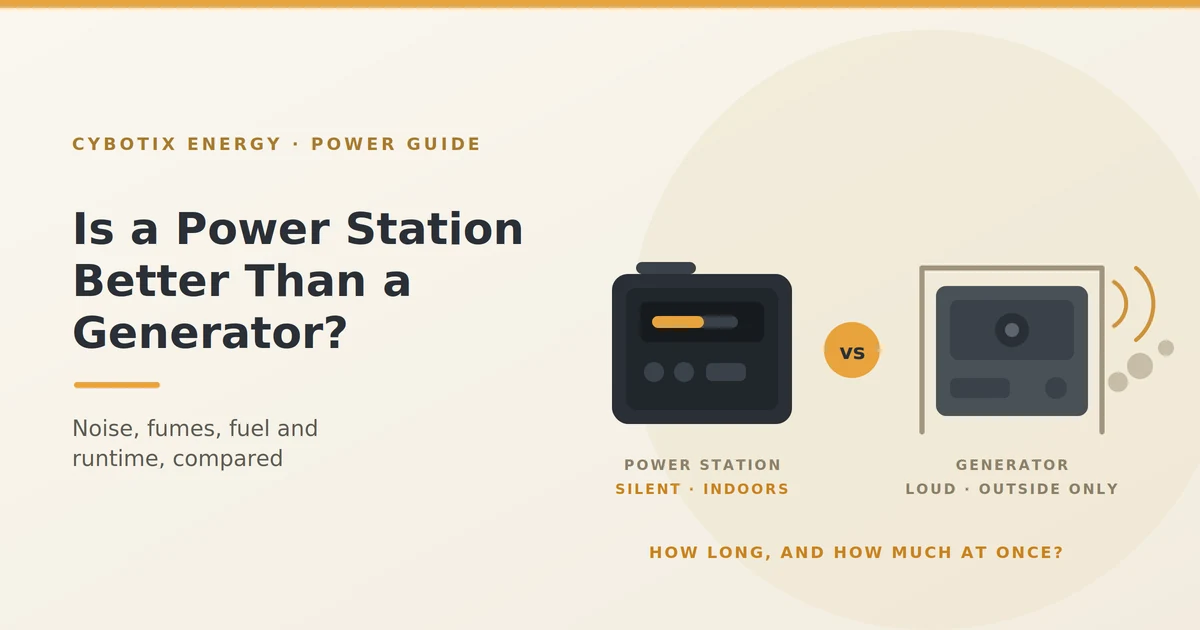
So: is a power station better than a generator? For most New Zealand buyers, yes. Not for everyone, though, and the exceptions are specific enough to be worth knowing before you spend anything.
The short answer
A power station wins on noise, safety, maintenance and convenience, and it suits the outages and camping trips most New Zealanders actually have. A generator still wins when you need heavy loads running for days and you can reliably get fuel.
Which one is better comes down to how long you need power and how much of it.
The five differences that actually decide it
Not features decision factors.
1. Noise
A generator is loud. Not “background hum” loud loud enough that it’s antisocial at a campsite, irritating for neighbours during an outage, and unpleasant to sit near for an evening.
A power station makes no noise at all. Nothing to hear, nothing to site away from the house, no conversation about it with anyone next door.
For a lot of New Zealand buyers this one factor settles it. Freedom camping and many DOC sites either restrict generators or make them socially unwelcome, and the rules vary by council and location worth checking before you rely on one.
2. Fumes and safety
A generator produces carbon monoxide. It must run outdoors, always, well away from windows and doors, in any weather. Not in a garage, not under a carport, not “just inside the door because it’s raining.”
People die of this after storms, every year, in every country that has them. It’s the single most important practical difference between the two devices.
A power station produces no exhaust. It sits in the lounge next to the fridge and does its job.
3. Fuel versus recharging
Petrol has to be bought, stored, and rotated it degrades over months, and stale fuel is the most common reason a generator won’t start when you finally need it.
A power station recharges from mains, from your car, or from solar panels. No storage, no rotation, no fuel container in the shed.
And here’s the timing problem: fuel is hardest to get exactly when you need the generator most. After a storm, stations queue up or close entirely.
4. Maintenance
Oil changes, air filters, spark plugs, carburettor cleaning, and starting it periodically so it doesn’t seize.
Most people don’t do any of that. Which is why so many generators are dead weight by the second winter the machine is fine, the maintenance wasn’t.
A power station needs a charge every few months. That’s the whole routine.
5. Output and runtime
The generator’s genuine advantage, and it’s a real one.
A generator produces sustained high output for as long as you keep feeding it. A power station holds a fixed amount of energy and then it’s empty. If you need 2,000W running for two days, a generator does that easily and a battery does not.
Side by side
| Power station | Petrol generator | Inverter generator | |
|---|---|---|---|
| Upfront cost | Higher | Lowest | Middle |
| Running cost | Near zero | Fuel + servicing | Fuel + servicing |
| Noise | Silent | Loud | Quieter, still audible |
| Indoor use | Yes | Never | Never |
| Maintenance | Charge occasionally | Regular | Regular |
| Starting after months idle | Reliable | Often won’t | Often won’t |
| Output | Limited by rating | High | Moderate to high |
| Runtime | Fixed capacity | As long as fuel lasts | As long as fuel lasts |
| Refuel / recharge | Mains, car, solar | Petrol | Petrol |
| Power quality | Clean, pure sine | Can be rough | Clean |
| Portability | Carry it | Heavy | Moderate |
Two things about that table.
The inverter generator is the real competition, not the cheap open-frame type. It’s quieter, produces clean power that’s safe for electronics, and runs more efficiently at part load. If you’re seriously considering a generator, this is the category to compare against not the $400 special.
Upfront price is the wrong comparison. A generator is cheapest to buy and most expensive to keep. A power station is the reverse. The honest comparison is over five years, not at the checkout.
Where a power station wins clearly
- Camping, particularly freedom camping and DOC sites, where a generator is often restricted and always unpopular
- Short and medium outages a few hours to a night, which describes the large majority of New Zealand power cuts
- Townhouses and apartments with no safe outdoor space to run a generator at all
- Sensitive electronics computers, medical devices, anything where clean power matters
- Anyone who won’t maintain equipment, which is most of us, honestly
If your situation is on that list, the decision is straightforward.
Where a generator still wins
Stated plainly, because a page that pretends otherwise isn’t worth reading.
- Multi-day outages with heavy loads. Heat pumps, electric hot water, workshop tools. A battery large enough to do that for three days costs several times what a generator does.
- Rural properties with high demand. Water pumps, sheds, milking equipment, long outages. Different problem, different tool.
- Where fuel is easy and solar isn’t practical. Heavy shade, no roof space, a site you’re only at occasionally.
- Cost per kilowatt-hour at high output. It isn’t close. A generator delivers far more energy per dollar of hardware.
For some rural households the honest answer is both a power station for silent overnight essentials, and a generator for the heavy work during the day. That’s not a cop-out; it’s what people with real experience of long outages tend to end up with.
The maths people get wrong
Watts versus watt-hours
The distinction that causes most bad purchases.
A generator is rated in watts how much it can supply at once. It supplies that indefinitely, as long as there’s fuel.
A power station has both: watts (how much at once) and watt-hours (how much in total before it’s empty).
Comparing a 2,000W generator with a 2,000Wh power station is comparing two different things. The generator supplies 2,000W for as long as you feed it. The power station supplies 2,000W for about an hour.
Surge ratings matter for both
Motors fridges, pumps, compressors, power tools draw several times their running wattage for a moment at start-up. If either device can’t supply that surge, the appliance simply won’t start, no matter how much capacity sits behind it.
Check the surge rating against your heaviest motor load before you buy either.
Five-year cost, not shelf price
Add up fuel across the outages you actually have, plus servicing, plus the replacement when an unmaintained generator dies. Then compare that with a one-off battery purchase that needs a charge every few months.
Sizing either one for a New Zealand home
Start with what genuinely has to keep running.
Typical essentials: fridge or freezer, LED lighting, router, phone and laptop charging. That’s roughly 2–3 kWh across a day for most households.
What changes the answer: a heat pump, electric hot water, or a well pump. These are large continuous loads, and they’re what pushes people from “a mid-sized power station is fine” to “I need a generator or a much bigger battery.”
Write your list before you shop. Most disappointed buyers sized against what they hoped to run rather than what they measured.
Solar is what settles it for most people
Here’s the argument a generator can’t answer.
A power station with panels recharges every day the sun comes up. A generator is only ever as good as the fuel you can get and New Zealand outages usually follow storms, which is precisely when fuel supply and road access are disrupted.
Realistic sizing: panels deliver roughly 70–80% of their rated output in practice, so 400W of panel puts back around 300W in good conditions. Enough to refill a mid-sized unit across a day, less in winter or heavy cloud.
Size the panels against a poor-weather day rather than a clear one. A setup that only works in February isn’t a setup for the week you’ll actually need it.
What about a home battery instead?
Worth knowing this option exists, because it’s the adjacent question.
An installed hybrid battery system switches over automatically when the grid fails, powers whole circuits rather than individual appliances, and recharges from your roof panels. It’s also several times the cost and needs an electrician, consent and a distributor application.
Different product for a different problem more permanent, more expensive, and genuinely better if your outages are frequent and long. We’ve covered how to choose one separately.
FAQs
Is a power station cheaper than a generator?
Not to buy. A generator costs less upfront and more every year in fuel and servicing. Over five years the gap narrows considerably, and for occasional use the power station often comes out ahead.
Can a power station run a fridge?
Yes. A typical fridge cycles rather than running constantly, using roughly 1–1.5 kWh a day, so a mid-sized unit covers most of a night. Check the surge rating so the compressor actually starts.
Can I use a generator indoors?
No. Never not in a garage, not under a carport, not in a doorway. Carbon monoxide is lethal and odourless. A power station is the option that runs safely indoors.
How long does a power station last compared to a generator?
A power station runs until its capacity is used, then needs recharging. A generator runs as long as you have fuel. For hours-long outages the difference rarely matters; for multi-day heavy use it decides the answer.
Are generators allowed at New Zealand campsites?
It varies. Many DOC sites and council freedom camping areas restrict or prohibit them, and where they’re permitted they’re often unwelcome. Check the rules for your destination a power station avoids the question entirely.
Can a power station run a heat pump?
Only a large one, and not for long. Heat pumps are substantial continuous loads. If heating through an outage is the goal, you’re looking at a large battery system or a generator.
Which is better for a power cut?
For most New Zealand outages a few hours to a night, essentials only a power station, comfortably. For multi-day outages with heavy loads on a rural property, a generator.
The bottom line
Answer two questions and the choice makes itself: how long do you need power, and how much at once?
Hours to a night, running essentials, possibly at a campsite or in a townhouse a power station, without much debate. Days at a time running heavy loads somewhere you can get fuel a generator, and it isn’t close.
And if you’re rural with long outages and a real load, buying both isn’t indecision. It’s what people who’ve been through a few winters usually end up with.