The product page said two hours. Your unit has been sitting in full sun since nine in the morning and it’s showing 43%. Nothing is broken you are just comparing your Ōtaki afternoon to a laboratory.
How Long Does a BLUETTI Take to Charge from Solar
How long a BLUETTI takes to charge from solar comes down to two numbers: how much panel wattage you’ve actually got, and how many hours of useful sun you’ll get that day. Manufacturer figures answer the first and quietly assume the second. Here’s how to work out your real number.
The short answer
Divide your unit’s capacity by your panels’ realistic output, not their rated output. A 2,048Wh station with 1,200W of panels charges in roughly 2 hours under ideal test conditions, and closer to 3–4 hours in real New Zealand sun. With 400W of panels on the same unit, expect most of a day.
Two variables, and only one of them is on the box.
The formula, and the number everyone gets wrong
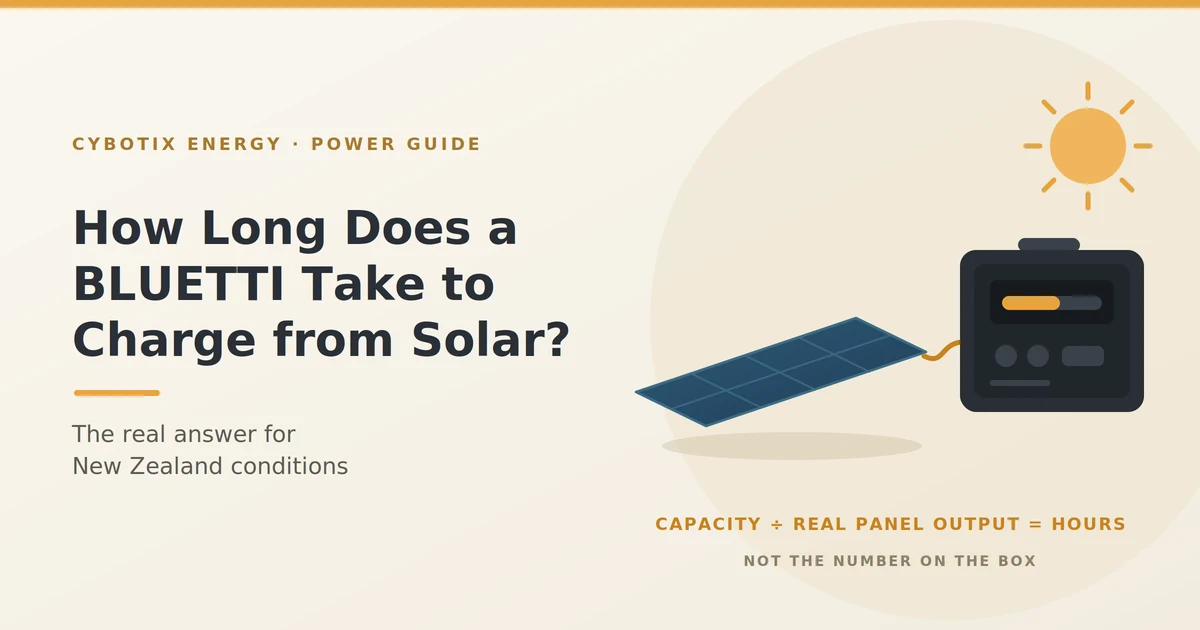
Charging hours = capacity (Wh) ÷ (panel wattage × real-world efficiency)
That efficiency figure is the part people skip. Panels realistically deliver about 70–80% of their rated output in normal use, because of:
- Panel angle relative to the sun
- Cell temperature (hot panels produce less)
- Cable losses, especially with long or thin cables
- Cloud, haze and atmospheric conditions
- MPPT conversion losses
Rated wattage is measured at 1,000 W/m² irradiance with the panel perfectly aligned and the cell at 25°C. Your deck doesn’t do that.
A worked example
Say you have a 2,048Wh station and 400W of panels.
Rated maths: 2,048 ÷ 400 = 5.1 hours. Realistic maths: 400W × 0.75 = 300W. Then 2,048 ÷ 300 = 6.8 hours.
Nearly seven hours of good sun, from empty to full. Do that sum with your own numbers before you buy panels, not after.
Charging hours versus daylight hours
Here’s the distinction that catches people out.
Seven charging hours doesn’t mean seven hours of daylight. Output ramps up through the morning, peaks near midday, and drops away in the afternoon. What matters is peak sun hours the equivalent number of hours at full-strength sunlight.
In a Nelson summer, seven effective hours is achievable. On a Dunedin day in July, it isn’t you might be looking at two or three, which turns a “one-day charge” into a three-day charge.
How much sun do you actually get in New Zealand?
New Zealand averages roughly 4–5 peak sun hours a day over the year in the north, and less further south with a substantial seasonal swing. Summer days can deliver 6 or more; winter days in southern or cloudy regions may give 2 or less.
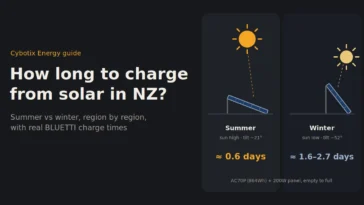
Summer versus winter
This matters most for anyone planning to rely on solar recharging during a winter outage.
In January, a decent panel array refills a mid-sized unit within a day. In July, the same array might take two or three days exactly when storms make outages more likely and you most want the unit full.
The practical response is to size panels for winter if winter is when you’ll need them, and to top up from mains whenever mains is available.
Cloud isn’t zero
Overcast doesn’t stop charging, it slows it. Panels still generate from diffuse light, typically at a fraction of rated output depending on cloud thickness.
So a grey day usually means a longer charge, not a failed one. Where charging genuinely stops is heavy cloud combined with a setup that can’t reach the controller’s start-up voltage covered in the troubleshooting section.
Charging times by model
| Model | Capacity | Max solar input | Voc limit | Manufacturer figure | Realistic NZ time |
|---|---|---|---|---|---|
| AC180 | 1,152Wh | 500W | 60V | ~6–7 hrs with one 200W panel | 7–9 hrs, or two good days in winter |
| AC200MAX | 2,048Wh | 900W (1,400W total with AC) | 145V | — | 3–4 hrs at full solar input |
| AC200L | 2,048Wh | 1,200W | 145V | ~2 hrs at 1,200W; 3–3.5 hrs with recommended panel sets | 3–4 hrs in good summer sun |
| Elite 200 V2 | 2,073.6Wh | ~1,000W | 150V | — | 3–4 hrs in good conditions |
Two things the table can’t show.
The Voc limit matters as much as the wattage. A unit accepting 1,200W is useless to you if your panel string exceeds its open-circuit voltage ceiling. The AC180’s 60V limit constrains how many panels you can wire in series far more tightly than the 145–150V limits on the larger units.
Bigger isn’t automatically faster. A larger battery with the same panel array takes longer to fill. Capacity and charge speed are separate decisions.
How many panels do you actually need?
Work backwards from the charge time you want, then sanity-check against your unit’s input ceiling.
BLUETTI’s own recommended combinations for the AC200L give a useful reference point: six PV120 panels, four PV200s, or two PV350s all land it at roughly 3 to 3.5 hours. That’s around 700–1,200W of panel to fill a 2kWh unit in an afternoon.
The sizing principle that prevents disappointment: size for a poor-weather day, not a perfect one. If your plan only works in January sunshine, it isn’t a plan for the week you’ll actually need it.
Series or parallel?
- Series adds voltage while current stays the same. This helps the MPPT controller start in low light and lets you reach the unit’s input ceiling without exceeding its current limit.
- Parallel adds current while voltage stays the same. Useful when you’re near the voltage ceiling but under the wattage limit.
For bad-weather charging, series generally performs better, because voltage sags under cloud and a series string stays above the controller’s start-up threshold longer.
One hard rule: never exceed your model’s maximum open-circuit voltage. Voc rises in cold conditions, so leave headroom rather than sitting right on the limit. Exceeding it can damage the unit.
Don’t overshoot the input ceiling
Panels beyond what your unit can accept are wasted money the controller simply caps input at its maximum. Match your array to the ceiling, then spend anything left on better positioning rather than more wattage.
Why yours is charging slower than expected
Work through these in order before assuming a fault.
- Shading. Even a partial shadow a pole, a cable, a roof edge can collapse output disproportionately. This is the most common cause by a wide margin.
- Panel angle. A flat panel in mid-winter catches far less than a tilted one. Repositioning twice a day makes a measurable difference.
- Heat. Ironically, very hot panels produce less. Airflow behind a panel helps.
- Dirty panels. Dust, salt film, bird mess. Easy to fix, often overlooked.
- Cable length and gauge. Long thin cables lose voltage before it reaches the unit.
- Connector mismatch. MC4 connectors and adapters need to seat properly.
- Low light and start-up voltage. In very dim conditions a panel may produce power but not enough voltage for the controller to begin charging at all.
The pass-through trap
The single most common explanation for “it’s been in the sun all day and barely moved.”
If you’re running a fridge, a laptop or lights off the unit while it charges, what you see is net input solar coming in minus what’s going out. Pull 200W out of a unit receiving 300W and you’re charging at 100W, which is a third of the speed you expected.
To fill it quickly, take the loads off.
Getting a faster charge
In order of how much difference it makes:
- Add panels up to your input ceiling. The biggest single improvement available, and panels are the cheapest part of the system.
- Angle them, and move them. Aim at the sun, not at the sky. Repositioning mid-day is free.
- Take the loads off while charging. See above.
- Use shorter, thicker cables. Cheap, immediate, and permanent.
- Keep them clean. Especially after a coastal trip.
- Combine AC and solar where your model supports simultaneous input several BLUETTI units accept both at once for a much higher total.
When solar isn’t the right way to charge it
Worth saying plainly: if you have mains power, use it.
AC charging is dramatically faster. The AC200L reaches 80% in around 45 minutes with turbo charging enabled at normal room temperature a figure no solar setup approaches.
Solar’s value isn’t speed. It’s independence: charging where there’s no grid, or where the grid is down for days. Use mains when you have it, solar when you don’t, and car charging as a slow middle option on long drives.
That’s also the honest planning advice for outages. Fill the unit before the storm arrives; use solar to extend it afterwards.
FAQs
How long does a BLUETTI take to charge from solar?
Divide capacity by realistic panel output about 70–80% of rated. A 2,048Wh unit with 1,200W of panels takes roughly 3–4 hours in good New Zealand sun; with 400W of panels, closer to seven hours of useful daylight.
Can I charge a BLUETTI on a cloudy day?
Yes, more slowly. Panels generate from diffuse light at a fraction of rated output, so a grey day stretches the charge rather than stopping it unless conditions are dim enough that the controller can’t reach its start-up voltage.
How many solar panels do I need?
Enough to reach your unit’s input ceiling without exceeding its voltage limit. For a 2kWh station, roughly 700–1,200W of panel gives an afternoon charge in good conditions.
Can I use the power station while it’s charging from solar?
Yes, but it slows charging considerably you see net input, not full input. If you want it full quickly, disconnect the loads.
Can I connect third-party solar panels?
Usually yes, provided the panel’s open-circuit voltage and current stay within your model’s limits and the connectors match. Check the Voc figure before buying, since exceeding it can damage the unit.
Why is my BLUETTI showing no solar input at all?
Most often shading, a connector not fully seated, or light too dim for the controller to start. Check for shadows first, then the connection, then consider wiring panels in series to raise voltage staying within the Voc limit.
Is solar or AC charging faster?
AC, by a wide margin some models reach 80% in under an hour from mains. Solar is for when mains isn’t available, not for speed.
The bottom line
Do the sum with realistic numbers: capacity divided by roughly three-quarters of your rated panel wattage. Then check whether your location and season actually deliver that many peak sun hours, because the second number is what turns a four-hour charge into a two-day one.
If your unit is charging slower than the maths suggests, it’s nearly always shading, angle, or loads left running while it charges. Those three account for most of what gets reported as a fault.