It’s a clear morning at the bach. Your power station is down to 25% after a night of running the fridge and lights, and you’ve just unfolded the solar panel on the deck. Will it be full by dinner?
How long a power station takes to charge from solar depends on four things: the size of the battery, the watts of your panels, the power station’s solar input limit, and how much strong sun you actually get. In New Zealand, that last one changes enormously between a January afternoon in Nelson and a June morning in Invercargill.
How Long to Charge a Power Station from Solar
This guide gives you a simple way to work it out, with real estimates for BLUETTI models in summer and winter.
The short answer
On a clear NZ summer day, a mid-size power station like the 864Wh BLUETTI AC70P can charge from solar in roughly 3–6 hours of strong sun with 200–400W of panels. In winter, the same setup can take a full day or more. Battery size, panel watts, the solar input limit and sun hours decide the real answer.
As a rough guide:
- Summer, 200W panel, AC70P: about six hours of strong sun, usually within a sunny day.
- Summer, 400W of panels, AC70P: about three hours of strong sun.
- Winter, 200W panel, AC70P: around two days in many parts of the country.
The sections below show how to work it out for your own setup and location.
The formula, and the limit most people miss
Divide your battery’s capacity by your panels’ real-world output, which is about 75% of their rated watts. That tells you how many hours of strong sun you need. Then check two limits: how many hours of strong sun you’ll actually get, and the maximum solar input your power station accepts.
The simple calculation
Hours of strong sun ≈ battery capacity (Wh) ÷ (panel watts × 0.75)
The 0.75 allows for losses from heat, panel angle, dirt and charging conversion.
Example: charging an 864Wh AC70P with a 200W panel.
- 200W × 0.75 = about 150W of real charging power
- 864 ÷ 150 = about 5.8 hours of strong sun
The solar input limit
Every power station has a maximum solar input. Panels beyond that limit won’t charge it any faster. The AC70P accepts up to 500W of solar, so 400W of panels is a sensible maximum, while 800W would be wasted.
Panels also need to fall within the power station’s input voltage range, so check the spec sheet before wiring several panels together.
Peak sun hours, not daylight hours
A summer day in New Zealand can have 14 or more hours of daylight, but panels only produce close to full power when the sun is high. Solar planners call this “peak sun hours”: the equivalent number of hours at full sun. That’s the number that matters for charging.
NZ sun by season and region
In New Zealand, a well-angled solar panel produces roughly two and a half to four times as much energy on a summer day as on a winter day. The further south you are, the bigger the gap. If you’ll rely on solar all year, size your setup for winter, not summer.
Here’s the average daily output per kilowatt of solar panels for three cities, for a fixed panel facing north at the ideal angle:
| Location | Summer | Autumn | Winter | Spring | Ideal fixed tilt |
|---|---|---|---|---|---|
| Auckland | 7.17 kWh | 4.00 kWh | 2.69 kWh | 5.58 kWh | 32° north |
| Christchurch | 6.61 kWh | 3.47 kWh | 2.06 kWh | 5.55 kWh | 38° north |
| Invercargill | 6.34 kWh | 2.85 kWh | 1.59 kWh | 5.02 kWh | 40° north |
Source: profileSOLAR’s solar PV analysis for each location. Figures are per kilowatt of panels, per day, averaged by season.
To use the table, multiply by your panel size in kilowatts. A 200W (0.2kW) panel in Christchurch, for example, produces about 1.3kWh a day in summer, but only around 0.4kWh in winter.
Three things stand out:
- Summer is similar across the country. Long southern summer days help make up for a lower sun angle.
- Winter is where the regions split. Invercargill’s winter output is around 40% lower than Auckland’s.
- Portable panels do a little worse. The figures assume a fixed panel at the ideal angle. A folding panel on the ground, re-angled a few times a day, may produce 20–30% less.
Charge times for BLUETTI models
In summer, the right panels can fill an AC70P or Premium 200 V2 from empty in well under a day almost anywhere in New Zealand. In winter, the same setups take one to three days, depending on how far south you are. Doubling your panel watts roughly halves the time, up to the power station’s solar input limit.
Estimated days to charge from empty to full, using the regional figures above:
| Setup | Auckland, summer | Auckland, winter | Christchurch, summer | Christchurch, winter | Invercargill, summer | Invercargill, winter |
|---|---|---|---|---|---|---|
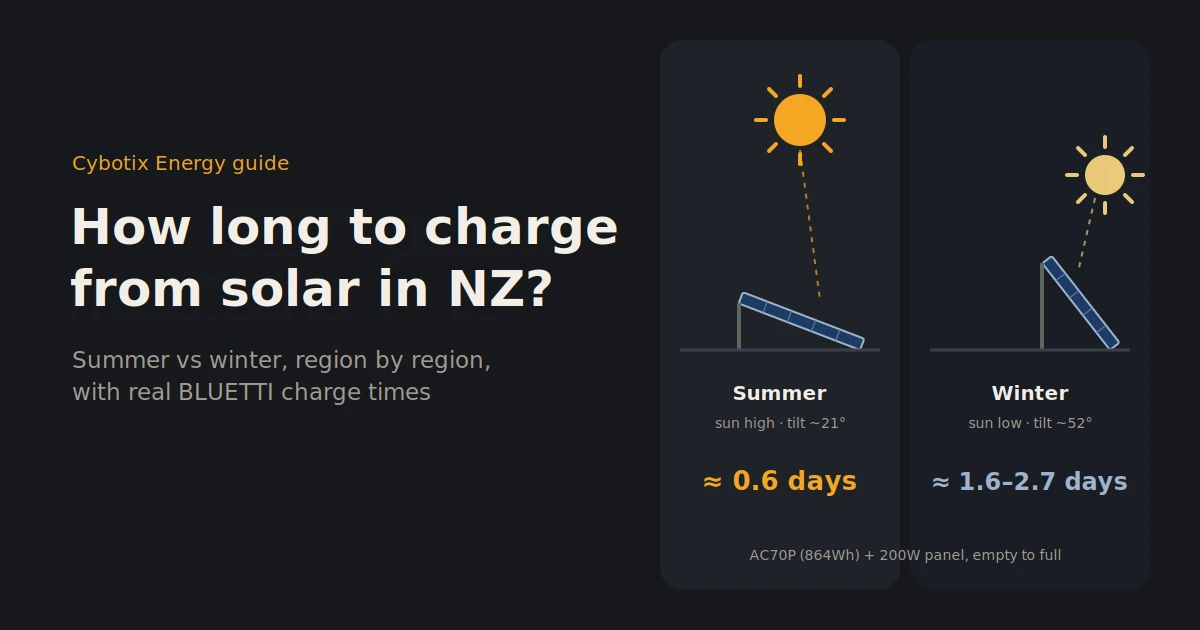
| AC70P (864Wh), 200W panel | About 0.6 days | About 1.6 days | About 0.65 days | About 2.1 days | About 0.7 days | About 2.7 days |
| AC70P (864Wh), 400W of panels | About 0.3 days | About 0.8 days | About 0.35 days | About 1.1 days | About 0.35 days | About 1.4 days |
| Premium 200 V2 (2,073.6Wh), 400W of panels | About 0.7 days | About 1.9 days | About 0.8 days | About 2.5 days | About 0.8 days | About 3.3 days |
| Premium 200 V2 (2,073.6Wh), 800W of panels | About 0.35 days | About 1 day | About 0.4 days | About 1.3 days | About 0.4 days | About 1.6 days |
“0.6 days” means a little over half a typical day’s solar output, so you’d usually be full by mid-afternoon on a clear day.
These are estimates for a well-angled panel with nothing else running. Portable panels on the ground, cloud, shade and running appliances while charging all add time. The AC70P accepts up to 500W of solar and the Premium 200 V2 up to 1,000W, so the panel sizes above stay within their limits.
What slows solar charging in New Zealand
The usual culprits are a low winter sun, cloud, shade from trees, hills or buildings, panels facing the wrong way, and cold mornings. Running appliances while you charge also slows things down, because whatever they use comes out of the solar input first.
- Low winter sun. In winter, the sun sits low in the northern sky, so panels need a steeper angle, and hills and trees cast long shadows.
- Cloud and short days. Overcast weather can cut output sharply, and winter days are short in the south.
- Shade. Even partial shade on a panel can reduce output far more than the shaded area suggests.
- Facing the wrong way. In New Zealand, panels should face north. A panel facing south in winter produces very little.
- Cold mornings. LiFePO4 power stations shouldn’t charge below 0°C. The AC70P, for example, charges between 0°C and 40°C, so on frosty mornings charging waits until the unit warms up.
- Dirt, dust and salt. A grimy panel at the beach or on a dusty road produces less.
- Running appliances while charging. If your fridge draws 50W and the panel supplies 150W, only about 100W goes into the battery.
- Slower charging near full. The last 10–20% usually charges more slowly as the battery tops up.
How to charge faster
Face your panels north, tilt them more steeply in winter, re-angle them during the day, keep them out of shade, and add panels up to your power station’s solar input limit. Topping up from the car or a powered site helps when the sun won’t cooperate.
- Face north. In New Zealand, the sun tracks across the northern sky.
- Tilt steeper in winter. In Auckland, profileSOLAR suggests about 21° from horizontal in summer but around 52° in winter. Further south, go steeper still.
- Re-angle a few times a day. Following the sun from morning to afternoon makes a noticeable difference with portable panels.
- Chase the sun, not the shade. Set up in the open, and move panels as shadows shift across the campsite or section.
- Add panels up to the input limit. Going from 200W to 400W on an AC70P roughly halves charge time.
- Wire within the voltage range. Series wiring raises voltage and parallel raises current; keep the total within the power station’s solar input range.
- Keep panels clean. Wipe off dust and salt with water and a soft cloth.
- Combine charging sources. Top up from your car’s 12V socket while driving, or from a powered site when you can.
A common mistake is laying a panel flat on the ground in winter. A steeper angle facing north can produce noticeably more.
How many solar panels do you need?
Work out how much energy you use in a day, then divide by your region’s seasonal output per kilowatt. That gives you the panel size needed to keep up. A 200W panel covers light summer use almost anywhere; winter use, or heavier loads, usually needs 400–800W.
Panel watts needed ≈ daily use (Wh) ÷ seasonal output per kW (from the table above)
For example, using 1,000Wh a day in Christchurch in winter: 1,000 ÷ 2.06 = about 485W of panels. In summer, the same use needs only about 150W.
| Use case | Typical daily use | Summer panels | Winter panels |
|---|---|---|---|
| Weekend camping: lights, phones, small 12V fridge | About 500Wh | About 100–200W | About 200–300W |
| Bach or campervan: fridge, lights, devices, fan | About 1,000–1,500Wh | About 200–300W | About 400–900W |
| Power-cut backup: fridge-freezer, modem, lights | About 1,200–1,500Wh | About 200–300W | About 450–900W |
These assume well-angled panels and typical regional figures. In the far south in winter, or with heavier use, plan for the top of each range, or rely on driving or a generator top-up as well.
If you need more than your power station’s solar input allows, that’s a sign to step up to a larger power station, or to a fixed home solar and battery system.
FAQs
How long does it take to charge a power station with a 200W solar panel?
It depends on battery size and season. In an NZ summer, a 200W panel can charge an 864Wh AC70P from empty in roughly two-thirds of a sunny day. In winter, expect around one and a half to three days, depending on how far south you are.
Can you charge a power station with solar in winter in NZ?
Yes, but much more slowly. A well-angled panel produces roughly a third to a quarter of its summer output in winter, with lower figures further south. Use more panels, tilt them steeply towards the north, and top up from your car when you can.
Which way should solar panels face in New Zealand?
North. In New Zealand, the sun travels across the northern sky, so north-facing panels produce the most. Tilt them more steeply in winter, when the sun sits lower.
How many solar panels do I need for a 2,000Wh power station?
To fill a 2,000Wh battery in one summer day, about 400W of well-angled panels is usually enough. In winter, you’d need closer to 800W or more, depending on your region, and within the power station’s solar input limit.
Can I use my power station while it charges from solar?
Yes. Most BLUETTI power stations support pass-through charging. Whatever your appliances use comes out of the solar input first, so the battery charges more slowly.
Why is my power station charging slowly from solar?
Common causes are a low winter sun, partial shade, cloud, panels facing the wrong way or lying flat, dirty panels, cold temperatures and running appliances at the same time. Check the live solar input on the display to see what you’re getting.
Get the sun working for you
Solar can keep a power station running for days off-grid in New Zealand, as long as you size it for the season you’ll actually use it in. Face your panels north, angle them for the time of year, and choose enough watts to cover winter if you rely on it year-round.
Browse BLUETTI power stations and solar panels at Cybotix Energy, with NZD pricing including GST. Not sure what panel size you need for your region? Tell our New Zealand team where you are and what you want to run, and we’ll help you size it.