After the last long power cut, the idea is appealing: one big battery in the garage, and next time the grid goes down, the whole house just keeps running. Hot showers, the oven, the heat pump, all of it.
Can a Power Station Power My Whole House
So, can a power station power your whole house? For almost every New Zealand home, a single portable power station can’t run everything at once, the way the grid does. But it can do far more than most people expect, and there are realistic ways to get closer to whole-home backup if that’s what you need.
This guide explains why, using two simple numbers, and walks through the options that actually work.
The short answer
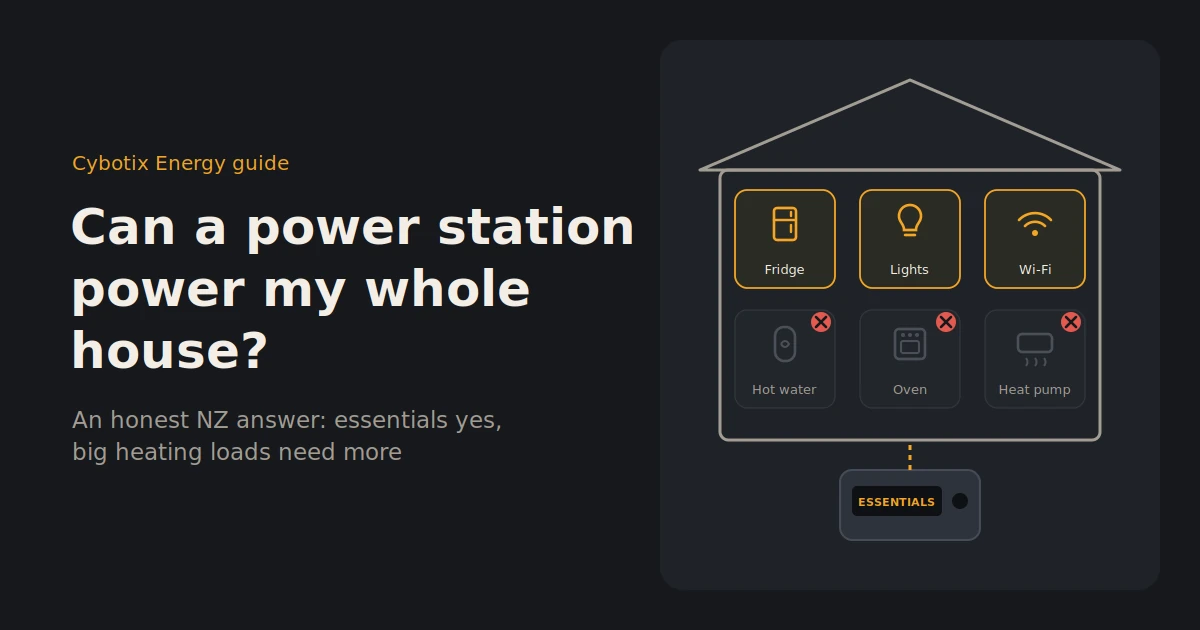
Not normally. A typical NZ home uses far more energy in a day, and far more power at once, than a portable power station can supply. A power station runs your essentials well: the fridge, modem, lights and devices. Whole-home backup usually needs a larger expandable system or a fixed home battery, installed by a licensed electrician.
| What you want | Realistic option |
|---|---|
| Keep essentials running in a power cut | Portable power station, plugged in directly |
| Keep selected circuits running | Expandable power station on essential circuits, with a changeover switch fitted by a licensed electrician |
| Run most of the house as normal | Fixed home battery system, usually with solar |
The two numbers that decide it: kWh and kW
Whole-home backup comes down to two numbers. Energy, in kilowatt-hours, is how much electricity your home uses over a day. Power, in kilowatts, is how much it draws at the same moment. A typical NZ home is too big on both counts for one portable power station.
Energy over a day (kWh)
The average New Zealand household uses around 7,000 kWh of electricity a year, according to MBIE data. That’s roughly 19 kWh a day on average, and more in winter, when heating and hot water work harder.
Compare that with power station capacities:
- A 1,000Wh (1 kWh) power station holds about one-twentieth of an average day’s use.
- A 2,000Wh (2 kWh) unit holds about a tenth.
- A large expandable system with several add-on batteries can store a day or more, but at a size and cost closer to a fixed home battery.
Power at the same moment (kW)
The second number catches people out. At breakfast, you might run the kettle, toaster, heat pump and hot water cylinder at the same time. That can add up to 7–10 kW for a few minutes.
Most portable power stations deliver 1–3 kW. Even if the battery were big enough, the inverter couldn’t supply all of those appliances at once.
The big loads that make whole-home backup hard
A handful of appliances use most of a New Zealand home’s electricity, and they’re the hardest to back up. Hot water cylinders, ovens, heat pumps, kettles, dryers and heaters each draw 1.5–3 kW or more. Many NZ homes rely on electricity for all of them, especially hot water and heating.
| Appliance | Typical draw | Can a portable power station run it? |
|---|---|---|
| Hot water cylinder | About 2–3 kW element, often for hours | Not practical. It would drain most batteries quickly |
| Oven and cooktop | About 2–4 kW or more | Not practical. Use gas, or plan meals around outages |
| Heat pump (heating) | About 1–2.5 kW, plus a start-up surge | Only very large systems, briefly |
| Electric kettle | About 2–2.4 kW | Usually above a 1–2 kW unit’s output |
| Clothes dryer | About 2–2.5 kW | Not practical |
| Electric heater | About 1–2.4 kW | Drains a battery fast; use an electric blanket instead |
| Washing machine (hot cycle) | Up to about 2 kW while heating | Cold cycles possible on larger units |
| Fridge-freezer | About 0.7–1.6 kWh a day | Yes |
| Lights, modem, TV, devices | Small | Yes |
The pattern is clear. Anything that heats is the problem. Anything that cools, lights, connects or charges is easy.
What a power station can realistically run
A portable power station is excellent at keeping your essentials going: the fridge-freezer, modem and router, lights, phones, laptops, TV and medical devices like a CPAP. For most power cuts, that covers what matters most, without the noise and fumes of a generator.
A typical essentials list during an outage:
- Fridge-freezer, to keep food safe
- Modem and router, to stay connected
- LED lights for the evening
- Phones, laptops and tablets
- TV or radio for news
- CPAP or other medical devices
- An electric blanket, for warmth on a cold night
A 1,000–2,000Wh power station covers this list through an overnight power cut. For longer outages, add solar panels or a larger battery.
Three realistic options
There are three practical routes, from simple to whole-home. A portable power station plugs in and runs essentials. An expandable system like the BLUETTI Apex 300 can power selected circuits through a changeover switch fitted by a licensed electrician. A fixed home battery with solar comes closest to running the whole house as normal.
| Portable power station | Expandable system on essential circuits | Fixed home battery with solar | |
|---|---|---|---|
| What it powers | Essentials, plugged in directly | Selected circuits, such as the fridge, lights and some outlets | Most or all of the house |
| Typical capacity | 1–2 kWh | 3–20 kWh or more | Varies, often 10 kWh or more |
| Output | About 1–3 kW | About 3.8 kW per unit, more in parallel | Varies by system |
| Installation | None | Changeover switch fitted by a licensed electrician | Professional installation |
| Portable? | Yes | Partly; heavy units | No |
| Relative cost | Lowest | Medium to high | Highest |
| Best for | Short outages, renters, apartments | Homeowners wanting more than essentials | Frequent outages, solar homes, full independence |
Portable power station for essentials
The simplest and cheapest option. No installation: plug the fridge, modem and lamps straight into it. Ideal for renters, apartments and households that mostly face short outages.
Expandable power station on essential circuits
A larger, modular system can go further. The BLUETTI Apex 300, for example, provides 3,840W of 230V output and 2,764.8Wh of storage per unit. It takes up to six expansion batteries, and up to three units can run in parallel for 11.52kW of output and 58kWh of storage. With a changeover switch installed by a licensed electrician, it can power selected circuits in your home rather than only what you plug in.
Fixed home battery with solar
For genuine whole-home backup, a fixed home battery integrated with your switchboard, usually paired with rooftop solar, is the most complete solution. It’s also the most expensive, and it needs professional design and installation.
Wiring a power station into your home: the rules
In New Zealand, connecting any backup power source to your home’s wiring must be done by a licensed electrical worker, with a changeover switch so power can’t flow back into the network. Plugging appliances straight into a power station needs no electrician. Connecting it to your switchboard does.
Why it matters:
- Back-feeding is dangerous. Without a proper changeover switch, power can flow back into the street lines and electrocute line workers repairing the fault.
- WorkSafe is clear. Connecting generation to a house’s electrical system must be done by a licensed electrical worker.
- Insurance and compliance. Unapproved wiring can create fire risks and insurance problems.
What a proper setup looks like:
- A licensed electrician assesses which circuits you want to back up, such as the fridge, lights and some power points.
- They install a changeover switch or transfer arrangement at your switchboard.
- Your power station connects through an approved inlet, such as the Apex 300’s 50A port.
- During an outage, you switch over safely, and switch back when the grid returns.
Never use a homemade lead with a plug on both ends to feed power into a wall socket.
How to decide what you need
Start with how often your power goes out, what you can’t live without, your budget, and whether you have or plan to add solar. Most households find a portable power station for essentials is enough. Those with frequent long outages, medical needs or solar plans may justify more.
Ask yourself:
- How often do outages happen here, and for how long? Occasional short cuts suit a portable unit. Frequent multi-day outages, common in some rural areas, justify more.
- What must keep running? Medical equipment, a home office or a freezer full of food changes the picture.
- Do you have gas or a wood burner? If your cooking, hot water or heating isn’t all electric, backup gets much easier.
- Do you have, or want, solar? Solar makes larger battery systems far more useful year-round.
- What’s your budget? A portable unit costs a fraction of a whole-home system.
A sensible path for many homes is to start with a portable power station for essentials, then expand with extra batteries or a professionally installed system later if outages become a bigger problem.
Ways to make a smaller system go further
You don’t need whole-home backup to stay comfortable in a power cut. Move heating, hot water and cooking off electricity during outages where you can, run only one big appliance at a time, and focus your battery on essentials. A modest power station then goes much further.
- Use gas or a wood burner for cooking, heating or hot water, if you have them.
- Heat the person, not the room. An electric blanket uses far less than a heater.
- Fill the hot water cylinder before a storm, and use hot water sparingly during the outage.
- Keep the fridge and freezer closed to hold their temperature.
- Run one big load at a time, never several together.
- Use DC and USB outputs for phones, laptops and 12V gear, to save energy.
- Add solar panels to recharge during long outages.
FAQs
Can a power station run my whole house?
Not normally. A typical NZ home uses around 19 kWh a day and can draw several kilowatts at once, more than a portable power station can supply. It can run your essentials, and larger expandable or fixed home battery systems can get closer to whole-home backup.
How many kWh does an NZ house use per day?
The average New Zealand household uses around 7,000 kWh of electricity a year, according to MBIE data. That’s roughly 19 kWh a day on average, with more in winter.
Can a power station run a hot water cylinder?
Not practically. A typical cylinder element draws about 2–3 kW for long periods and would drain most power stations quickly. Fill your cylinder before an expected outage, or use gas hot water if you have it.
Can I plug a power station into my house wiring?
Not yourself. In New Zealand, connecting any backup power to your home’s wiring must be done by a licensed electrical worker, with a changeover switch. Plugging appliances directly into the power station is fine.
What’s the difference between a power station and a home battery?
A power station is portable and plugs in, though some, like the Apex 300, can also connect to home circuits through a professionally installed switch. A home battery is fixed, wired into your switchboard, and usually paired with solar for everyday use as well as backup.
How big a power station do I need for home backup?
For essentials overnight, about 1,000–2,000Wh is usually enough. For longer outages or more circuits, consider 3,000Wh or more, an expandable system, or solar panels to recharge.
Get an honest home backup plan
A single power station won’t run your whole house like the grid does, but it doesn’t need to. Most homes get the most value from backing up what matters, then expanding if outages become a bigger problem.
Browse BLUETTI power stations and expandable systems at Cybotix Energy, with NZD pricing including GST. Tell our New Zealand team what you’d like to keep running, and we’ll give you an honest recommendation, from a simple essentials setup to an expandable system.