Solar power for farm sheds in NZ solves a common rural problem: sheds, workshops and pump sites that sit too far from the mains for affordable power. Solar panels paired with a battery or portable power station let you run lights, tools and chargers off-grid.
What Is Solar Power for Farm Sheds?
Solar power for a farm shed is a small stand-alone system. Panels on the roof or a ground frame charge a battery during the day, and the battery runs your shed loads when you need them.
It replaces running a long cable from the house or firing up a petrol generator. A modern setup uses a LiFePO4 (lithium iron phosphate) portable power station, which is quiet, fume-free and needs no fuel.
Key Benefits of Solar Power for Farm Sheds
1. No Trenching or Cabling
A solar shed system generates power where you use it. You avoid digging trenches or running long cable runs across paddocks.
2. Quiet, Fume-Free Power
A solar-charged power station runs silently with no exhaust. It is safer to use inside a closed shed or workshop than a petrol generator.
3. Long Battery Life
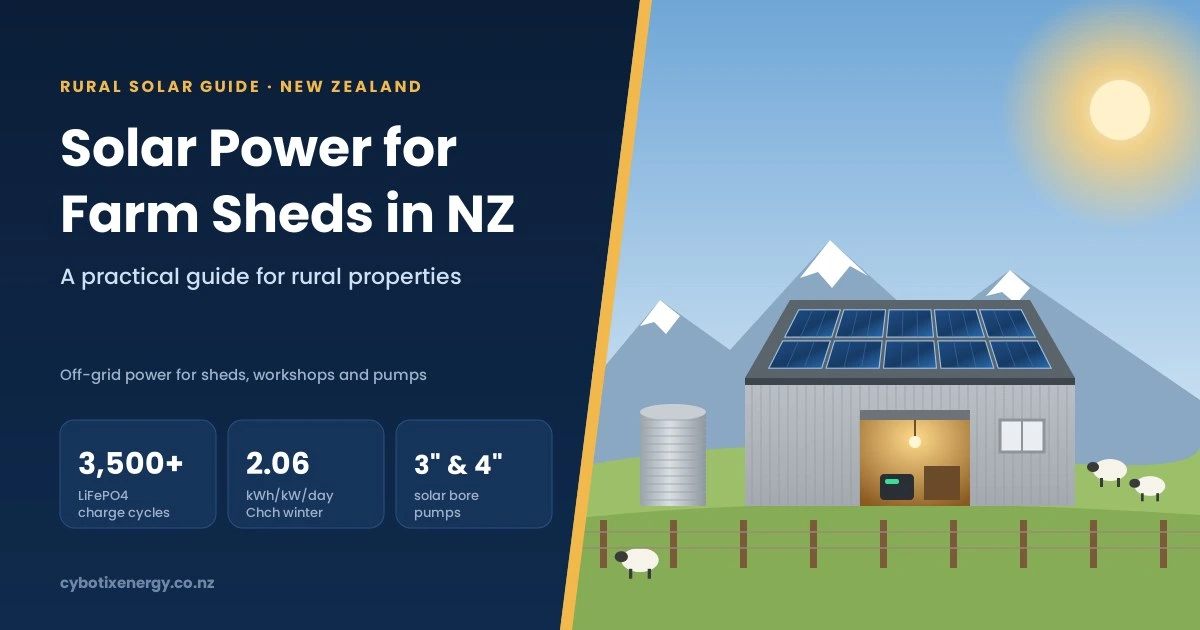
BLUETTI power stations use LiFePO4 cells rated for 3,500+ charge cycles. That suits daily charging on a working farm.
4. Works Through Winter
Solar panels still generate in a South Island winter. Modelled averages show about 2.06 kWh per day for each kW of panels in Christchurch from June to August.
5. Portable Between Sites
A portable power station can move from the woolshed to the calf shed or a remote paddock. One unit can cover several jobs across a lifestyle block.
6. Solar Water Pumping
DC and hybrid solar bore pumps in 3″ and 4″ sizes are built to run on solar. They suit stock water and irrigation away from the mains.
Things to Consider Before Buying
- Your loads: List what the shed runs, such as LED lights, a radio, battery chargers, a fridge or power tools, and add up the watts.
- Winter output: Rural Canterbury and Southland get far less sun in June than in January, so size panels and storage for winter, not summer.
- Tool startup power: Grinders, compressors and saws draw a surge when they start, so check it sits within your power station’s output rating.
- Panel position: Mount panels facing north at a steep angle, clear of hills, trees and shelter belts that shade the roof in winter.
- NZ weather: Wellington wind and Canterbury nor’westers need a solid ground frame or roof fixing, and frost and rain mean you should keep batteries inside the shed.
- Panel matching: Check that your panels’ voltage and wattage suit the power station’s solar input before you buy.
How Much Does Solar Power for Farm Sheds Cost in NZ?
At entry level, a BLUETTI AC70P portable power station (1,000W, 864Wh) is $1,049.95 NZD, and LONGi solar panels start at $242 NZD each. Mid-range, the BLUETTI AC180P (1,800W, 1,440Wh) is $1,699.95 NZD. Premium options are the BLUETTI Elite 400 at $4,299.95 NZD and the Apex 300 (3,840W, 2,764.8Wh) at $4,899.95 NZD, all including GST.
For stock water and irrigation, see the solar water pump range.
FAQs
Can solar power run a farm shed without mains power?
Yes. Solar panels charge a battery or portable power station during the day, which then runs lights, tools and chargers in an off-grid shed.
Do solar panels work in a Canterbury winter?
Yes. Modelled averages show about 2.06 kWh per day for each kW of panels in Christchurch from June to August, roughly a third of summer output.
Can a portable power station run power tools in a shed?
Yes. A unit such as the BLUETTI AC180P (1,800W, 1,440Wh) can run many workshop tools, as long as each tool’s startup surge stays within its output rating.
Are LiFePO4 batteries suitable for daily farm use?
Absolutely. The LiFePO4 cells in BLUETTI power stations are rated for 3,500+ charge cycles, giving years of daily solar charging.
Can solar power a bore pump on a farm?
Yes. DC and hybrid solar bore pumps in 3″ and 4″ sizes are built to run on solar power for stock water and irrigation.
Conclusion
Solar power for farm sheds in NZ gives rural properties dependable power without trenching, cabling or generator fuel. Size your panels and power station for winter output and your largest tool’s startup surge. You get quiet, fume-free power wherever the farm needs it.