Every solar quote you have seen assumes a four-bedroom house with two kids, a heat pump in every room and a spa pool out the back. You live in a two-bedroom townhouse. Your power bill is $130 a month. So when you go looking at solar panels for small homes in New Zealand, the standard 6.6 kW recommendation feels like being sold a ute when you need a hatchback.
Solar for Small Homes NZ
Here’s the thing: sizing solar has almost nothing to do with the size of your house. It depends on how much electricity you use and more importantly when you use it. This guide gives you the method, the real numbers, and one piece of timing that matters a lot for small households right now.
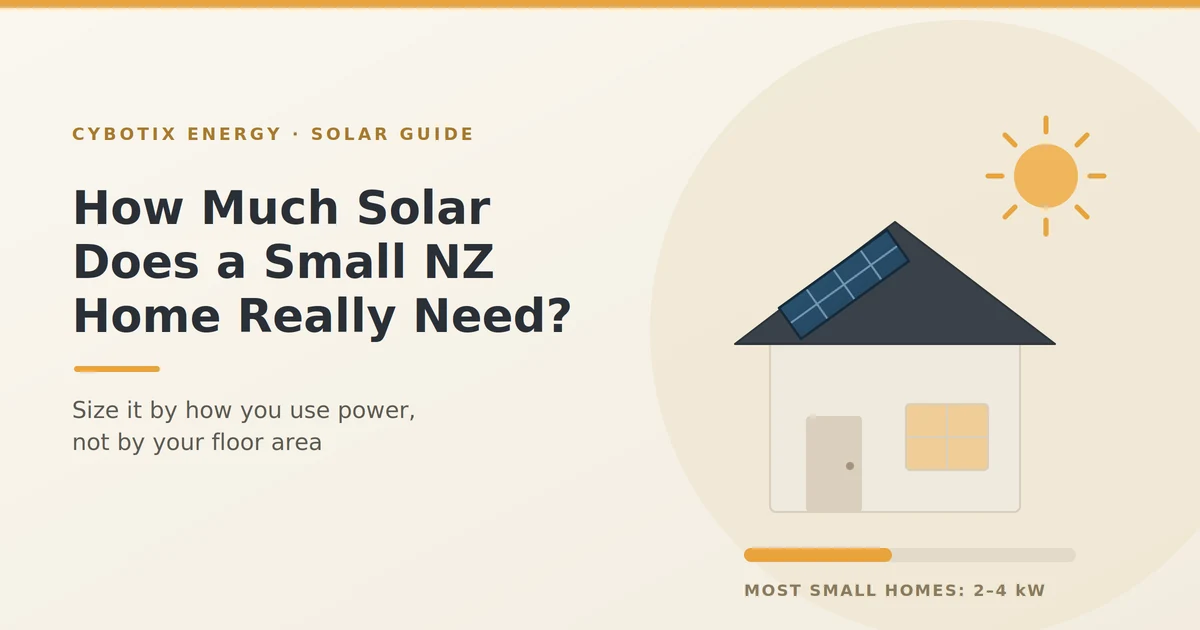
The short answer: most small NZ homes need 2–4 kW, not 6.6
A small household using 3,000–6,000 kWh a year is usually well matched by a 2–4 kW array. But the right size follows your annual kWh and your daytime usage pattern, not your floor area. A one-person unit and a retired couple in the same townhouse can need very different systems.
That’s the honest short answer. The longer one has a twist in it, which is covered further down going too small carries its own cost.
Work out your number first (it takes five minutes)
Before anyone quotes you, find your annual consumption in kilowatt-hours. It’s on your power bill or in your retailer’s app, usually under usage history. Add up twelve months, or take a recent bill’s daily average and multiply by 365.
Typical small-home ranges in New Zealand:
- One person, unit or small flat: roughly 2,000–4,000 kWh a year
- Couple, two-bedroom townhouse: roughly 3,500–6,000 kWh
- Small home with electric hot water and a heat pump: 5,000–8,000 kWh
- Bach or holiday home: highly variable, often under 2,000 kWh
The commonly quoted “average New Zealand household” figure of 7,000–9,000 kWh a year is exactly what makes small-home advice go wrong. If you use half that, every recommendation built on the average overshoots you by about double.
Daytime use is the number that actually matters
This is the part most guides skip, and it decides everything.
When you use your own solar power as it’s generated, you avoid buying a unit from your retailer currently around 30 cents or more per kWh for most households. When you export it instead, you’re paid a buyback rate, which across NZ retailers sits somewhere in the 7–21 cents range depending on who you’re with and what plan you’re on.
So a self-consumed kilowatt-hour is worth roughly two to four times an exported one.
For a small household, that changes the sizing question completely. If you’re out of the house from 7am to 6pm, a big array spends the day exporting at the low rate while you buy power back at the high rate each evening. If someone’s home during the day retired, working from home, small kids your solar is worth far more per panel.
A rough sizing rule of thumb
In most of New Zealand, each kilowatt of well-oriented panels generates somewhere in the region of 1,200–1,400 kWh a year, varying by region, roof angle and shading. Nelson and Marlborough sit at the top of that range; Southland and shaded Wellington sites at the bottom.
So a 3 kW system produces roughly 3,600–4,200 kWh a year but you’ll only use 30–50% of it directly without a battery or deliberate load shifting.
The fixed-charge problem nobody mentions to small households
Solar reduces the variable part of your power bill. It does nothing at all to the daily fixed charge. On a small home, that fixed charge is a much larger share of the total which caps how much solar can ever save you.
Run the numbers on your own bill. Split it into the daily charge and the usage charge. If you’re paying $130 a month and $55 of that is the fixed charge, then solar is competing for the remaining $75, not the whole $130. Nobody selling you a system will lead with this.
What changes on 1 April 2027
This matters more for small households than anything else in this article.
New Zealand has been phasing out the low fixed charge regulation since 2022. The capped low-user daily charge has risen by 30 cents each April, reaching $1.80 a day in April 2026, and the regulations are removed entirely on 1 April 2027. After that, retailers are no longer required to offer a discounted low-user daily charge at all.
Most small households are on low-user plans. That means the fixed portion of your bill has already climbed substantially, and the structure changes again next April.
What to take from that, carefully: nobody knows exactly how retailers will price after the regulation lifts, and anyone claiming certainty is guessing. But two things follow. First, the fixed portion of a small-home bill has been trending up, which makes the usage portion the part solar addresses a smaller target. Second, if you’re weighing a 20-year investment, check your plan structure now and again in March 2027, because the comparison you did this year may not hold.
How much solar do you really need? Sizing by household
Four realistic small-home profiles. All figures are indicative and depend on your roof, region and retailer.
| Household | Annual use | Suggested size | Indicative installed cost | Bill offset | Rough payback |
|---|---|---|---|---|---|
| One person, out weekdays | ~2,500 kWh | 2–3 kW | $6,000–$9,000 | Modest without load shifting | Long — 10+ years |
| Retired couple, home during the day | ~4,000 kWh | 3–4 kW | $8,000–$11,000 | Strong | Shorter than average |
| Two professionals, out 9–5 | ~4,500 kWh | 3–4 kW | $8,000–$11,000 | Moderate; timer-dependent | Middling |
| Small home with EV or heat pump | ~7,000 kWh | 5–6 kW | $11,000–$14,000 | Strong | Best of the four |
The retired couple is the best solar candidate in the country. They’re home when the sun is up, so almost everything the panels make gets used at full retail value rather than exported at a fraction of it.
The two professionals out all day are the hardest case not hopeless, but their result depends entirely on whether they shift load into daylight. Dishwasher on a delay timer, washing machine at midday, hot water cylinder on a timer instead of overnight. That’s free, and it can lift self-consumption dramatically.
Small system, worse payback and what to do about it
Here’s the uncomfortable part. Smaller systems generally take longer to pay back than mid-sized ones. Recent New Zealand quote data puts the median payback on systems under 5 kW at around 11 years, against roughly 7 years for systems in the 5–12 kW range.
The reason is simple: a lot of the cost doesn’t scale with the array. Scaffolding, labour, the inverter, the electrical work, the paperwork, the trip to your house those cost much the same whether you’re fitting eight panels or eighteen. Spread across fewer panels, the per-kilowatt cost rises.
Three practical responses:
- Size slightly larger than feels natural. Going from 3 kW to 4 kW often adds less cost than you’d expect and improves the per-kW economics, provided you have roof space and can use or export the extra.
- Shift load into daylight. Timers on the hot water cylinder, dishwasher and washing machine. This is the highest-return change available to a small household and it costs nothing.
- Wait, if the numbers don’t work. A guide that never tells you to hold off isn’t a guide, it’s a brochure. If your annual use is under about 2,000 kWh and nobody’s home during the day, the case is weak today.
Does a small home need a battery?
Usually not as a first step. A battery raises self-consumption considerably which is exactly what small homes need but it adds a substantial amount to the upfront cost and typically lengthens payback rather than shortening it. Panels first is the sound default.
A battery does earn its place in specific cases:
- Your retailer’s buyback rate is poor, so exporting is barely worth anything
- You’re on a rural line with frequent or lengthy outages, and backup has value to you beyond the maths
- You already have an EV or plan to, changing both your usage and your evening load
- You’re on a time-of-use plan where evening power is expensive
What it costs, and what a quote should show you
The industry benchmark sits around $2,000 per kilowatt installed, which puts a 3 kW system roughly in the $7,500–$10,000 range and a 5 kW system around $10,000–$13,000, including GST. Prices vary with roof complexity, storey height, cable runs and region.
Panels are a minority of that total. The inverter, mounting, electrical work, scaffolding, compliance and labour make up the larger share which is why a quote built around cheap panels isn’t a cheap system, and why the panel brand alone tells you very little.
What a good quote itemises:
- Panel make, model, wattage and performance warranty (25–30 years is standard) plus the product warranty, which is usually shorter
- Inverter brand, model and warranty the component most likely to need replacing first
- Expected annual generation for your roof, not a regional average
- Any export limit imposed by your lines company
- Whether the installer is a SEANZ member and who holds the workmanship warranty
One thing that got cheaper in 2025
Building consent is no longer required for most residential solar installations in New Zealand, a change that came into effect in October 2025. That removes both cost and several weeks of waiting from the process.
You still need a licensed electrician, proper electrical certification, and approval from your lines company and retailer to connect and export. “No consent” doesn’t mean “no paperwork.”
Roof reality check for small homes
Constraints that hit small properties harder:
- Limited north-facing area. A small roof with a chimney, a vent and a skylight can lose a surprising amount of usable space. East-west splits work, just with lower output.
- Shading on tight sections. Neighbouring two-storey builds, boundary fences and mature trees. Afternoon shade on a small array costs proportionally more than on a large one.
- Townhouse and body corporate rules. Check your title, covenants and body corporate rules before you get quotes, not after.
- Rentals. If you don’t own the roof, solar isn’t your call though a portable battery or generator can still cover outages and reduce peak-rate use.
Getting connected and getting paid
Your installer handles the technical connection, but you deal with two organisations: your lines company approves the connection and any export limit, and your retailer sets your buyback rate.
Buyback rates vary widely between retailers from single digits to the high teens or low twenties per kWh, depending on the plan. Shop plans after your system is installed and you know your actual export volume. Switching retailers is free and takes a few days, and a better buyback rate can shorten payback meaningfully.
FAQs
How many solar panels does a small house need in NZ?
Typically 5–10 panels, or 2–4 kW, for a household using 3,000–6,000 kWh a year. The figure depends on your annual consumption and daytime usage pattern rather than the size of the house.
Is solar worth it if my power bill is only $120 a month?
It can be, but the case is weaker. Part of that $120 is a fixed daily charge that solar can’t touch, so you’re offsetting a smaller number than it appears. It works best if someone is home during the day.
Do I need building consent for solar panels in New Zealand?
Not for most residential rooftop installations since October 2025. You still need a licensed electrician, electrical certification, and connection approval from your lines company and retailer.
How much can I save with a 3 kW system?
A 3 kW array generates roughly 3,600–4,200 kWh a year in most of NZ, but your saving depends on how much you use directly versus export. Self-consumed power is worth two to four times exported power.
Do solar panels work in a Wellington winter?
Yes, with reduced output. Panels generate in overcast conditions, just less expect winter production well below summer. Annual figures already account for this, which is why you size on yearly totals rather than a good day in January.
Should I get a battery or more panels?
More panels first, in most cases. Batteries improve self-consumption but add significantly to cost and usually lengthen payback. Consider a battery when your buyback rate is poor, outages are frequent, or you have an EV.
Will the end of low-user plans in 2027 affect my solar decision?
It affects the structure of your bill, not how much your panels generate. Since the fixed portion of small-home bills has been rising, re-check your plan in March 2027 and compare solar buyback plans alongside standard ones.
The bottom line
Small homes don’t need small solar so much as correctly sized solar. Start with your annual kWh, look hard at when you use power, and size from there.
Three things to hold onto: self-consumption is worth far more than export, so shifting load into daylight is the cheapest improvement you can make; very small systems carry proportionally higher costs, so don’t undersize purely to save upfront; and the fixed portion of your bill is a real limit on what solar can save you.