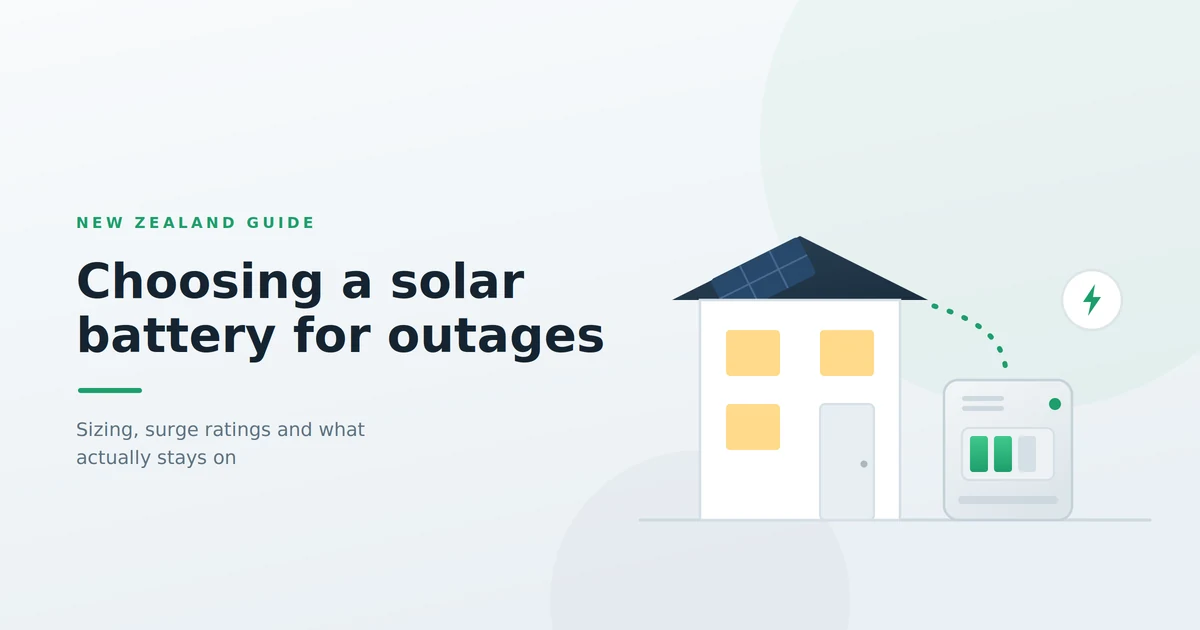
The power went out at 6pm, came back at 11pm, and you spent five hours discovering how much of your house depends on electricity. Fridge, internet, heat pump, hot water. If you’re now working out how to choose a solar battery for power outages in New Zealand, the good news is that the decision comes down to a handful of numbers.
How to Choose a Solar Battery for Power Outages in NZ
The bad news is that most people start with the wrong one. They start with price. The number that should drive everything is how many kilowatt-hours you need to keep running, and for how long.
portable power station or installed home battery?
These are two different products for two different problems. A portable power station is a plug-in box you run appliances from directly no electrician, no approvals, typically 1–5kWh. An installed home battery is wired into your switchboard, powers whole circuits automatically, and requires a registered electrician plus lines company sign-off.
Decide which category you’re in before you compare anything else. The specs don’t transfer between them, and neither does the advice.
Plug-in power stations
You plug the appliance into the unit, and the unit into a wall socket or solar panel to recharge. That’s the whole system. No consent, no installer, and you can take it camping.
The limitation is what you can physically plug in. Your fridge, yes. Your lights on the ceiling, no those are hardwired. Hot water cylinder, no. It’s excellent for keeping food cold and devices charged, and useless for anything on a fixed circuit.
Installed home batteries
Wired to your switchboard, so when the grid drops the battery picks up your nominated circuits automatically. Lights come on. The internet never blinks. Nobody has to go find an extension cord in the dark.
That automatic changeover is what you’re paying for, along with meaningful capacity. It also means an electrician, a Certificate of Compliance, and a conversation with your lines company.
Work out what you actually need to keep running
List your essential appliances, multiply each one’s watts by the hours you’d run it, and add them up. That total in watt-hours divided by 1,000 for kilowatt-hours is your daily requirement during an outage. Everything else follows from this figure.
Be honest about what’s essential. Most people find the real number is smaller than they feared.
A worked example for a typical NZ home
| Load | Power draw | Hours/day | Daily use |
|---|---|---|---|
| Fridge-freezer | ~150W average cycling | 24 | ~1.2 kWh |
| LED lighting | 100W | 5 | 0.5 kWh |
| Router and modem | 15W | 24 | 0.36 kWh |
| Phones and laptop | — | — | ~0.3 kWh |
| Essentials subtotal | ~2.4 kWh | ||
| Heat pump (one room) | 1,000W | 4 | 4.0 kWh |
| With heating | ~6.4 kWh |
That table tells the whole story. Keeping food cold and staying connected is a modest 2.4kWh a day. Adding heating almost triples it. A 5kWh battery covers your essentials for two days, or one evening of heat pump use.
Work out your own version before you get a quote. It takes ten minutes and it’s the difference between buying the right size and buying whatever was on the shelf.
Rural households: the extra loads that catch people out
If you’re on tank water, your pump is not optional no power means no water, no toilet flush, no shower. Add it to the list.
Also worth checking: septic or effluent pumps, electric gates, freezers in the shed, and anything to do with stock water or milking. These loads are often forgotten in the planning and then discovered on day two of an outage.
Capacity vs output: the two numbers people confuse
Capacity (kWh) tells you how long a battery lasts. Continuous output (kW) tells you how much it can power at once. A battery can hold plenty of energy and still refuse to run your heat pump, because those are separate limits.
Think of it as a water tank. Capacity is how much water is in it. Output is how fast it can come out of the tap. You need both to match your situation.
Surge and startup loads
Anything with a motor draws far more power for the first fraction of a second than it does while running. A bore pump rated at 750W might pull two or three kilowatts on startup. A fridge compressor does the same on a smaller scale.
That’s why output ratings list two figures continuous and surge. If your pump’s startup exceeds the surge rating, the battery trips and you get nothing, regardless of how many kilowatt-hours are sitting in it.
Check the surge rating against the startup draw of your largest motor load. This single check prevents the most frustrating category of buyer’s remorse.
Comparison table: sizing against outage length
| Capacity | Realistically runs | Outage covered | Install needed | Best for |
|---|---|---|---|---|
| 1–2 kWh | Devices, router, a lamp, small fridge briefly | Hours | No | Short urban outages, camping |
| 2–3 kWh | Fridge-freezer, lights, internet | ~1 day of essentials | No | Most short-outage households |
| 5 kWh | Essentials plus a water pump, or one evening of heating | 1–2 days | Usually wired | Rural or families |
| 10 kWh | Essentials, pump, some heating, automatic changeover | 2–4 days of essentials | Yes | Storm-prone or lifestyle blocks |
| 15 kWh+ | Most of the house, extended periods | Several days | Yes | Off-grid or long-outage areas |
Battery chemistry: what to look for in NZ conditions
Lithium iron phosphate (LiFePO4) is the sensible default for outage backup. It offers long cycle life, tolerates partial charging without harm, and is more thermally stable than older lithium chemistries. The trade-offs are weight and upfront cost.
Older lead-acid batteries are cheaper per kWh but you can’t use their full capacity without shortening their life, they need ventilation, and they last a fraction as long. For a battery that sits mostly idle waiting for an outage, the longevity difference matters more than the sticker price.
Cycle life and what it means in years
A battery rated for several thousand cycles sounds abstract until you translate it. Used for outage backup only, you might cycle it a dozen times a year that rating will outlive the warranty comfortably. Cycled daily as part of a solar self-consumption setup, the same rating works out to roughly a decade.
So the same battery has a very different lifespan depending on how you use it. Ask what warranty period is offered and under what usage assumptions, not just what the cycle count is.
Can it recharge itself? Solar input and recharge speed
A battery that recharges from solar keeps working through a multi-day outage. One that only recharges from the grid is a single-use tank. If outages in your area last more than a day, solar input isn’t a nice-to-have.
The catch in New Zealand is seasonal. Summer might give you 5–6 peak sun hours; winter drops to roughly 2–3 in much of the country, and less in the deep south. Same panels, half the harvest.
Why a multi-day winter outage is the real test
Winter storms cause the outages, and winter is when your panels produce least and your heating demand is highest. All three work against you simultaneously.
Plan for the winter figure, not the annual average. A system that comfortably recharges in February may barely keep pace in July which is precisely when you’ll need it.
Regulations, install and safety in New Zealand
Plug-in power stations need no approvals. Anything wired into your switchboard requires a registered electrician, must meet the relevant AS/NZS standards, and a Certificate of Compliance has to be issued after the work. If your system connects to the grid, your lines company is involved too.
This is the part that offshore guides get wrong, because they’re written for the US or Australia. New Zealand’s rules sit across three layers: the Electricity Authority’s Part 6 Code, the AS/NZS 4777 and 5139 standards, and your individual lines company’s requirements.
A few specifics worth knowing before you get quotes:
- Grid connection uses the Part 1A pathway for residential systems. If your distributor doesn’t respond within 10 business days, the application is deemed approved.
- Your inverter needs a Declaration of Conformity with AS/NZS 4777.2:2020 including its amendments, from an accredited laboratory. Some lines companies keep their own approved inverter lists.
- Voltage settings changed in November 2025. New Zealand moved to the Australia A setting, and inverters configured to the older NZ-specific profile will fail inspection.
- Most rooftop solar is now exempt from building consent under rules that changed in late 2025 worth roughly a thousand dollars in avoided fees. Confirm whether your specific battery installation falls inside the exemption, since consent rules and electrical compliance are separate questions.
- Battery systems have their own standard, AS/NZS 5139, covering safe installation and placement.
Get all of this confirmed by your installing electrician in writing. Standards and lines company policies move, and 2025–26 saw more change than usual.
Grid-tied, hybrid and off-grid: which applies to you
Grid-tied solar without a battery exports to the grid and reduces your bill. In an outage it gives you nothing see below.
Hybrid combines solar, battery and an inverter capable of running your nominated circuits when the grid is down. This is what most outage-focused NZ households actually want.
Off-grid means no connection at all, and a much larger system sized for your worst week of the year.
What “backup” does and doesn’t mean on a grid-tied system
Here’s the trap that catches people who already have solar. A standard grid-tied solar system shuts down during an outage. It has to anti-islanding protection stops it energising lines that a crew may be working on.
So if you have panels on the roof and no battery, a blackout leaves you with no power at all, in the middle of a sunny day. Getting backup requires both a battery and an inverter designed to island your circuits safely. Adding a battery to an existing setup sometimes means changing the inverter too.
Pros and cons of a solar battery versus a generator
Battery advantages: silent, no fuel to store or source, safe indoors with no exhaust, automatic changeover on wired systems, no maintenance routine, and it can earn its keep daily by storing solar rather than sitting idle.
Generator advantages: much cheaper upfront per kilowatt-hour, runtime limited only by fuel, and better suited to genuinely long outages where recharging isn’t realistic.
Battery drawbacks: high initial cost, finite capacity, recharge depends on sun or grid.
Generator drawbacks: noise, fumes and the carbon monoxide risk that comes with it, fuel that degrades in storage, manual starting, and needing to buy petrol during exactly the emergency when everyone else is queuing for it.
For most New Zealand homes facing outages measured in hours or a couple of days, a battery is the better fit. For a rural property that loses power for a week, a battery for the essentials plus a generator for heavy loads beats either alone.
Mistakes that cost NZ buyers money
- Shopping on price before calculating loads. You’ll either overspend or buy something that doesn’t cover your fridge.
- Ignoring surge ratings. A battery that can’t start your pump is not a backup for your water supply.
- Assuming existing solar provides outage backup. It usually doesn’t. Confirm before you assume.
- No automatic changeover. Manual switching is fine until the outage starts at 2am.
- Sizing on summer solar figures. Winter is when you’ll need it and when panels produce least.
- Skipping the lines company step. Retrofitting approval after an install is slower and more expensive than doing it in order.
- Buying capacity you can’t recharge. A 15kWh battery with 1kW of panels takes days to refill in winter.
Matching a battery to your situation
Urban home, short storm outages. A 2–3kWh portable unit covers fridge, lights and internet through the four-to-eight-hour outages that make up most of what you’ll face. No installer, no approvals, and it’s useful the rest of the year.
Rural property with pump loads. Look at 5–10kWh wired in, with attention to surge rating rather than capacity alone. Water is the non-negotiable load, and a pump decides your minimum output requirement.
Work-from-home household. Internet uptime is the priority and the loads are small 2–5kWh with automatic changeover means a dropped connection never costs you a meeting. The changeover matters more than the capacity here.
FAQs
How long will a solar battery power my house?
Divide the battery’s usable kWh by your hourly consumption. A 10kWh battery running 500W of essentials lasts about 20 hours. Running a 2kW heat pump as well, closer to 4. It depends entirely on what you switch on.
Can a solar battery run a heat pump?
Often yes, but check both numbers. The battery’s continuous output must exceed the heat pump’s running draw, and its surge rating must handle startup. Then accept that heating will drain capacity several times faster than your other essentials combined.
Do I need an electrician to install a solar battery in New Zealand?
For anything wired to your switchboard, yes a registered electrician, compliant with the relevant AS/NZS standards, issuing a Certificate of Compliance. Plug-in portable power stations need nobody.
Will a battery charge from my existing solar panels?
Sometimes, but not always directly. It depends on your inverter and whether it can operate during an outage. Retrofits occasionally need an inverter change, so get that assessed before you buy the battery.
How long do solar batteries last?
LiFePO4 batteries used for occasional outage backup typically outlast their warranty period comfortably, since you’re cycling them a handful of times a year rather than daily. Warranties in this category commonly run around ten years confirm the terms and the usage assumptions behind them.
Is a battery worth it if outages are rare where I live?
On outage protection alone, a small portable unit makes more sense than a whole-home system. If your battery also stores daytime solar for evening use, it works every day rather than a few times a year, which changes the economics considerably.
Can I add a battery to my solar system later?
Usually, though it’s cheaper to plan for it upfront. The deciding factor is whether your current inverter supports battery coupling and islanding ask your installer specifically, not generally.