You’ve got a perfectly good steel roof and someone wants to drill holes in it. That’s the sticking point for a lot of people, and it’s a fair thing to hesitate over.
Can You Install Solar Panels on a Metal Roof
Here’s the short version: yes, you can install solar panels on a metal roof in New Zealand, and metal is arguably the best roof type for it. The risk isn’t the roof it’s the installer. What follows is how to tell a good mounting proposal from a bad one, and the one decision people get wrong before any of it starts.
The short answer
Yes. Corrugated and long-run steel roofs are strong, structurally predictable and long-lived, and the mounting methods for them are well established.
Standing seam roofs can often be done with no penetrations at all, using clamps that grip the seam. If that’s what you have, you’re in the best position of anyone.
Why metal suits solar better than most roof types
Three reasons, and they compound.
Strength and predictable structure
Steel roofing sits on purlins at known spacings. That means an installer can locate structure reliably and fix into it, rather than guessing or relying on the sheeting itself to carry load.
Predictability is what makes a mounting system engineered rather than improvised.
Lifespans that match
A steel roof and a solar array have broadly comparable service lives. Install them at the same stage and they age together, rather than one needing replacement while the other has decades left.
That alignment is worth more than it sounds and it’s the basis of the roof-age advice further down.
Simpler than tile
No tiles to lift, crack or find replacements for. No hunting a discontinued profile because two broke during install. Metal roof installs are generally faster, cheaper and have fewer things that can go wrong.
| Roof type | Typical mounting | Penetrations | Complexity |
|---|---|---|---|
| Corrugated steel | Brackets through the crest into purlins | Yes, sealed | Low |
| Long-run / trapezoidal | Profile-specific brackets | Yes, sealed | Low |
| Standing seam | Clamps gripping the seam | None | Lowest |
| Concrete or clay tile | Tile hooks under lifted tiles | Yes | Moderate tiles can break |
| Membrane / flat | Ballasted or specialist fixings | Depends | Higher waterproofing critical |
Which metal roof do you have?
The profile determines the mounting method, and plenty of people don’t know which they’ve got. Take a photo from the ground and you’ll be able to tell.
Corrugated
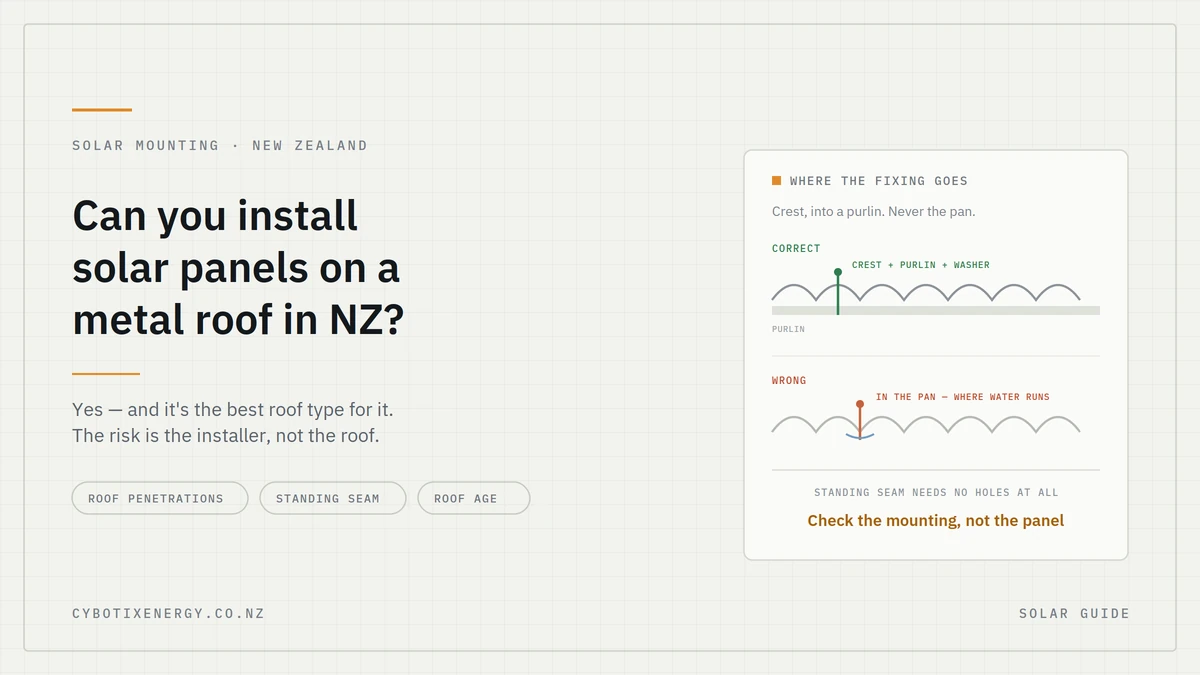
The classic wavy profile rounded ridges running down the slope. Fixings go through the crest of the corrugation, never the pan where water runs.
Long-run trapezoidal
Angular ribs rather than rounded waves, common on newer homes. Same principle, different bracket shapes to match the profile.
Standing seam
Raised vertical seams joining the sheets, with no visible fixings on the surface. These allow clamp-on mounting with nothing penetrating the roof at all.
Tray, membrane and flat
Less common residentially. Waterproofing is more critical and the approach differs worth a specialist look rather than a standard bracket kit.
The leak question, answered properly
Correctly installed penetrations don’t leak. Badly installed ones do and so does bad flashing around a chimney, a vent or a skylight.
The roof type isn’t the risk. Workmanship is.
What a proper penetration looks like
- Fixed into a purlin, not just through sheeting
- Through the crest, above the water path, never in the pan
- Correct fastener with a bonded EPDM washer, which is what actually forms the seal
- Sealant as secondary defence, not as the thing holding water out
- Correct torque: over-tightening deforms the washer and creates the leak it’s meant to prevent
Done that way, a mounting penetration is no more of a risk than the hundreds of fixings already holding your roof down.
What a bad one looks like
- Fixed into the pan, where water flows
- Sealant doing the work, with no proper washer beneath
- Fixings into sheeting only, missing the purlin
- Wrong fastener material for your roofing
- No consideration of thermal movement, which steel roofs do
If a quote doesn’t mention fastener type or sealing method at all, that’s the gap worth asking about.
Galvanic corrosion: the NZ-specific one
This matters here more than in most markets, because so much of the country is coastal.
When two dissimilar metals sit in contact in salty, humid air, one corrodes faster. An incompatible bracket or fastener against your roofing can produce corrosion around every fixing point within a few years and you’ll see it as rust streaks running down the roof.
Ask what material the brackets and fasteners are, and whether they’re compatible with your specific roofing. Within a few kilometres of the sea, this is a question worth asking twice.
Standing seam: the no-holes option
If you have a standing seam roof, clamps grip the raised seam and the mounting system attaches to those. Nothing penetrates the roofing at all.
That removes the leak question entirely, keeps the roofing untouched, and generally sidesteps any warranty conditions about penetrations.
The honest caveat: it depends on your seam profile being compatible with available clamps, and not every profile is. An installer will confirm from a photo or a site visit.
Roof age: the decision to make first
If your roof has under ten years of life left, replace it before the array goes on.
This is the most common regret in this whole category, and it’s entirely avoidable.
The cost of doing it the other way round
Removing an array, replacing a roof and reinstalling the array costs real money scaffolding, labour, and often replacement mounting components. Nobody’s warranty covers it, because nothing failed.
You’d be paying twice for the same work because of sequencing.
How to assess your roof’s remaining life
Look for:
- Coating condition — chalking, fading, or exposed metal
- Rust at fixings and laps, which is where it starts
- Previous patch repairs, especially several of them
- Age, if you know it
If any of that is present, get a roofer’s assessment before you design a solar system rather than after you’ve paid a deposit. It’s a small cost that decides the order of two large ones.
Wind zones and fixing density
Your site’s wind zone determines how many fixings the array needs and how they’re spaced. This is a safety and compliance matter, not a performance one.
Higher wind zones need more fixings, and the mounting system should carry a stated engineered rating. Wellington, exposed Canterbury sites, and coastal properties anywhere sit at the demanding end.
Ask for the wind rating of the system as installed not just the panel. Panel load ratings are a separate specification, covered in our guide to choosing the right solar panel.
What to check in a mounting quote
The mounting is where quotes differ most and where buyers look least. Run yours against this:
- Rail and bracket material, and compatibility with your roofing
- Fastener type and material, including washer type
- Sealing method, stated explicitly
- Confirmation that fixings land on purlins, not sheeting
- Stated wind rating for the mounting system
- Roof condition assessment before design
- Penetration count fewer isn’t automatically better, but you should know
- Standoff height, since airflow behind panels affects their operating temperature
A quote that details panels and inverters at length but says nothing about mounting has skipped the part most likely to cause you trouble.
The roofing warranty question
Some roofing warranties carry conditions about penetrations or third-party fixings. Worth checking before the install, not after a problem.
When the roof isn’t the answer
Sometimes it isn’t. If your roof is old, heavily shaded, poorly oriented or structurally marginal, a ground mount avoids the question completely.
Trade-offs: it needs space, costs more in framing and cabling, and may bring consent considerations that a roof install doesn’t. Our guide to solar consent requirements covers that side.
The upside is a proper tilt angle, easy cleaning, no roof penetrations at all, and no coupling between your array and your roof’s replacement schedule.
FAQs
Will solar panels damage my metal roof?
Not when properly installed. Fixings go through the crest into purlins with bonded washers forming the seal. The risk comes from poor workmanship wrong fastener, wrong position, or over-tightening rather than from the roof type.
Do solar panels on a metal roof leak?
Correctly installed penetrations don’t. Your roof already has hundreds of fixings through it. The concern is legitimate but it points at installer quality rather than at metal roofing.
Can you install solar on a standing seam roof without drilling?
Usually yes. Clamps grip the raised seam so nothing penetrates the roofing. It depends on your seam profile matching available clamps, which an installer can confirm from a photo.
Does solar void my roofing warranty?
It can, depending on the manufacturer and the conditions attached. Check your roofing warranty terms before the install and ask your installer whether their method complies.
How old is too old for a roof to take solar?
If the roof has under ten years left, replace it first. Removing and reinstalling an array costs real money that nobody’s warranty covers, and it’s entirely avoidable with the right sequencing.
Is a metal roof better than tiles for solar?
Generally yes. Metal is structurally predictable, has no tiles to break, and installs faster. Tile is perfectly workable but fiddlier, and broken tiles during install are a common annoyance.
Do metal roofs make panels hotter?
Dark roofs of any material raise the temperature around an array, and panels lose output as they heat. What matters more is standoff height the airflow gap behind the panels which is a mounting design decision worth asking about.