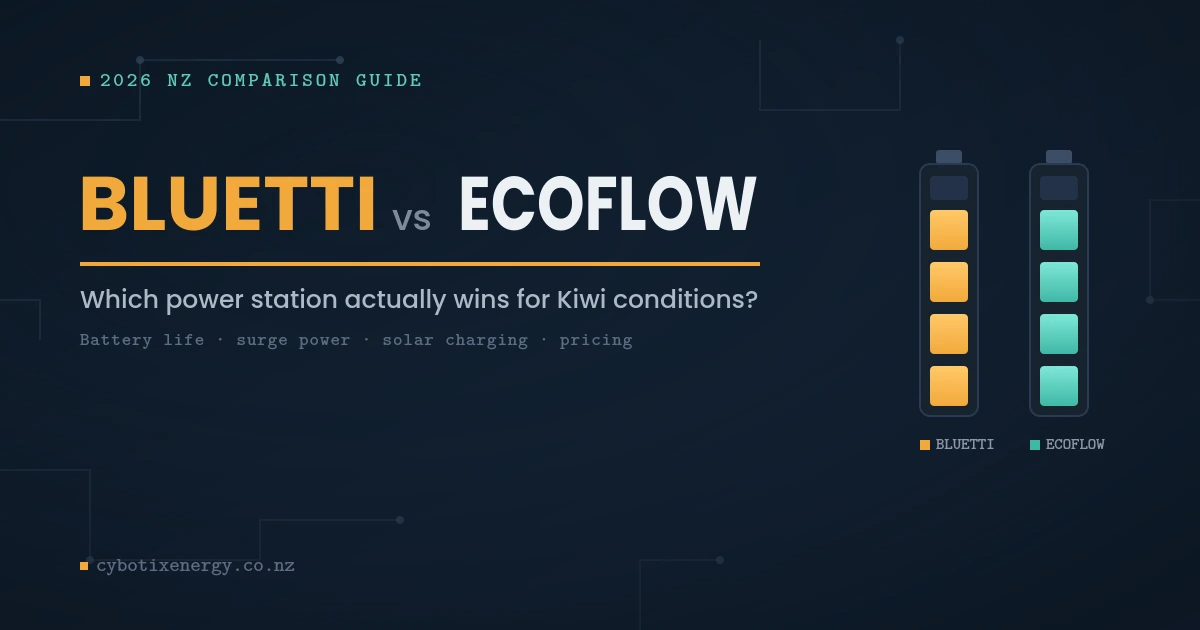
If you’ve been through a Wellington windstorm outage or a week of grey skies on the West Coast, you already know why Kiwis are buying portable power stations faster than most retailers can restock them. Two brands dominate the conversation: BLUETTI and EcoFlow. Both make solid gear. Neither is the “obviously better” choice for every situation and that’s really what this comparison is about.
This guide breaks down how BLUETTI and EcoFlow stack up on the things that actually matter for New Zealand conditions: battery life, power output, solar charging in our variable weather, portability, and total cost over the years you’ll actually own the thing.
Why This Comparison Matters for NZ Buyers in 2026
New Zealand’s mix of rural properties, unpredictable weather, and a growing number of off-grid baches means portable power stations aren’t a novelty purchase anymore they are becoming standard kit. Choosing between BLUETTI and EcoFlow comes down to matching battery chemistry, output, and charging speed to how you’ll actually use the unit.
Outages from storms and wind events are a regular feature of NZ winters, particularly outside main centres where lines can take longer to repair. At the same time, more households are running rooftop or portable solar and want a battery that can store that generation for evening use. Then there’s the recreational side tramping trailheads, freedom camping, and boat trips where mains power simply isn’t an option.
BLUETTI vs EcoFlow
Both BLUETTI and EcoFlow serve all three of these buyers, but their product lines lean differently. BLUETTI has generally focused on larger-capacity home backup and expandable systems, while EcoFlow has built a strong reputation in the compact, camping-friendly segment though both brands have expanded well outside those original lanes in recent years.
BLUETTI vs EcoFlow at a Glance
Both brands offer LiFePO4-based power stations spanning small portable units to whole-home backup systems, with the main differences showing up in expandability, app ecosystem, and warranty terms rather than raw specs alone.
| Factor | BLUETTI | EcoFlow |
|---|---|---|
| Battery chemistry | Primarily LiFePO4 across current range | Primarily LiFePO4 across current range |
| Typical cycle life | 3,000–6,000+ cycles (model dependent) | 3,000–6,000+ cycles (model dependent) |
| Capacity range | Compact units to 20kWh+ expandable home systems | Compact units to whole-home expandable systems |
| Surge power (flagship models) | Up to several kW on higher-end units | Up to several kW on higher-end units |
| Solar input | High-wattage MPPT charging on larger units | High-wattage MPPT charging on larger units |
| App control | BLUETTI app (WiFi/Bluetooth) | EcoFlow app (WiFi/Bluetooth) |
| NZ availability | Available through NZ retailers including [https://cybotixenergy.co.nz/] | Available through multiple NZ retailers |
| Warranty (typical) | Commonly 2–5 years depending on model | Commonly 2–5 years depending on model |
Battery Chemistry & Longevity
Both brands have moved almost entirely to LiFePO4 (lithium iron phosphate) cells across their current lineups, which is the right chemistry for a power station you plan to keep for years. LiFePO4 is more thermally stable and handles far more charge cycles than older lithium-ion chemistries.
In practice, this means a well-specced unit from either brand should retain a meaningful portion of its original capacity after several years of regular charge-discharge cycles, rather than degrading noticeably within a year or two like cheaper lithium-ion units can.
What differs between models isn’t chemistry so much as rated cycle count and depth of discharge tolerance. When comparing specific units:
- Check the manufacturer’s cycle rating to 80% capacity, not just “cycles until failure”
- Look at the operating temperature range, since NZ winters can dip below what some cheaper units are rated for
- Confirm whether the battery management system (BMS) supports partial charging without accelerating degradation
Power Output & Surge Capacity
Continuous output tells you what you can run for extended periods; surge capacity tells you whether the unit can handle the initial power spike from things like fridge compressors, power tools, or induction cooktops. Both matter, and they’re often confused.
For NZ households, this is usually the deciding factor between “backs up a few essentials” and “runs the whole kitchen.” A fridge-freezer alone can draw a startup surge of 1,500W or more even though it only needs a few hundred watts to run continuously a power station with weak surge handling will trip out the moment the compressor kicks in.
When comparing BLUETTI and EcoFlow models at similar capacity points:
- Continuous AC output — check this against the combined wattage of what you’d actually run at once (fridge + lights + router + laptop charging, for example)
- Surge/peak output — this is what protects you from nuisance trip-outs on compressor-based appliances
- Split-phase or expansion support — relevant if you’re thinking about scaling up to partial home backup later
Higher-capacity models from both brands are increasingly capable of running power tools, induction cooktops, and even short bursts from larger appliances, but this varies significantly by model tier don’t assume a compact camping unit and a home backup unit from the same brand perform the same way.
Charging Speed & Solar Compatibility
Charging speed matters more in New Zealand than in sunnier markets, simply because solar input is less consistent through autumn and winter. A unit that charges quickly from mains power and makes efficient use of whatever sun you do get will be more useful here than one optimised purely for peak solar conditions.
Both BLUETTI and EcoFlow offer fast AC charging on their higher-end units, often reaching 80% capacity within an hour when charging from mains. This matters if you’re topping up between outages or before a weekend away, rather than leaving a unit on trickle charge overnight.
On the solar side, look for:
- Maximum PV input wattage — higher input means faster charging on the shorter, lower-intensity daylight hours common through NZ winter
- MPPT charge controller support — improves efficiency when panel output fluctuates with cloud cover
- Charging enhancer/expansion accessories — some brands, including BLUETTI, offer add-on devices that boost solar input rates and add charging flexibility (car, lead-acid, additional solar) beyond what the base unit supports on its own
If solar charging is a priority say, for a bach without mains connection prioritise the model’s rated solar input wattage over its battery capacity alone. A larger battery charged slowly by weak solar input can leave you short during a run of overcast days.
Portability & Design
If the power station is coming tramping, on a boat, or into a ute tray every weekend, weight and footprint matter as much as capacity. If it’s staying in a garage or hallway cupboard for emergency backup, portability matters less than total output and expandability.
Compact units in both ranges typically sit in the 10–15kg bracket with carry handles designed for one-person transport, while larger home-backup units are intentionally less portable in exchange for higher capacity and expansion options. Neither brand has a clear universal advantage here it comes down to the specific model and how it’s built for its intended use case.
Things worth checking before you buy:
- Actual weight including any built-in handle or wheeled trolley
- Physical dimensions relative to where you’ll store or transport it
- IP rating if it’s going anywhere near a campsite or boat deck
- Noise level under load, particularly for units you’ll run overnight
App, Smart Features & Expandability
Both BLUETTI and EcoFlow offer companion apps for monitoring charge level, adjusting output settings, and on select models enabling higher-draw modes like power lifting for resistive loads. This is useful, but it’s not the deciding factor for most buyers; treat it as a convenience layer on top of the hardware fundamentals.
Expandability is the more practical consideration long-term. If there’s a realistic chance you’ll want more capacity down the track say, moving from backing up a fridge to backing up half the house check whether the model you’re considering supports:
- Add-on expansion batteries
- Multiple unit stacking or parallel operation
- Firmware updates that unlock new features post-purchase
Buying a unit with expansion support built in, even if you don’t need it immediately, is generally cheaper than replacing an entire unit later.
Pricing & Value in the NZ Market
Sticker price is the least useful number when comparing BLUETTI and EcoFlow cost per Wh, warranty length, and expected cycle life together give a far more accurate picture of value over the life of the unit.
Both brands span a wide price range, from sub-$1,000 compact units to several-thousand-dollar home backup systems with expansion batteries. Rather than comparing headline prices, work out:
- Cost per Wh of capacity: divide the price by the rated Wh to compare units of different sizes fairly
- Cost per rated cycle: a unit rated for 6,000 cycles at a similar price to one rated for 3,000 cycles is the better long-term value, assuming similar output specs
- Warranty coverage: longer warranties reduce your risk if a cell degrades faster than expected
- Local support and service: buying through an NZ-based retailer such as [https://cybotixenergy.co.nz/] matters if you ever need warranty support, replacement parts, or advice on sizing a system correctly
Which One Should You Choose?
Match your choice to your primary use case rather than the brand name a unit built for camping and one built for home backup solve different problems, even within the same brand.
- Off-grid or bach use with solar charging: prioritise high solar input wattage and expansion battery support over compact size.
- Home power cut backup: prioritise continuous output high enough to cover fridge, lighting, and router, plus fast AC recharge between outages.
- Camping, tramping, or vehicle use: prioritise weight, footprint, and quiet operation over maximum capacity.
- Tradies or mobile work: prioritise surge capacity for power tools and a rugged, transport-friendly build.
- Emergency preparedness for sensitive equipment: prioritise low switchover time if running medical devices or similar equipment that can’t tolerate interruption.
Neither brand is a universal winner. The right call is the model not just the brand that matches your wattage needs, charging environment, and how often you’re moving the unit around.
FAQs
Is BLUETTI or EcoFlow better for New Zealand power cuts?
Both can work well for power cuts, provided the model has enough continuous output to cover your essentials and a fast enough recharge time between outages. Focus on matching output wattage to your appliances rather than the brand itself.
Which lasts longer, BLUETTI or EcoFlow?
Both brands use LiFePO4 batteries with comparable cycle life ratings on their current models, generally in the thousands of cycles. Actual lifespan depends more on the specific model’s cycle rating and how the unit is charged and discharged than on brand alone.
Can a portable power station run a fridge during an outage?
Yes, provided the unit’s surge output is high enough to handle the fridge compressor’s startup spike, not just its running wattage. Check both continuous and surge/peak output ratings before assuming a unit will handle it.
How fast can these power stations charge from solar in NZ conditions?
Charging speed depends on the panel wattage, the unit’s maximum PV input rating, and available sunlight, which varies significantly by season and region in New Zealand. Larger panels and higher MPPT input ratings will charge noticeably faster during shorter winter daylight hours.
Do I need an expansion battery, or is one unit enough?
It depends on what you’re backing up. A single unit is usually enough for lighting, device charging, and a fridge, but running multiple appliances or backing up part of a house for extended periods often calls for expansion capacity.
Are these power stations safe to run indoors overnight?
LiFePO4-based units from reputable brands are generally considered safe for indoor use, including overnight operation, due to the chemistry’s thermal stability compared to older lithium-ion batteries. Always follow the manufacturer’s ventilation and placement guidance regardless of chemistry.
Where can I buy BLUETTI power stations in NZ with local support?
BLUETTI power stations are available through NZ-based retailers including [https://cybotixenergy.co.nz/], which can help with model selection, sizing for your specific needs, and warranty support.
Ready to Compare Models Side by Side?
Specs on paper only tell part of the story the right power station depends on your specific power draw, charging setup, and how you’ll actually use it. Browse the current BLUETTI range at [https://cybotixenergy.co.nz/] to compare models by capacity, output, and price, or get in touch for help sizing a system to your household or off-grid setup.