The connection quote comes back at fourteen thousand dollars. Or the nearest line is four hundred metres away across a neighbour’s paddock, and nobody’s keen. Or you just decided from the start that you’d rather not be connected at all.
However you got here, designing solar power for a tiny home in NZ works differently from putting panels on a suburban roof. Grid-tied systems can be undersized and nobody notices you simply buy the shortfall. Off-grid, an undersized system means sitting in the dark in July with a flat battery and a week of cloud ahead.
Solar Power for Tiny Homes in NZ
That single difference drives every decision below.
The short answer
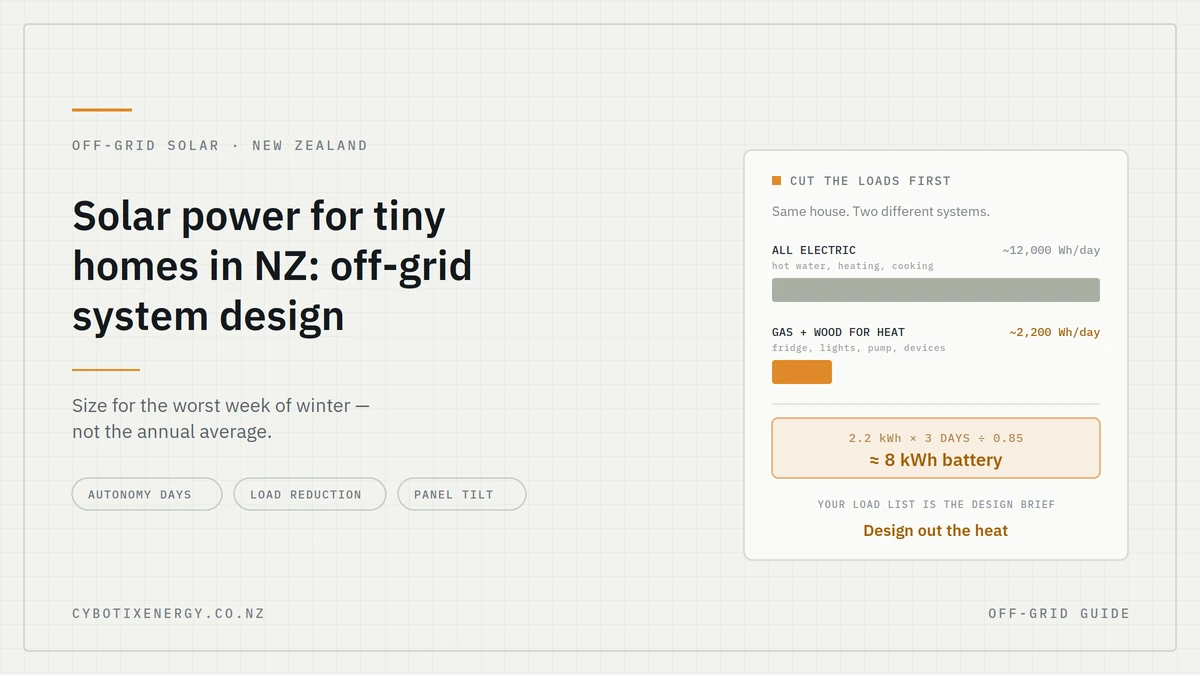
Size your system for the worst week of winter, not your annual average. That usually means more battery and more panel than online calculators suggest, plus designing out every electrical heating load you can.
Get the load reduction right and the system gets dramatically cheaper. Get it wrong and no amount of panel fixes it.
Off-grid is a different problem to grid-tied
Most solar advice assumes a grid connection sitting behind it as a safety net. Remove that and the maths changes.
No fallback changes everything
On a grid-tied system, a shortfall is a bill. Off-grid, a shortfall is no power no fridge, no lights, no water pump if you’re on a tank.
That asymmetry is why off-grid systems carry margin that would look wasteful on a suburban roof. You’re not optimising for return on investment; you’re buying reliability.
Why the average is the wrong number
Annual generation figures hide the shape of the year. In New Zealand, midwinter output can be a fraction of midsummer shorter days, a lower sun angle, and more cloud, all arriving together.
You don’t live through the average week. You live through the worst one, and if the system can’t carry you then, the annual figure is irrelevant.
If you’re sizing storage for grid-connected backup instead, that’s a different calculation our guide to home battery backup sizing covers that case.
Step one: cut the loads before you size anything
This is where the money is. Every load you remove is panel and battery you don’t have to buy, and in a tiny home the wins are proportionally enormous.
Do this before you calculate anything.
The heating loads to design out
Anything that makes heat is the enemy of an off-grid system. A single electric element can consume more in an hour than your lights use in a week.
| Load | If electric | Alternative | Why it matters |
|---|---|---|---|
| Hot water | ~3kW element | LPG instant, or wetback on a log burner | The single largest saving available |
| Space heating | 1.5–2.4kW | Log burner, diesel heater, LPG | Highest demand in the lowest-generation season |
| Cooking | 1.5–3.5kW | LPG hob | Brief but heavy, and daily |
| Clothes drying | 2–3kW | Line, or airer near the burner | Easy to eliminate entirely |
| Kettle | 2–2.4kW | Stovetop kettle | Small, but it’s the classic surge trip |
Design those out and your remaining load is small enough that a modest system runs it comfortably. Leave any of them in and you’re building a much larger and more expensive system.
What’s worth keeping electric
- Fridge — around 0.8–1.2kWh a day for a decent 12V or efficient household unit
- LED lighting — negligible
- Water pump — modest daily use, but check the surge
- Laptops, phones, internet — small and steady
- Ventilation or a small fan — worth keeping for humidity control
That’s a genuinely light load list, and it’s achievable.
The composting toilet question
Worth considering beyond the obvious. A composting toilet removes any septic or effluent pump load, and it cuts water use substantially which reduces how often your water pump runs.
Small savings individually. In a system this size, they’re a meaningful percentage.
Step two: work out your daily consumption
Add up the daily watt-hours of the loads you’ve kept. Be specific, use real figures from rating plates where you can, and don’t round down.
A realistic tiny home load list
| Load | Draw | Daily use | Daily Wh |
|---|---|---|---|
| Fridge (efficient) | Cycling | ~⅓ of the time | 800–1,200 |
| LED lighting | 30W total | 5 hours | 150 |
| Water pump | 600W | Short bursts | 200–400 |
| Laptop | 60W | 4 hours | 240 |
| Internet router | 15W | Continuous | 360 |
| Phone charging | — | Daily | 100 |
| Fan or extractor | 40W | 3 hours | 120 |
| Total | ~2,000–2,400Wh |
Around 2kWh a day is a realistic target for a well-designed tiny home with gas for heat. That’s a much easier system to build than the 8–10kWh a typical suburban household uses.
The mistake in most calculators
They combine summer generation with average consumption. That’s optimistic twice over your generation is at its annual peak and your consumption estimate is at its annual middle.
Do it the other way round: winter generation against winter consumption, which is usually higher because lights run longer and you’re inside more.
Step three: autonomy days the spec nobody talks about
Autonomy days is how many days your battery can run the home with no meaningful generation. It’s the number that determines your battery size, and your battery is usually the most expensive component.
Most guides skip it entirely.
How many days do you need in New Zealand?
Two days is optimistic almost anywhere here. Three to five is the honest range, depending on region and how much a blackout costs you in comfort.
The demanding locations are the ones with persistent winter cloud Wellington, the West Coast, Southland. Hawke’s Bay and Marlborough are kinder. If you’re in the south, size toward the upper end.
The arithmetic
Daily consumption × autonomy days ÷ 0.85 = battery capacity needed
Using 2.2kWh a day and three days: 2.2 × 3 = 6.6kWh, ÷ 0.85 = roughly 7.8kWh of nameplate capacity.
Four days pushes that past 10kWh. That’s the step where budgets get tested, and it’s why the load reduction in step one matters so much.
Why more battery isn’t always the answer
Three reasons. Cost, obviously. Weight, if the home is on wheels and you’re thinking about towing. And the fact that a large battery you can’t recharge in a July week of cloud is dead weight at some point the array becomes the constraint rather than the storage.
Balance the two rather than solving with battery alone.
Step four: sizing the array for winter, not summer
Size the array to refill your battery from winter generation. If it can do that, summer looks after itself.
What winter actually looks like
Fewer daylight hours, a low sun angle, and more cloud. Real output on an overcast midwinter day can be a small fraction of a panel’s rating, and southern New Zealand sees noticeably less winter sun than the north.
Plan on needing considerably more array than a summer calculation suggests. Surplus in January is wasted; shortfall in July is a problem.
Tilt matters more off-grid
Here’s something rarely mentioned. A steeper, winter-optimised tilt catches the low winter sun far better than a shallow roof-pitch angle at the cost of some summer output you don’t need anyway.
If you’re mounting on a frame rather than a roof, a steeper angle is one of the cheapest performance improvements available. Being able to adjust it seasonally is better still.
Roof space is usually the constraint
A tiny home roof is a small roof, and that ceiling is often what forces the decision. Many off-grid tiny homes end up with a ground-mounted or frame-mounted array alongside the building, either instead of or in addition to roof panels.
Ground mounts also let you set the tilt properly and clean the panels without a ladder.
Step five: system voltage and components
12V, 24V or 48V?
Higher voltage means lower current for the same power, which means thinner cable and lower losses. Broadly:
- 12V — simplest, wide range of camping and marine appliances, but heavy cable and losses on larger systems
- 24V — a common middle ground for tiny homes
- 48V — most efficient for larger systems and better inverter options, though fewer DC appliances
For a system in the range described here, 24V or 48V generally makes more sense than 12V. Decide early, because it dictates almost every component choice afterwards.
What you actually need
- Panels
- MPPT charge controller — sized to your array, not just your battery
- Battery bank
- Inverter — sized for continuous load and surge, particularly your water pump
- Balance of system — fuses, isolators, correctly rated cabling, and monitoring
That last item gets skipped and shouldn’t be. Off-grid without monitoring means you find out about a problem when the lights go off.
LiFePO4 versus lead-acid
LiFePO4 gives you far more usable capacity per nameplate kWh, many more cycles, and considerably less weight which matters on wheels. Lead-acid is cheaper upfront and much more expensive per usable kWh over its life.
For a new off-grid build, LiFePO4 is generally the sensible choice.
The backup question: generator, or bigger system?
Most genuinely reliable off-grid setups include a small generator, or a way to charge from a vehicle. Not because the design failed, but because it’s cheaper.
Sizing an array and battery to cover a genuine worst-case week five days of thick cloud in July costs considerably more than a small generator you run six times a year. That’s an engineering trade-off, not a compromise.
A portable power station also works as a secondary layer: it charges from your array on good days, runs critical loads independently, and comes with you when you travel. You can see options at Cybotix Energy.
Compliance, and who does the work
Electrical work in a tiny home requires certification by a licensed electrical worker, the same as in any dwelling. What differs is what else applies homes on wheels and homes on foundations are treated differently, and councils don’t all interpret it the same way.
Our guide to solar consent requirements in NZ covers the general position on approvals.
A worked example: one-bedroom tiny home, Wairarapa
- Heat and hot water: log burner with wetback, LPG hob
- Daily electrical consumption: ~2.2kWh (fridge, lights, pump, laptop, internet, charging)
- Autonomy target: 3 days
- Battery: 2.2 × 3 ÷ 0.85 ≈ 7.8kWh nameplate, so an 8kWh LiFePO4 bank
- Array: sized to refill that bank from winter generation, on an adjustable frame mount at a steep winter tilt
- Inverter: sized for the water pump’s startup surge, which is the largest momentary load
- Backup: small generator for extended cloudy periods
FAQs
How many solar panels does a tiny home need in NZ?
It depends entirely on your daily consumption and your region’s winter generation. A well-designed tiny home using around 2kWh a day needs far less than a home with electric hot water. Work out the load first panel count is the output of that calculation, not the input.
Can you run a tiny home entirely on solar in winter?
Yes, if the loads are designed for it gas or wood for heat and hot water, and enough battery for three or more days of poor weather. Trying to run electric heating off-grid through a New Zealand winter is where people come unstuck.
How much does an off-grid tiny home system cost?
It varies too much for a useful single figure battery capacity is the biggest driver, and that follows directly from your consumption and autonomy target. Cut the loads first; it’s the cheapest way to reduce the total.
What size battery do I need for a tiny home?
Daily consumption × autonomy days ÷ 0.85. For 2.2kWh a day and three days of autonomy, roughly 8kWh nameplate. Add more autonomy if you’re somewhere with persistent winter cloud.
Do I need a generator as well?
Most reliable off-grid setups include one. Sizing the array and battery for a genuine worst-case week costs more than a small generator used a handful of times a year, so it’s usually the economical choice rather than an admission of failure.
Can I run a heat pump off-grid?
Technically possible with a large enough system, but rarely sensible in a tiny home. Heat pumps are efficient by heating standards and still substantial by off-grid standards, and demand peaks in the lowest-generation season. Wood or diesel heating is the usual answer.
Do I need consent for solar on a tiny home?
It depends on whether the home is on wheels or foundations, and on your council. Electrical work needs certification either way. Check with your local council and a licensed installer before committing.