You have got solar panels on the roof or you’re about to and somewhere along the way the question hits: do solar panels produce AC or DC? Your house runs on AC. Your appliances expect AC. So what exactly is coming off those panels, and what happens between the roof and the wall socket? It’s one of those questions that sounds basic but actually explains how your entire solar system works.
Here’s the short answer and the full picture in plain English, no electrical-engineering degree required.
Do solar panels produce AC or DC?
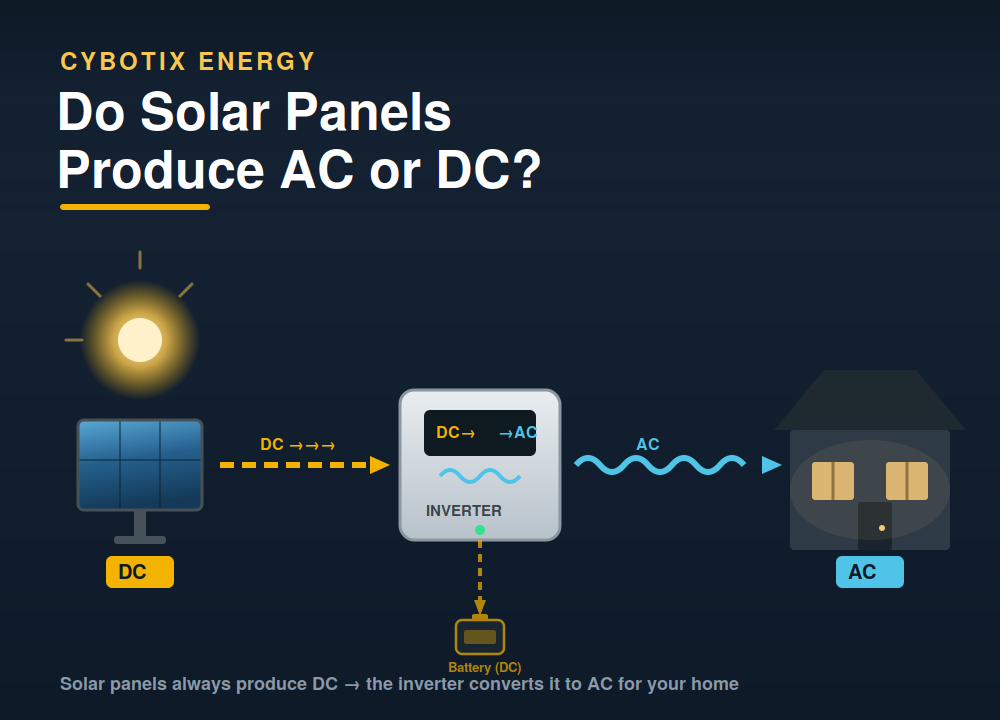
Solar panels produce DC (direct current). Every photovoltaic panel, on every roof, in every country, generates DC electricity. Your home, however, runs on AC (alternating current), which is what the New Zealand grid delivers. That’s why every residential solar system includes a device called an inverter it converts the DC from your panels into AC your home can actually use.
So the answer is simple: panels make DC, the inverter turns it into AC, and your home never knows the difference.
What’s the difference between AC and DC?
DC (direct current) flows in one direction, like water through a hose. AC (alternating current) rapidly switches direction many times per second 50 times per second in New Zealand, which is why our grid runs at 50Hz. Your appliances are built for AC, which is why the conversion matters.
A simple way to picture it: DC is a river flowing one way, steadily. AC is a tide that reverses back and forth, very fast. Both carry energy, but they carry it differently and our homes and grid are wired for the tide.
| DC (Direct Current) | AC (Alternating Current) | |
|---|---|---|
| Direction | Flows one way | Reverses direction rapidly |
| Used by | Solar panels, batteries, electronics | Grid, home wiring, appliances |
| Produced by | Solar cells, batteries | Power stations, inverters |
| NZ grid | No | Yes (230V, 50Hz) |
Both are forms of electricity. The difference is just how the current moves and your solar system handles the translation automatically.
Why do solar panels produce DC and not AC?
Solar panels produce DC because of how they generate electricity at the cell level. When sunlight hits a photovoltaic cell, it knocks electrons loose in the silicon, and the cell’s structure pushes those electrons in one direction creating a steady, one-way flow of charge. That one-way flow is, by definition, direct current.
There’s no mechanical spinning involved (unlike a power station’s generator, which naturally produces AC). The photovoltaic effect is a one-direction process, so DC is what you get. It’s not a design choice it’s physics.
How does the DC from solar panels become AC for your home?
The inverter does the conversion. It takes the DC electricity from your panels and electronically switches it back and forth at precisely the right frequency (50Hz in NZ) to produce clean AC power your home and the grid expect. Without an inverter, the DC from your panels would be useless to your household wiring.
The flow looks like this:
- Solar panels generate DC electricity from sunlight
- DC travels down cables to the inverter
- The inverter converts DC into AC at 230V / 50Hz
- AC feeds your home — powering appliances, lights, and everything else
- Surplus AC exports to the grid for a buy-back credit (if you’re grid-connected)
The inverter is arguably the hardest-working part of a residential solar system. It runs all day, every day the sun shines, converting everything your panels make.
String inverters vs microinverters
Most NZ homes use one of two inverter types:
- String inverter — a single box (usually wall-mounted in the garage or beside the switchboard) that handles the output from all your panels at once. Simple, cost-effective, and the most common setup.
- Microinverters — small inverters attached to each individual panel on the roof, converting DC to AC right at the source. Each panel works independently, so shading on one doesn’t drag the rest down.
String inverters suit most straightforward NZ installs. Microinverters earn their higher cost when panels face different directions, when shading hits part of the array, or when you want panel-level monitoring. Your installer should recommend based on your roof layout.
Does the DC-to-AC conversion lose energy?
Yes a small amount. No energy conversion is perfectly efficient, and the DC-to-AC process typically loses around 2–5% of the energy passing through the inverter. A quality inverter sits at the lower end of that range; a cheaper one wastes more.
That 2–5% is normal and factored into any properly designed system’s output estimates. What affects it: inverter quality, operating temperature (inverters in hot, unventilated spots lose more), and how well the system is sized. It’s a reason to choose a reputable inverter brand the efficiency difference over 25 years of daily operation adds up.
What about batteries AC or DC?
Batteries store DC, just like solar panels produce DC. That’s why panels and batteries are a natural pairing in a DC-coupled system, the solar DC charges the battery directly without converting to AC first, which is more efficient. The inverter then converts stored DC to AC when your home needs it.
There are two ways a battery connects to a solar system:
- DC-coupled — the battery sits on the DC side, between the panels and the inverter. Solar charges the battery directly (DC → DC), and the inverter converts to AC when you use it. More efficient for solar-to-battery charging.
- AC-coupled — the battery has its own inverter and connects on the AC side. Solar DC is first converted to AC, then back to DC to charge the battery, then back to AC to use. Extra conversion steps mean slightly lower efficiency, but it’s easier to add to an existing solar system.
For a new install, DC-coupled is usually more efficient. For adding a battery to an existing system, AC-coupled is often simpler. Either way, the principle is the same: batteries store DC, and an inverter handles the AC your home needs.
Why does any of this matter for your NZ solar system?
Understanding that solar panels produce DC and your home uses AC matters for three practical reasons: it explains why the inverter is so important, it helps you make better decisions about efficiency and battery compatibility, and it gives you the right questions to ask an installer.
The practical takeaways:
- The inverter is the brain of your system — its quality directly affects how much of your solar production you actually get to use. A cheap inverter wastes more energy in conversion.
- Battery choice depends on coupling — knowing the DC/AC distinction helps you understand why DC-coupled batteries are more efficient for new builds, and why AC-coupled suits retrofits.
- Efficiency adds up — a few percent of conversion loss sounds small, but over 20–25 years of daily operation it’s a meaningful amount of energy (and money).
- It demystifies the system — when you know the flow (panels → DC → inverter → AC → home), the whole setup makes sense, and you can have a more informed conversation with any installer.
If you’re planning a solar system or adding a battery and want to understand what setup suits your home, the team at Cybotix Energy can help you design the right system panels, inverter, and battery matched to your roof and your usage.
FAQs
Do solar panels produce AC or DC electricity?
DC. Solar panels always produce direct current. An inverter then converts it to the alternating current (AC) your home and the NZ grid use. This conversion happens automatically in every residential solar system.
Can I use DC from solar panels directly?
Technically yes some DC devices (like certain lights or chargers) can run on DC. But your home wiring, appliances, and the grid all use AC, so for any standard residential setup the inverter conversion is essential.
What does an inverter do in a solar system?
It converts the DC electricity from your panels into AC electricity at the right voltage and frequency (230V / 50Hz in NZ) for your home and the grid. It’s the link between what panels produce and what your house can use.
Do solar batteries store AC or DC?
DC. Batteries store direct current, the same type solar panels produce. When you draw power from the battery, an inverter converts it to AC for your home.
Does the inverter waste electricity?
A small amount typically 2–5% of the energy passing through it is lost as heat during conversion. Quality inverters sit at the lower end of that range, which is why inverter quality matters over the life of a system.
Do I need a special inverter for a battery?
It depends on the setup. A DC-coupled battery connects through a hybrid inverter that manages both solar and battery. An AC-coupled battery has its own inverter and connects on the AC side. Your installer will recommend the right configuration for your system.
Is AC or DC better for solar?
Neither is “better” they serve different roles. Panels naturally produce DC, batteries store DC, and your home uses AC. A well-designed system handles the conversion efficiently so you get the most from both.
Still have questions about how solar works?
Now you know the basics: solar panels produce DC, an inverter converts it to AC, and batteries store DC for later. The rest is choosing the right equipment to do that as efficiently as possible for your home. If you’d like help designing a system or just want someone to explain it without the jargon talk to the Cybotix Energy team and we’ll walk you through it.