You need water moved from a bore, a well, a dam, or a tank and the pump site has no mains power. Or it does, but the electricity or diesel cost is eating into the farm budget month after month. A solar water pump solves both problems at once: it runs directly off solar panels, works completely off-grid, and once it’s installed the energy is free. No power bills, no fuel runs, no generator noise.
This guide covers what a solar water pump is, who needs one in New Zealand, the types available (DC, hybrid AC/DC, 3″ and 4″), how to size one for your property, what it costs, and the mistakes that leave people with a pump that can’t keep up. Straight answers for rural, lifestyle, and off-grid properties.
What is a solar water pump and how does it work?
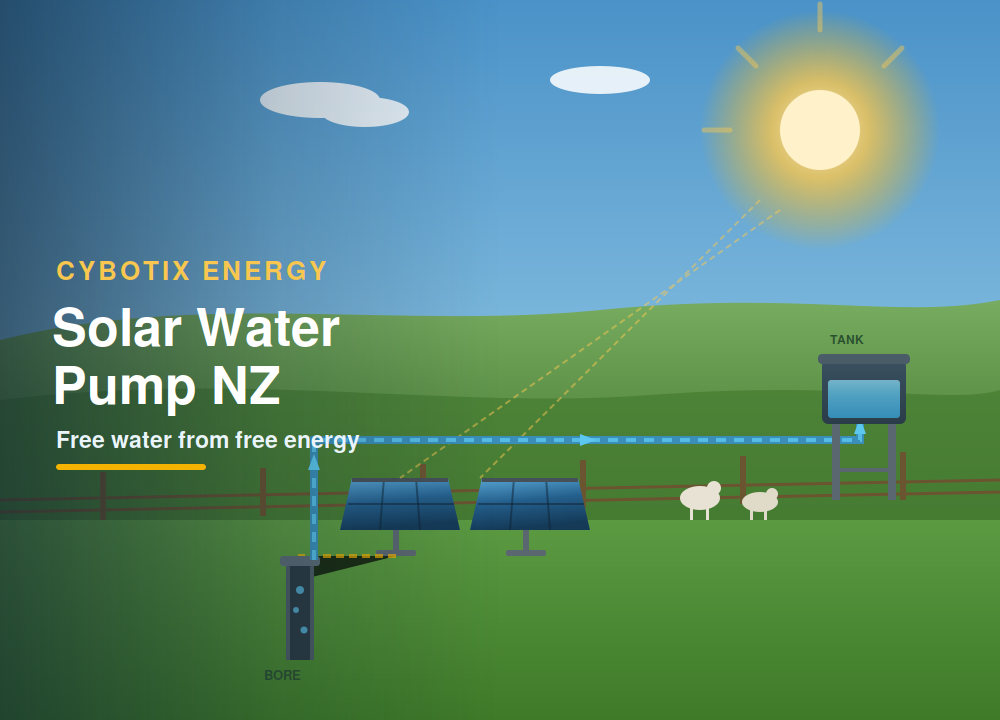
A solar water pump is a water pump powered directly by solar panels instead of the mains grid or a generator. Panels produce DC electricity, a controller manages the power flow, and the pump moves water from a bore, well, dam, or tank to wherever you need it. No grid connection required.
The system is simple:
- Solar panels generate DC electricity from sunlight
- A pump controller regulates voltage and protects the pump
- The pump draws water and delivers it to a tank, trough, or irrigation line
- A storage tank (optional but recommended) holds water for overnight or cloudy-day use
When the sun shines, the pump runs. When it’s dark, the pump stops which is why most setups pump into a storage tank during the day and gravity-feed from the tank at night. No batteries needed in most configurations.
Who needs a solar water pump in NZ?
Anyone moving water in a location without mains power — or anyone tired of paying to run a pump electrically or on diesel. Solar water pumps suit New Zealand’s rural and lifestyle landscape particularly well, because many pump sites sit hundreds of metres from the nearest power line.
Common NZ use cases:
- Stock water — pumping from a bore or well to troughs across paddocks
- Dam-to-trough or dam-to-tank — lifting water from a low source to a higher storage point
- Irrigation — drip or spray systems for orchards, market gardens, and small cropping
- Rainwater tank transfer — moving collected rainwater to a header tank for gravity pressure
- Off-grid homes and baches — domestic water supply where there’s no grid
- Lifestyle blocks — water for a few animals, a garden, and general property use
If you’ve got sun and you’ve got water underground or in a dam, a solar pump is a practical way to connect the two.
Types of solar water pumps
Solar water pumps come in two main power configurations DC-only and hybrid AC/DC and two common bore sizes 3″ and 4″. The right combination depends on whether you have grid access, how deep and wide your bore is, and how much water you need to move.
DC solar water pumps
A DC solar pump runs entirely on the direct current produced by your panels. No inverter, no grid connection, no mains dependency. It’s the simplest, most efficient configuration for off-grid pumping the panels power the pump directly through a controller, and that’s the entire system.
Best for: fully off-grid sites, remote bores, stock water, and anywhere mains power isn’t available or isn’t worth connecting.
Hybrid AC/DC solar water pumps
A hybrid pump accepts both DC from solar panels and AC from the mains grid (or a generator). It runs on solar when the sun’s out and switches to grid power when it isn’t or you can set it to solar-priority with grid backup. This gives you the free-energy benefit of solar with the security of mains for cloudy stretches or high-demand periods.
Best for: sites with grid access that want to cut running costs, properties needing guaranteed flow regardless of weather, and setups where overnight pumping is occasionally required.
3″ vs 4″ pumps
The inch measurement refers to the pump’s outer diameter, which determines the minimum bore size it fits into:
- 3″ pumps fit bores as small as 75mm — common on lifestyle blocks and older, narrower bores
- 4″ pumps fit standard 100mm+ bores — the most common size for farm and rural bores, often with higher flow rates and greater head capacity
If your bore is narrow, a 3″ pump is your only option. If your bore is 100mm or wider, a 4″ pump typically delivers more water at greater lift.
DC vs hybrid AC/DC which do you need?
The choice comes down to one question: do you have grid power at or near the pump site, and do you need guaranteed flow in all conditions?
| Factor | DC solar pump | Hybrid AC/DC solar pump |
|---|---|---|
| Power source | Solar panels only | Solar + mains grid (or generator) |
| Grid connection needed | No | Yes (for backup) |
| Runs at night / cloudy days | No (pump into a tank for buffer) | Yes (switches to grid) |
| Efficiency | Highest (no conversion loss) | High on solar, standard on grid |
| Best for | Fully off-grid, remote sites | Grid-accessible sites wanting solar savings + backup |
| Complexity | Simplest setup | Slightly more wiring |
If you’re off-grid or the bore is far from any power line, DC is the straightforward choice. If you have got mains nearby and want the belt-and-braces of grid backup, hybrid gives you both.
How to size a solar water pump for your property
Size a solar water pump around three numbers: how much water you need per day, how high the pump has to push it (total head), and how much solar panel capacity to match. Get those right and the pump delivers; get them wrong and you’ll either run short or overspend.
Flow rate and daily volume
Start with how much water you actually use. Stock water demand depends on animal numbers and type; domestic use depends on household size; irrigation depends on area and method. Work out litres per day, then check the pump’s rated flow to confirm it can deliver that volume within the available sunshine hours.
Total dynamic head explained simply
Total head is the vertical distance the pump lifts water, plus the friction loss in the pipes. A bore that’s 30 metres deep with a tank 10 metres above ground has roughly 40 metres of static head add a few metres for pipe friction and fittings, and your total dynamic head might be 45 metres. The pump must be rated for at least that head at your required flow rate.
Matching panel size to pump
The pump’s controller will specify a recommended solar array size in watts. Undersizing the panels is the single most common mistake the pump runs weakly, starts late, stops early, and never hits its rated flow. Size the array to the controller’s recommendation or slightly above, and angle the panels for maximum winter sun if year-round pumping matters.
What are the benefits of solar water pumping?
The case for solar pumping is strongest where there’s no grid, where running costs matter, or both:
- No running cost — once installed, the energy is free
- Fully off-grid capable — no power line, no generator, no fuel
- Low maintenance — no engine, no oil changes, no belts; the pump and panels just run
- Quiet — no diesel noise disturbing stock or neighbours
- Long lifespan — quality pumps last many years with minimal attention
- Environmentally clean — no emissions, no fuel spills, no noise pollution
Are there downsides?
Worth being honest about the trade-offs:
- Output depends on sunshine — less sun means less water; cloudy days and winter reduce flow
- Upfront cost — panels, pump, controller, and installation cost more than plugging in a mains pump (though running costs are zero after that)
- No overnight pumping (DC-only) — the pump stops when the sun does, so a storage tank is essential for overnight demand
- Reduced winter output — shorter days and lower sun angle mean less daily volume in mid-winter
A storage tank solves most of the intermittency pump during the day, use from the tank at night. And for sites where weather gaps are a real concern, a hybrid AC/DC pump adds grid backup.
How much does a solar water pump cost in NZ?
Prices range from roughly $1,000 for a smaller DC pump to several thousand for a larger hybrid system with panels and installation. The pump itself is only part of the cost panels, controller, mounting, pipe, and install labour add up. But with zero running cost after that, the payback against diesel or mains pumping is usually measured in a few years.
| Pump type | Typical use | Rough cost range (NZD, pump only) |
|---|---|---|
| 3″ DC Solar Water Pump | Narrow bores, lifestyle blocks, light stock water | Lower end |
| 3″ Hybrid AC/DC Solar Water Pump | Narrow bores with grid backup | Mid range |
| 4″ DC Solar Water Pump | Standard bores, farm stock water, irrigation | Mid range |
| 4″ Hybrid AC/DC Solar Water Pump | Standard bores, grid backup, higher demand | Higher end |
For help sizing and costing a system for your property, talk to the team at Cybotix Energy they’ll match the pump to your bore, your water needs, and your budget.
Installation and maintenance
Installation involves lowering the pump into the bore or water source, mounting the solar panels nearby, wiring the controller, and connecting the delivery pipe. For bore pumps, a driller or pump installer typically handles the downhole work; the solar and electrical side is straightforward for anyone experienced with solar.
Ongoing maintenance is minimal:
- Panels — occasional clean to remove dust and bird mess (same as rooftop solar)
- Pump — quality submersible pumps run for years without servicing; check the manufacturer’s interval
- Controller — no moving parts, no regular maintenance
- Pipes and fittings — standard plumbing checks
Compared with a diesel pump (fuel, oil, filters, servicing) or even a mains pump (electricity bills, motor wear), a solar setup is about as low-maintenance as water infrastructure gets.
Common mistakes to avoid
- Undersizing the solar array — the pump never reaches rated flow and starts late / stops early
- Ignoring total dynamic head — buying a pump rated for 30m head on a 50m bore means it can’t deliver
- Wrong bore diameter — a 4″ pump won’t fit a 75mm bore; measure first
- No storage tank — relying on real-time pumping with no buffer for overnight or cloudy days
- Choosing DC-only when grid backup matters — if guaranteed flow in all weather is essential, hybrid is worth the extra cost
- Poor panel orientation — panels facing the wrong way or shaded by trees lose output when you need it most
FAQs
How much water can a solar pump move per day?
It depends on the pump, the head, and the sun. A well-matched system can move several thousand litres per day in good conditions enough for stock water, domestic use, or light irrigation. Check the pump’s rated flow at your specific head height and sunshine hours.
Do solar water pumps work on cloudy days?
They do, but at reduced output. Less sunlight means less power and lower flow. A storage tank buffers this pump on sunny days, draw from the tank when it’s overcast. Hybrid AC/DC pumps can switch to grid power when solar drops.
Can I run a solar pump completely off-grid?
Yes, that’s the primary use case for a DC solar pump. Panels, controller, pump, and a storage tank. No grid, no generator, no fuel. As long as you size the system to your daily water needs and have tank storage for overnight, it works independently.
3-inch or 4-inch pump which do I need?
It depends on your bore diameter. A 3″ pump fits bores as narrow as 75mm; a 4″ pump needs 100mm or wider. If your bore allows a 4″, it typically offers higher flow and greater head capacity. Measure your bore casing before ordering.
Do I need a battery with a solar water pump?
Usually not. Most solar pumping systems pump water into a storage tank during the day and gravity-feed from the tank at night the tank acts as the “battery.” Adding an actual battery is possible but adds cost and complexity that a tank avoids.
How long do solar water pumps last?
Quality submersible solar pumps last many years with minimal maintenance often comparable to conventional bore pumps. The solar panels typically carry 20–25 year warranties, and the controller has no moving parts. It’s a long-life system.
Ready to pump water for free?
A solar water pump turns sunshine into a steady water supply no power bill, no fuel, no engine noise. Whether you’re watering stock from a remote bore or cutting the running cost on a farm pump, the right system pays for itself and keeps running for years. Browse the solar water pumps at Cybotix Energy, or get in touch and we’ll help you size a system for your property, your bore, and your water needs.