Lithium-ion batteries power your phone, your laptop, your drill, and increasingly your car. Now they’re being pitched for your solar system, your home backup, and your next portable power station and suddenly the specs matter. NMC or LiFePO₄? 500 cycles or 6,000? What does a BMS actually do? If you’re spending real money on a lithium-ion battery for energy storage, you need to know the difference between a battery that lasts a decade and one that fades in three years.
This guide covers how lithium-ion batteries work, the types you’ll encounter in New Zealand, the comparison that actually matters (NMC vs LiFePO₄), charging, safety, lifespan, and what to look for when buying. No chemistry degree required.
What is a lithium ion battery?
A lithium-ion battery is a rechargeable battery that stores and releases electrical energy by moving lithium ions between two electrodes through a liquid electrolyte. It’s the dominant rechargeable battery technology because it’s light, energy-dense, holds its charge well, and can be recharged hundreds to thousands of times before wearing out.
You’ll find lithium-ion cells in phones, laptops, power tools, e-bikes, electric vehicles, home solar batteries, and portable power stations. The name covers a family of chemistries not one single battery type which is where the differences start to matter.
How does a lithium-ion battery work?
When you charge a lithium-ion battery, an electrical current pushes lithium ions from one electrode (the cathode) to the other (the anode), where they’re stored. When you use the battery, those ions flow back, releasing energy that powers your device. The electrolyte between the electrodes carries the ions back and forth.
That’s the entire cycle: charge pushes ions one way, discharge lets them flow back. Each round trip is one “cycle,” and the battery has a finite number before capacity starts to fade. How many cycles you get — and how safely depends on the specific chemistry inside.
Types of lithium-ion batteries and which one matters to you
“Lithium-ion” is an umbrella term covering several chemistries with different strengths. For NZ consumers buying energy storage, power stations, or solar batteries, two matter most: NMC and LiFePO₄. The rest are more specialised.
NMC (Nickel Manganese Cobalt)
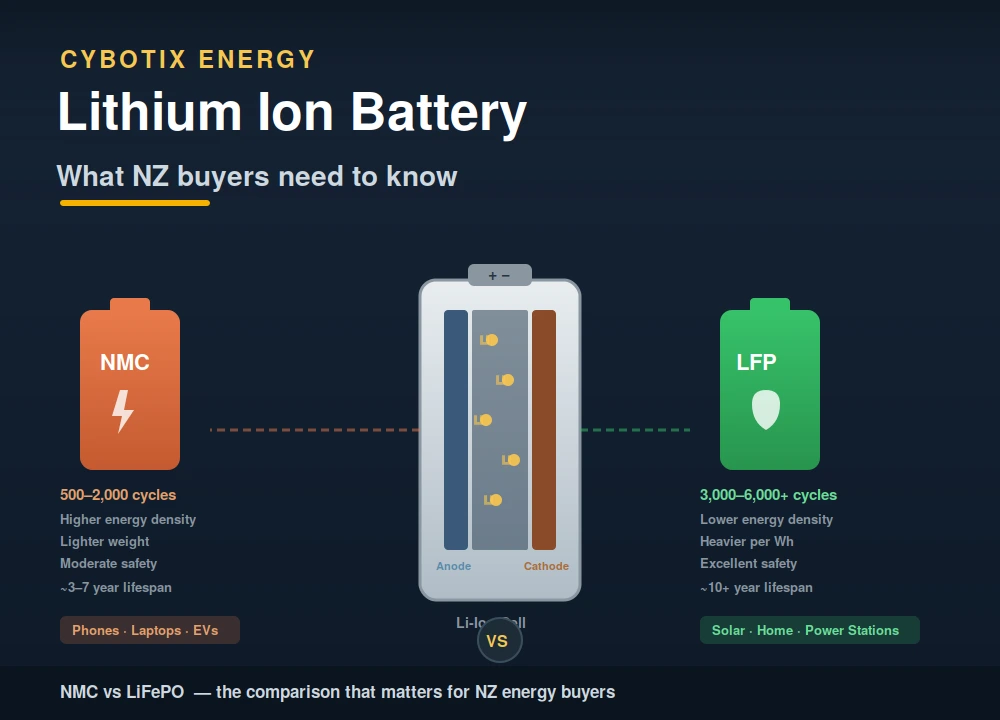
NMC batteries pack a lot of energy into a small, light package which is why they dominate phones, laptops, and most electric vehicles. They’re energy-dense, meaning more watt-hours per kilogram. The trade-off is a shorter cycle life (typically 500–2,000 cycles) and a higher thermal risk NMC is more prone to overheating under stress than LFP.
You’ll see NMC in older portable power stations, some EVs, and consumer electronics where weight and size matter more than longevity.
LiFePO₄ (Lithium Iron Phosphate / LFP)
LiFePO₄ is the chemistry now standard in home solar batteries, modern portable power stations, and increasingly in some EVs. It’s heavier per watt-hour than NMC, but it lasts far longer (typically 3,000–6,000+ cycles), handles heat better, and is significantly safer it’s much harder to push into thermal runaway.
For anything that sits in your home, stores solar energy, or needs to last a decade of daily cycling, LiFePO₄ is usually the right choice. It’s the chemistry behind most quality energy storage products sold in NZ today.
NCA, LTO, and others
NCA (Nickel Cobalt Aluminium) appears in some high-performance EVs. LTO (Lithium Titanate) offers extremely fast charging and long life but at lower energy density and higher cost used in some buses and industrial applications. For home and portable energy storage in NZ, these are niche. NMC and LiFePO₄ are the two you’ll actually choose between.
NMC vs LiFePO₄ which should you choose?
For most NZ energy-storage buyers solar batteries, home backup, portable power stations LiFePO₄ is the stronger choice. It lasts longer, runs safer, handles NZ temperatures better, and costs less per cycle over its lifetime, even though the upfront price per watt-hour can be slightly higher.
| Factor | NMC | LiFePO₄ (LFP) |
|---|---|---|
| Cycle life | ~500–2,000 cycles | ~3,000–6,000+ cycles |
| Safety | Good with BMS; higher thermal risk | Excellent; very resistant to thermal runaway |
| Energy density | Higher (lighter per Wh) | Lower (heavier per Wh) |
| Heat tolerance | Moderate | Strong |
| Lifespan | ~3–7 years typical | ~10+ years typical |
| Cost per Wh (upfront) | Slightly lower | Slightly higher |
| Cost per cycle (lifetime) | Higher (fewer cycles) | Lower (many more cycles) |
| Best for | Phones, laptops, weight-sensitive EVs | Solar storage, home batteries, power stations |
The short version: if weight is your top priority (phone, laptop, lightweight EV), NMC makes sense. If longevity, safety, and total lifetime value matter which they do for anything you’re installing in your home or relying on for backup LiFePO₄ wins.
How long do lithium-ion batteries last?
Lithium-ion battery lifespan depends on chemistry, usage, and conditions ranging from roughly 500 cycles for cheap NMC cells to 6,000+ cycles for quality LiFePO₄. A “cycle” is one full charge-and-discharge; partial cycles count proportionally, so draining to 50% and recharging counts as half a cycle.
What shortens lifespan:
- Deep discharging: regularly running to 0% wears cells faster than staying between 20–80%
- Heat: high temperatures accelerate degradation; storing or running batteries in hot environments matters
- Fast charging constantly: occasional fast charging is fine; doing it every time adds wear
- Leaving it fully charged or fully empty for long periods: both extremes stress cells during storage
In practical NZ terms: a quality LiFePO₄ home battery cycled daily lasts roughly 10+ years. A phone’s NMC battery, charged daily, typically shows noticeable fade after 2–3 years. Chemistry and how you treat it make the difference.
How to charge a lithium-ion battery properly
Use the correct lithium battery charger for your specific battery voltage and chemistry must match. A charger designed for lead-acid won’t charge lithium-ion correctly, and the wrong voltage can damage cells or create a safety risk. Quality batteries and power stations include an integrated charger and Battery Management System (BMS) that handles this for you.
Best practices for longer life:
- Use the manufacturer’s charger or a compatible one rated for the battery: voltage, current, and charge profile matter
- Avoid regularly charging to 100% or draining to 0%: the 20–80% range is gentlest on cells (most relevant for phones and laptops; home batteries with a BMS manage this internally)
- Don’t charge in extreme heat or cold: room temperature is ideal; most BMS systems will pause charging outside safe ranges
- Store at ~50% charge if leaving unused for weeks or months
- Don’t use a damaged or swollen battery: retire and recycle it
For solar batteries, home storage, and power stations, the built-in BMS handles charge management automatically. Your main job is choosing a quality product with a reputable BMS in the first place.
Are lithium-ion batteries safe?
Yes, when built correctly, managed by a BMS, and used as intended, lithium-ion batteries are safe for home and everyday use. The safety concern is thermal runaway: a chain reaction where a cell overheats, potentially leading to fire. This risk is real but manageable, and it varies significantly by chemistry.
The honest breakdown:
- LiFePO₄ is inherently more stable and far more resistant to thermal runaway it’s the safest mainstream lithium chemistry, which is why it’s standard in home batteries and modern power stations
- NMC has a higher energy density but a narrower thermal safety margin it requires careful BMS design and is more sensitive to overcharging, physical damage, and high temperatures
- A quality BMS (Battery Management System) monitors cell voltage, temperature, and current in real time, shutting down the battery before conditions become dangerous
NZ-relevant safety tips:
- Buy from reputable brands with certified BMS protection
- Don’t puncture, crush, or physically damage lithium cells
- Store batteries away from direct heat sources
- Transport carefully NZ has rules on lithium battery transport, especially by air
- Dispose of dead batteries properly (see below) don’t throw them in general rubbish
Common uses for lithium-ion batteries in NZ
Lithium-ion batteries particularly LiFePO₄ are now central to how NZ homes and businesses store and use energy:
- Solar energy storage — storing rooftop solar to use at night or during outages
- Home backup batteries — keeping essentials running when the grid drops
- Portable power stations — off-grid power for camping, travel, work, and events
- Electric vehicles and e-bikes — transport powered by lithium
- Power tools — cordless drills, saws, and gear running on lithium packs
- Marine and boating — house batteries and trolling motors
- Phones, laptops, and personal electronics — the original mass-market application
The fastest-growing segment in NZ is home energy storage pairing lithium batteries (predominantly LiFePO₄) with rooftop solar to cut electricity costs and provide outage backup.
What to look for when buying lithium batteries in NZ
Prioritise chemistry, cycle rating, BMS quality, and warranty. These four things determine whether the battery performs reliably for a decade or disappoints in a few years.
- Chemistry — LiFePO₄ for solar storage, home batteries, and power stations; NMC where weight matters (phones, laptops, some EVs)
- Cycle rating — how many full cycles before capacity drops to 80%; 3,000+ for LFP, less for NMC
- BMS — a quality Battery Management System with overcharge, over-discharge, temperature, and short-circuit protection
- Warranty — for home and solar batteries, 5–10 years is the standard from quality brands
- Brand reputation and NZ support — can you get help locally if something goes wrong?
- Certification — look for recognised safety certifications (UL, IEC, etc.)
For energy storage systems, solar batteries, and portable power stations built around quality LiFePO₄ cells, see what’s available at Cybotix Energy.
How to dispose of lithium batteries in NZ
Never put lithium-ion batteries in your general rubbish or recycling bin they can cause fires in waste and recycling facilities. In New Zealand, lithium batteries should be taken to a dedicated battery collection or e-waste drop-off point.
Options in NZ:
- Council e-waste events and drop-off points — many local councils run periodic collection events
- Retail take-back — some electronics retailers accept old batteries
- Product stewardship schemes — the Battery Industry Group (B.I.G.) is working toward a nationwide battery stewardship scheme in NZ
Tape the terminals of loose batteries before dropping them off to prevent short circuits during transport.
FAQs
How long does a lithium-ion battery last?
It depends on chemistry and use. NMC batteries typically last 500–2,000 cycles; LiFePO₄ batteries last 3,000–6,000+ cycles. In practical terms, a quality LiFePO₄ home battery lasts roughly 10+ years of daily use.
What’s the difference between lithium-ion and LiFePO₄?
LiFePO₄ is a type of lithium-ion battery a safer, longer-lasting chemistry. Standard lithium-ion (NMC) is lighter and more energy-dense but has a shorter cycle life and higher thermal risk. LiFePO₄ is the preferred choice for solar storage and home batteries.
Can lithium batteries catch fire?
It’s possible but rare with quality products. NMC cells have a higher thermal risk; LiFePO₄ is significantly more resistant to thermal runaway. A good BMS monitors conditions and shuts the battery down before things become dangerous. Buy from reputable brands with certified protection.
Do I need a special charger for lithium-ion batteries?
Yes, always use a charger matched to the battery’s chemistry and voltage. Chargers designed for lead-acid or other chemistries won’t charge lithium-ion correctly and can damage cells. Home batteries and power stations include integrated charging and BMS.
How should I store lithium batteries?
At roughly 50% charge, in a cool, dry place away from direct heat. Don’t leave them fully charged or fully empty for long periods. Most BMS-equipped products manage storage health automatically if left plugged in.
Can I use lithium-ion batteries for solar storage in NZ?
Yes, LiFePO₄ lithium-ion batteries are now the standard for residential solar storage in NZ, offering long cycle life, high safety, and good performance across New Zealand’s temperature range.
Are lithium batteries recyclable in NZ?
Yes, but they must go to dedicated collection points not in your general bin. Council e-waste events, some retailers, and emerging product stewardship schemes handle lithium battery recycling. Check your local council for the nearest drop-off.
Making the right battery choice
The lithium-ion battery you choose determines how long your investment lasts, how safely it runs, and how well it performs over years of use. For solar storage, home backup, and portable power in NZ, LiFePO₄ is the chemistry that delivers on all three. If you’re building or upgrading an energy storage system, talk to the Cybotix Energy team we’ll help you match the right battery and system to your home.