Ever looked up at a roof covered in sleek black panels and wondered how a flat sheet of glass quietly turns sunshine into the power running your fridge, your lights, and your late-night Netflix binge? You’re not alone. Solar is everywhere now, but the magic behind it still feels a little mysterious.
Good news: it’s simpler than you think and genuinely fascinating. Let’s break down how solar panels work, step by step, in plain English.
The 30-Second Version
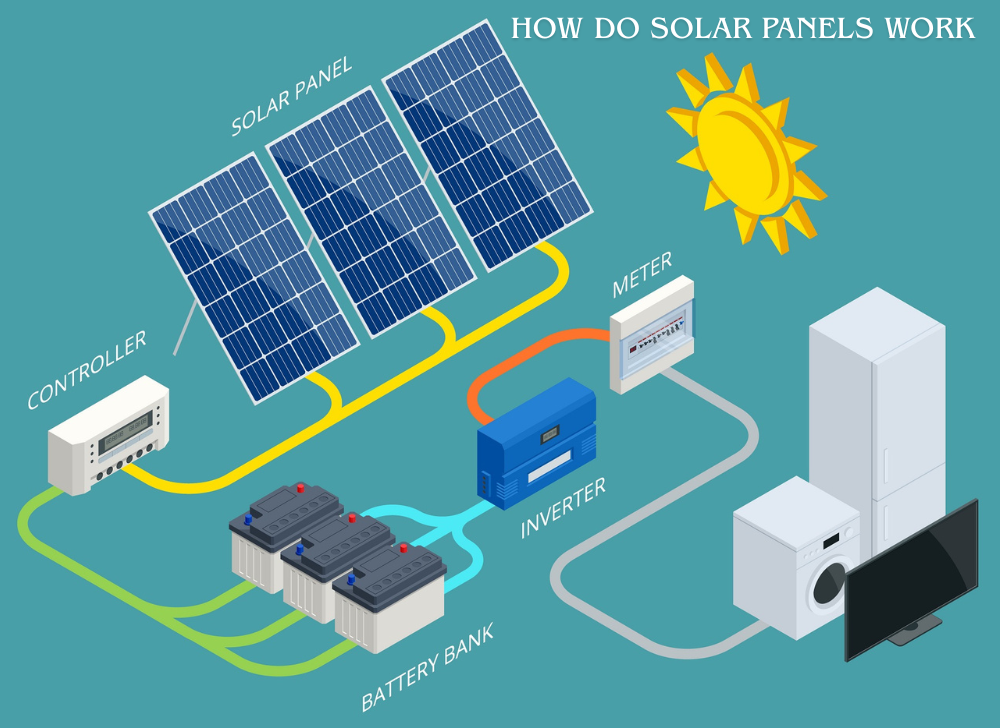
Solar panels capture sunlight and convert it into electricity using a clever piece of physics called the photovoltaic effect. Sunlight hits the panel, knocks electrons loose inside silicon cells, and that flow of electrons becomes the electricity you use every day. An inverter then translates that raw power into the kind your home actually runs on.
That’s the elevator pitch. Now let’s open the hood.
Step 1: It All Starts With the Sun (and a Lot of Tiny Particles)
Sunlight isn’t just warmth and brightness it’s packed with tiny energy particles called photons. Every second, an almost unimaginable number of them rain down on your roof. A solar panel’s entire job is to catch those photons and put them to work.
Think of photons as the spark that sets the whole process in motion.
Step 2: Meet the Real Hero — Silicon
Inside every solar panel are dozens of photovoltaic (PV) cells, and each one is built mostly from silicon the same element found in sand. Silicon is a semiconductor, which means it’s the perfect middle-ground material: not a full conductor like copper, not a full insulator like rubber, but something that can be coaxed into releasing electrons under the right conditions.
To make silicon do something useful, manufacturers treat it with other materials to create two layers:
- A negative layer (rich in extra electrons)
- A positive layer (with space for electrons to go)
Sandwich them together and you create an electric field at the junction basically an invisible one-way street waiting for traffic.
Step 3: The Photovoltaic Effect (Where the Magic Happens)
Here’s the moment everything clicks.
When photons from the sun strike the silicon cell, they transfer their energy and knock electrons loose from their atoms. Thanks to that built-in electric field, these freed electrons don’t just wander randomly they are pushed in one direction, creating a flow.
A flow of electrons is, quite literally, electricity.
This is the photovoltaic effect, and it’s the beating heart of every solar panel on the planet. No moving parts, no noise, no smoke just light in, power out.
Step 4: From DC to AC — The Inverter Translates
There’s one catch. The electricity solar cells produce is direct current (DC) a steady one-way flow. But your home appliances run on alternating current (AC).
Enter the inverter, the unsung translator of the solar world. It takes the DC electricity from your panels and converts it into clean AC power your home can actually use. Modern inverters also act as the system’s brain, monitoring performance and keeping everything safe and efficient.
Step 5: Powering Your Home (and Beyond)
Once converted, that electricity flows into your home’s electrical panel and powers everything plugged in. From here, a few things can happen:
- You use it instantly to run lights, appliances, and devices.
- You store it in a battery (like a home power station) for cloudy days and nighttime use.
- You send it back to the grid, often earning credits through net metering, depending on where you live.
So even when the sun goes down, the energy you captured during the day can keep working for you.
What Happens on Cloudy Days?
Common myth: solar only works in blazing sunshine. The truth? Panels still generate power on overcast days just less of it. They respond to light, not heat, so even diffuse daylight keeps electrons moving. Pair your system with battery storage and you’ve got a buffer that smooths out the cloudy patches entirely.
Why Solar Panels Are Built to Last
There’s something beautifully low-maintenance about solar. Because there are no moving parts, quality panels routinely last 25 years or more, quietly converting sunlight day after day. The biggest “maintenance” task for most owners? An occasional rinse to wash off dust and leaves.
The Bottom Line
Solar panels work by turning sunlight into electricity through the photovoltaic effect: photons knock electrons loose in silicon cells, that flow becomes DC electricity, and an inverter converts it into usable AC power for your home. Simple physics, elegant design, and a renewable fuel source that shows up for free every single morning.
Whether you’re powering a whole house, a campervan, or an off-grid cabin, understanding how solar works is the first step toward taking control of your own energy. And once you see how the sun-to-socket journey unfolds, those rooftop panels start to look a lot less mysterious and a lot more like the smartest investment on the block.